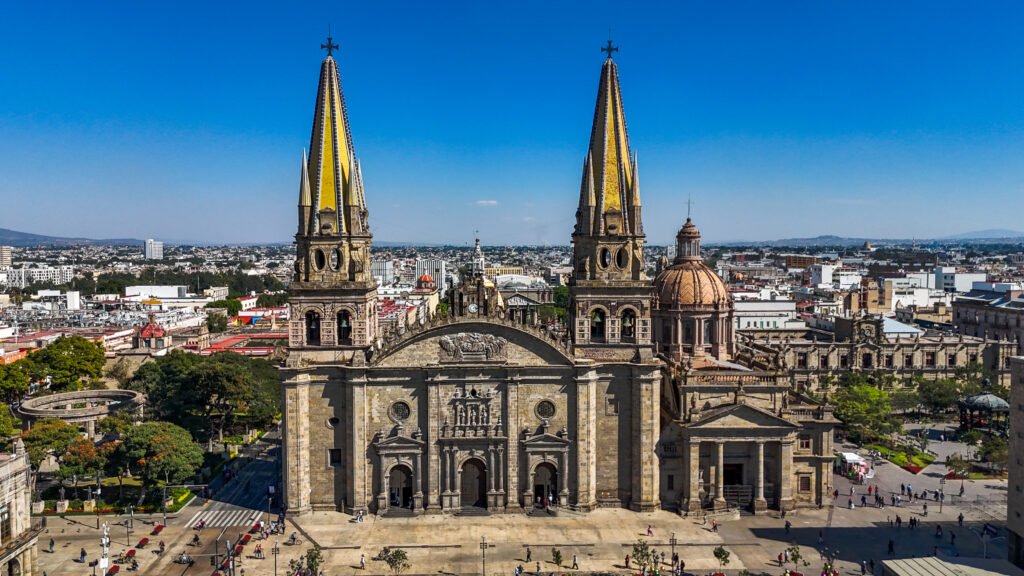
Guadalajara is the capital of the Mexican state of Jalisco and one of the country’s largest cities. Founded by Spanish colonists in the 16th century, it is widely regarded as the birthplace of mariachi music and is home to two distinct UNESCO-recognized landmarks within its historic center.
Where Is Guadalajara Located?
Guadalajara sits on a high plateau in western-central Mexico, in the state of Jalisco, roughly 160 kilometres from the Pacific coast. It is the seat of Jalisco’s state government and the anchor of one of Mexico’s largest metropolitan areas.
A Brief History of Guadalajara
Spanish colonists founded Guadalajara in 1542, after the settlement had been relocated several times from earlier, less defensible sites. It grew during the colonial period into a major administrative and religious center for western New Spain, and its historic core still reflects that era in its street grid and ecclesiastical architecture.
Guadalajara Cathedral
Construction of the Guadalajara Cathedral began in 1561 and continued for decades, with the building consecrated in the early 17th century. Its original towers were destroyed by an 1818 earthquake and rebuilt in the mid-19th century in a distinctive neo-Gothic style, topped with yellow ceramic tiles that have since become the single most recognizable image of the city’s skyline, visible from across the historic center.
Hospicio Cabañas: A UNESCO World Heritage Site
According to the UNESCO World Heritage Centre, the Hospicio Cabañas was built at the beginning of the 19th century to shelter and care for orphans, the elderly, people with disabilities, and chronic invalids. UNESCO describes it as unique for its time, citing the harmonious relationship between its open courtyards and built spaces and the simplicity of its overall design. In the early 20th century its chapel was decorated with a series of murals that UNESCO notes are now considered masterpieces of Mexican art, painted by José Clemente Orozco, one of the country’s most celebrated muralists. The complex was inscribed as a UNESCO World Heritage Site in recognition of both its original humanitarian architecture and Orozco’s later work.
What Is Guadalajara Known For?
Guadalajara is commonly credited as the city where mariachi music took its modern form, and it remains closely associated with the genre today. The nearby town of Tequila, also in Jalisco, gives its name to the spirit distilled there, and the broader Jalisco region is the legally protected heartland of tequila production. The city’s historic center, anchored by the cathedral and the Hospicio Cabañas, preserves a dense concentration of colonial and 19th-century civic architecture.
Why Guadalajara Matters
As the historic capital of western Mexico, Guadalajara has long served as a cultural counterweight to Mexico City, producing distinctly regional traditions in music, cuisine, and craft that are now recognized internationally. The Hospicio Cabañas in particular stands out among Mexico’s World Heritage Sites for combining a work of early-19th-century humanitarian architecture with one of the 20th century’s most significant mural cycles.
Key Takeaways
- Guadalajara was founded by Spanish colonists in 1542 and is the capital of the Mexican state of Jalisco.
- Guadalajara Cathedral’s yellow-tiled neo-Gothic towers, rebuilt after an 1818 earthquake, are the city’s defining visual landmark.
- The Hospicio Cabañas is a UNESCO World Heritage Site, built as a 19th-century orphanage and later decorated with murals by José Clemente Orozco. [1]
- Guadalajara is widely considered the birthplace of mariachi music and sits in the state that gives tequila its name.
Sources
Key facts
- Founded by Spanish colonists in 1542; capital of the state of Jalisco.
- Guadalajara Cathedral's yellow-tiled towers were rebuilt in neo-Gothic style after an 1818 earthquake.
- The Hospicio Cabanas is a UNESCO World Heritage Site, decorated with murals by Jose Clemente Orozco.1
- Widely regarded as the birthplace of mariachi music; near the town that gives tequila its name.
Quick checkWhat makes the Hospicio Cabanas a UNESCO World Heritage Site?Show answer
It combines a unique, harmoniously designed early-19th-century humanitarian complex built to shelter orphans and the disadvantaged with a later series of murals by Jose Clemente Orozco, considered masterpieces of Mexican art.
Sources
- UNESCO World Heritage Centre. Hospicio Cabanas, Guadalajara. Undated (accessed 2026-10-21)
Editorially reviewed by Specialty Digest Editorial TeamLast reviewed October 21, 2026Researched and drafted with AI assistanceReport an issue