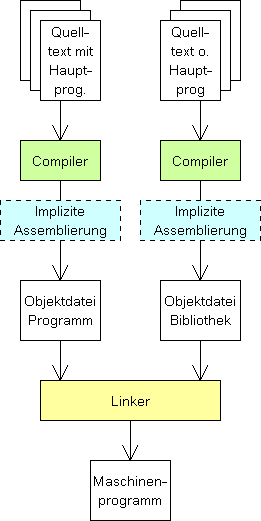
A compiler is a program that translates source code written by a human in a programming language, such as C, Java, or Rust, into another form, usually machine code, that a computer’s processor can execute directly. Compiling happens before a program ever runs, which distinguishes a compiler from an interpreter, a tool that reads and executes source code line by line while the program is running. Because a compiler does its translation work ahead of time and can analyze the entire program at once, compiled programs typically run faster than interpreted ones, which is why compilers remain central to operating systems, databases, games, and other software where performance matters most.
How Compilation Works
Compilation is usually broken into stages. The first stage, lexical analysis, scans the raw text of the source code and groups characters into meaningful tokens, such as keywords, variable names, numbers, and symbols. The second stage, syntax analysis or parsing, checks whether those tokens are arranged according to the grammatical rules of the language and builds a tree-shaped representation of the program’s structure. A third stage, semantic analysis, checks that the program makes logical sense, for example confirming that a variable has not been used before it was declared or that a function is called with the right number of arguments. Only after a program passes all three checks does the compiler move to code generation, where it produces the low-level instructions the processor will ultimately run.
Between parsing and final code generation, most compilers include an optimization stage that rewrites the program’s internal representation to run faster or use less memory, without changing what the program actually does. Optimizations range from simple tricks, such as calculating a fixed arithmetic expression once instead of every time a loop runs, to sophisticated techniques that rearrange entire blocks of code to take better advantage of a processor’s cache and pipeline. A single modern compiler may apply hundreds of such optimization passes, and the difference between an unoptimized and a heavily optimized build of the same program can be a factor of ten or more in execution speed.
Compilers in Practice
Not every language fits neatly into compiled or interpreted categories. Languages such as Java and C# use a hybrid approach: a compiler first translates source code into an intermediate form called bytecode, which is then either interpreted or compiled further, just in time, by a virtual machine while the program runs. This just-in-time compilation lets the system combine some of the portability benefits of interpretation with much of the speed of full compilation. Web browsers use a similar strategy to run JavaScript quickly despite JavaScript traditionally being an interpreted language.
Building a working compiler is considered one of the foundational challenges in computer science, and the field has its own long history of landmark tools, from the first FORTRAN compiler in the 1950s to widely used modern compilers such as GCC, Clang, and LLVM, the last of which has become a shared foundation that many newer compilers, including those for Rust and Swift, are built on top of. Compiler construction courses remain a staple of computer science degrees because the techniques involved, including parsing and formal grammars, show up throughout software engineering well beyond compilers themselves, in tools such as configuration file readers, search query parsers, and even spreadsheet formula engines.
Diagnostics and Cross-Compilation
A large part of a compiler’s practical value lies in the error messages it produces when source code is invalid. Early compilers often stopped at the first error found, forcing programmers through tedious one-error-at-a-time fixes, while modern compilers try to recover from an error and keep scanning so they can report many problems in a single pass, along with suggestions for likely fixes. Compiler-driven tooling built on these same diagnostic passes now powers features programmers rely on daily, including the autocomplete suggestions and inline error highlighting found in modern code editors.
Compilers can also target a processor different from the one they run on, a capability called cross-compilation. A developer writing software for a smartphone, a smartwatch, or an embedded sensor typically compiles the code on a powerful desktop computer but instructs the compiler to generate machine code for the much smaller chip inside the target device. Cross-compilation is essential to industries such as automotive and aerospace, where the final hardware is too limited or too inaccessible to run a full compiler itself, and it is part of why a single codebase can often be shipped to many different kinds of devices with only modest changes.
Frequently Asked Questions
What is the difference between a compiler and an interpreter? A compiler translates an entire program into machine code before it runs, producing a standalone executable file. An interpreter instead reads and runs source code directly, translating and executing it statement by statement each time the program is started, which is typically slower but allows for more flexible, interactive development.
Why do compiled programs usually run faster? A compiler can see the whole program at once and spend time applying thorough optimizations before the program ever runs, while an interpreter has to balance translation and execution simultaneously every time the code runs, leaving far less room for deep optimization.
Do compilers only work with programming languages people write by hand? No. The same compilation techniques translate between many kinds of formal languages, including the intermediate bytecode produced by one tool and consumed by another, and even domain-specific languages used in areas such as database queries, shader programs for graphics cards, and hardware description languages used to design computer chips.
Key facts
- Compilers translate code before it runs; interpreters translate it while running.
- Compilation has stages: lexical analysis, parsing, semantic analysis, and code generation.
- Optimization passes rewrite code to run faster without changing its behavior.
- Just-in-time compilers blend compiled speed with interpreted flexibility.
- LLVM is a shared foundation used by many modern compilers.
Quick checkWhy do compiled programs generally run faster than interpreted ones?Show answer
A compiler analyzes and optimizes the entire program ahead of time, while an interpreter must translate and execute code simultaneously each time it runs, leaving much less opportunity for deep optimization.
Sources
- Compilers: Principles, Techniques, and Tools (Aho et al.); LLVM Project documentation
Editorially reviewed by Specialty Digest Editorial TeamLast reviewed November 2, 2026Researched and drafted with AI assistanceReport an issue