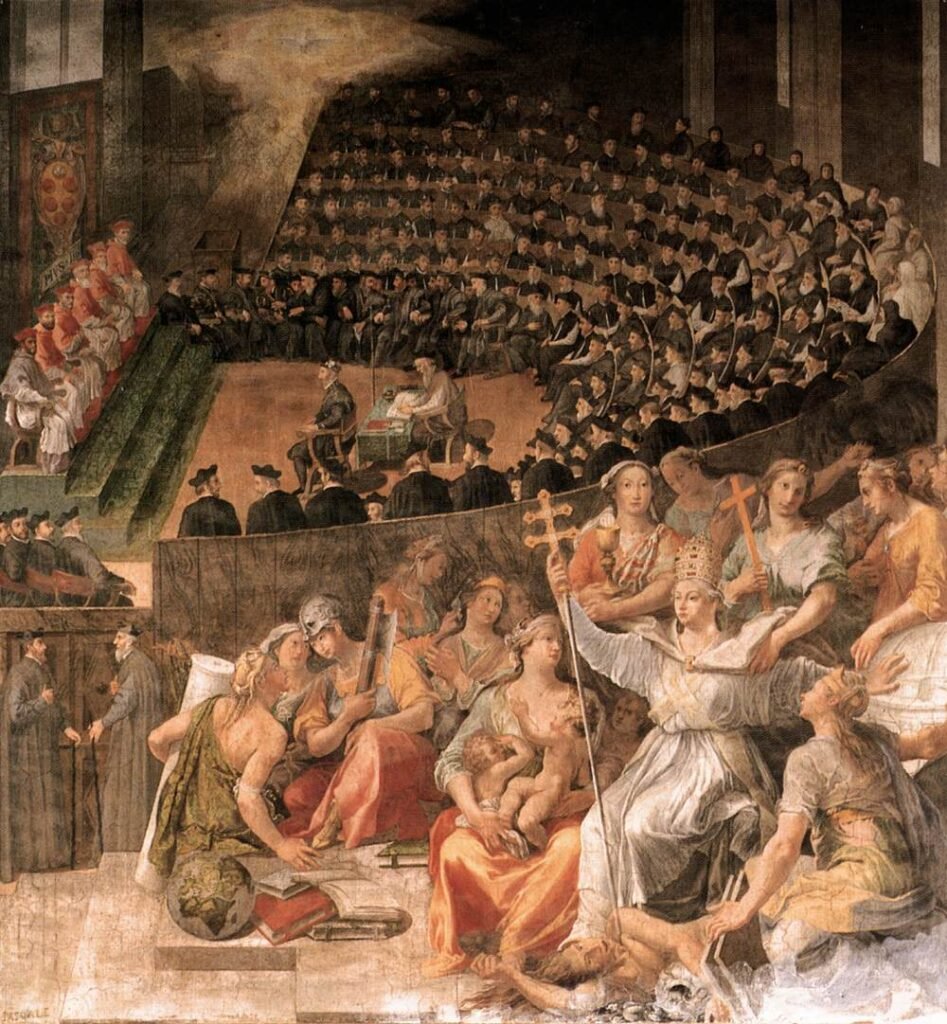
Overview
The Counter-Reformation refers to the Catholic Church broad response to the Protestant Reformation, encompassing doctrinal clarification, institutional reform, renewed spiritual and missionary energy, and substantial cultural patronage, unfolding significantly across the sixteenth and seventeenth centuries following the initial Protestant challenge.
The Council of Trent
The Council of Trent, convened across several sessions between 1545 and 1563, served as the central institutional response, clarifying Catholic doctrine on contested points such as justification and the sacraments, addressing clerical abuses, and establishing reforms aimed at improving priestly education and pastoral practice throughout the church.
New Religious Orders
This period produced significant new religious orders, most notably the Jesuits, founded by Ignatius of Loyola, who became especially active in education, missionary work, and theological scholarship, playing a central role in both defending Catholic doctrine and extending Catholic missionary reach across the globe.
Spiritual Renewal
Alongside institutional reform, this period saw significant spiritual renewal within Catholic life, exemplified by mystics and reformers such as Teresa of Avila and John of the Cross, whose writings on contemplative prayer and spiritual discipline remain influential within Catholic spirituality to the present day.
Cultural Expression
The Counter-Reformation also fueled significant artistic and architectural patronage, with the dramatic, emotionally engaging Baroque style emerging partly as a means of conveying Catholic teaching and devotional feeling to a broad popular audience through powerfully affecting visual and musical art.
Role Today
The Counter-Reformation legacy continues to shape Catholic institutional structure, religious education, and spiritual practice, with many reforms established during this period, including seminary-based priestly training, remaining foundational features of Catholic institutional life well into the modern era.
Missionary Expansion
Counter-Reformation energy fueled substantial missionary expansion well beyond Europe, with Jesuit and other Catholic missionaries active across the Americas, Asia, and Africa, often working alongside European colonial expansion while also developing distinctive, sometimes locally adapted approaches to religious instruction in diverse cultural settings.
These missionary efforts produced significant and lasting institutional presence in many regions, alongside considerable controversy both at the time and in later historical assessment regarding the relationship between missionary activity and colonial political and economic interests.
Education Reform
Reformed seminary education, mandated by the Council of Trent, established more systematic and consistent standards for priestly training across Catholic territories, addressing widespread earlier concerns about inadequate clergy education that reformers on both Protestant and Catholic sides had long criticized.
Artistic Patronage in Detail
Major Baroque artists and architects received substantial church patronage during this period, producing dramatic ceiling paintings, elaborate church facades, and emotionally powerful sculpture intended to inspire devotion and visually reinforce Catholic teaching for a broad audience, including many who could not read theological texts directly.
Rome itself underwent substantial architectural transformation during this period, with major building projects reflecting renewed papal confidence and the broader Counter-Reformation effort to visually project Catholic institutional strength and spiritual vitality to visitors and pilgrims arriving from across Europe and beyond.
Relationship to the Reformation
While often described as primarily reactive, historians increasingly emphasize that significant currents of Catholic reform predated the Protestant challenge, suggesting the Counter-Reformation drew on existing internal reform impulses even as the Protestant crisis undeniably accelerated and shaped the specific form these reforms ultimately took.
Comparative Assessment with Protestant Reform
Historians increasingly treat the Counter-Reformation and Protestant Reformation as parallel expressions of a broader shared sixteenth century impulse toward religious renewal and institutional reform, even as the two movements ultimately produced starkly different and competing theological and institutional outcomes across the divided Christian world.
This comparative framing helps explain certain shared features between otherwise opposed traditions, including heightened emphasis on personal piety, improved clergy education, and renewed missionary energy, suggesting common underlying currents of religious concern cutting across the deep doctrinal divisions separating Protestant and Catholic Europe during this period.
Closing Note
The Counter-Reformation legacy endures in Catholic institutional life today, standing as a decisive chapter in the broader story of how the church responded to one of the most significant challenges in its long history.
Historians continue to reassess its scope, recognizing both its reactive and its genuinely independent reforming impulses within Catholic life.
Final Thought
The Catholic Church response to the Protestant challenge reshaped its own institutions so thoroughly that the effects remain visible in parish life, seminary training, and religious art and architecture across the Catholic world today.
Its mark remains visible in Catholic churches, seminaries, and devotional life across the world today.
Each new study adds further nuance to this carefully examined chapter of Catholic history.
Few periods of church history show quite so clearly how crisis can spur genuine institutional renewal.
Its echo persists across many churches and seminaries even now.
Historians, theologians, and art scholars alike continue to study its patterns closely.
That scrutiny shows no sign of ending soon, given how much it reshaped Catholic life.
New studies of its art and documents keep appearing regularly, deepening the historical record considerably further still.
Interest shows no sign of fading anytime soon among historians of early modern Catholicism.
It remains a cornerstone topic for historians of early modern Catholicism and art.
It endures as a defining chapter of Catholic history.
The Council of Trent, which met across several sessions between 1545 and 1563, produced the doctrinal and institutional backbone of the Counter-Reformation, reaffirming traditional Catholic positions on the sacraments, the authority of church tradition alongside scripture, and the necessity of good works alongside faith. The council also addressed practical abuses that reformers had criticized, tightening rules on the sale of indulgences, improving the education and discipline of parish priests, and standardizing liturgical practice across Catholic regions. New religious orders, most notably the Jesuits founded by Ignatius of Loyola, became key instruments of the renewal, combining rigorous education with missionary activity that extended Catholic influence into Asia and the Americas. Catholic art and architecture of the period, often described as Baroque, aimed to move worshippers emotionally toward devotion, standing in deliberate contrast to the plainer aesthetic favored in many Protestant churches. The combined effect of doctrinal clarification, institutional reform, and renewed missionary energy allowed the Catholic Church to stabilize its position in much of southern and central Europe even as Protestant movements continued to expand elsewhere.
Key facts
- Array
Quick checkWhat major church council defined much of the Counter-Reformation doctrinal response?Show answer
The Council of Trent, convened across several sessions between 1545 and 1563, defined much of the doctrinal and institutional response to Protestant challenges.
Sources
- Array
Editorially reviewed by Specialty Digest Editorial TeamLast reviewed November 4, 2026Researched and drafted with AI assistanceReport an issue