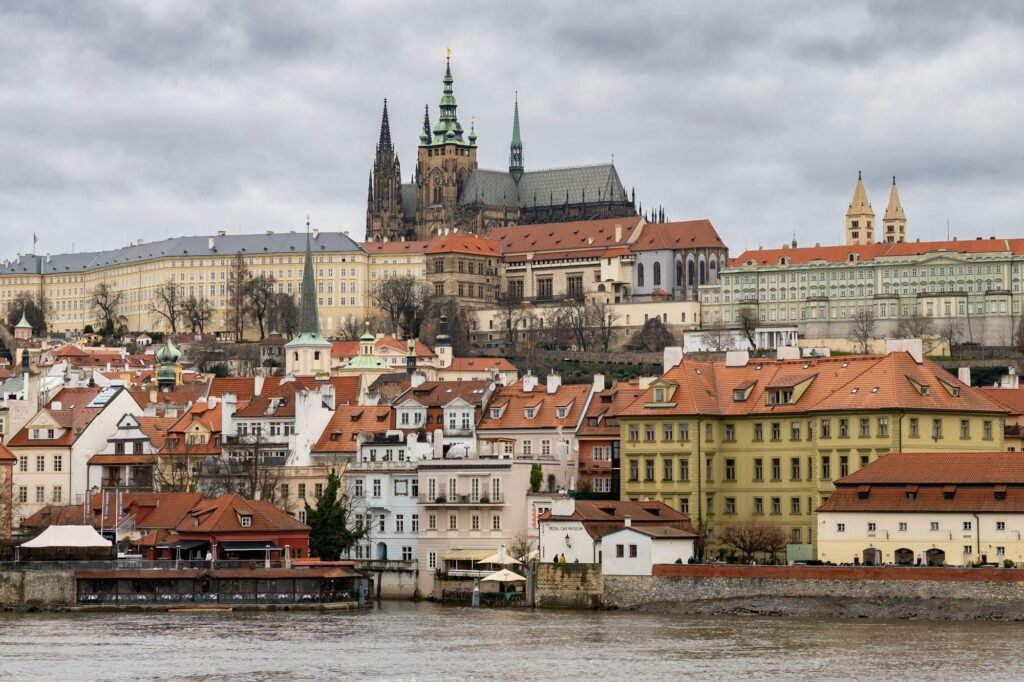
The Czech Republic, also known as Czechia, is a landlocked country in Central Europe bordered by Germany, Poland, Slovakia, and Austria. It became independent on January 1, 1993, when Czechoslovakia split peacefully into the Czech Republic and Slovakia. Home to roughly 10.9 million people and centered on the capital, Prague, the country belongs to the European Union, NATO, and the Schengen Area, and its historic core is protected by UNESCO as one of the best-preserved medieval city centers in Europe.
Where the Czech Republic Is
The Czech Republic covers 78,871 square kilometers in the heart of Central Europe, sharing borders with Germany to the west and northwest, Poland to the north and northeast, Slovakia to the east, and Austria to the south, according to the European Union’s official country profile. It has no coastline. The country is built from three historical lands, Bohemia in the west, Moravia in the east, and a small southern slice of Silesia, together often called the Czech Lands, as Britannica describes them. Prague, the capital and largest city, sits on the Vltava River in Bohemia and anchors a country now organized into 14 administrative regions.
A Short History
The Czech Lands have a long political history, running from the medieval Kingdom of Bohemia through centuries inside the Habsburg and Austro-Hungarian empires. Czechoslovakia emerged as an independent state in 1918 after the collapse of Austria-Hungary at the end of World War I, joining Czechs and Slovaks under one government. That state endured German occupation during World War II and more than four decades of Communist rule after 1948.
Communist rule ended in 1989 with the Velvet Revolution, a largely nonviolent wave of protests that brought the playwright and dissident Vaclav Havel to the presidency, according to Britannica. The unified Czechoslovak state did not last much longer. Political leaders in the Czech and Slovak halves of the federation could not agree on how to restructure its economy and institutions, and on January 1, 1993, Czechoslovakia dissolved into two fully independent countries, the Czech Republic and Slovakia. Parliament negotiated the split rather than putting it to a referendum, and it happened without violence, a fact that earned it the nickname the Velvet Divorce, echoing the revolution that had preceded it. Havel went on to serve as the first president of the independent Czech Republic.
Government and Economy
The Czech Republic is a parliamentary republic, led day to day by a prime minister, with a separately elected president serving as head of state, per the European Union. It joined NATO on March 12, 1999, together with Poland and Hungary, according to the Czech Ministry of Foreign Affairs, and became a member of the European Union on May 1, 2004, followed by the Schengen Area in December 2007. Despite EU membership, the country has kept its own currency, the Czech koruna, rather than adopting the euro, although it has stated an intention to do so eventually.
The economy is small but developed. According to World Bank data, the Czech Republic’s gross domestic product reached about $391 billion in 2025, with income per person of roughly $35,900, placing it among the World Bank’s high-income economies. Unemployment stood at under 3 percent, and manufacturing, especially automobiles and machinery, remains central to exports, reflecting the country’s position inside European industrial supply chains. Average income per person still trails the EU average, at about 34,500 euros against a bloc-wide 38,100 euros in the European Union’s own accounting, a gap typical of the EU’s newer, formerly Communist member states.
Culture and People
The population is overwhelmingly ethnic Czech, and Czech, a West Slavic language, is the country’s official tongue. Prague’s architecture and cultural institutions trace a lineage that UNESCO credits with shaping urban design across Central and Eastern Europe, from Gothic-era building under the 14th-century Holy Roman Emperor Charles IV to Baroque reconstruction in the 17th and 18th centuries. The city’s associations with figures such as the composer Antonin Dvorak and the writer Franz Kafka have made it a reference point in European musical and literary history.
Beer is a genuine part of daily life rather than a stereotype. Czechs have recorded the world’s highest per-capita beer consumption every year since 1993, the same year the country became independent, drinking an average of about 152 liters per person in 2023, according to industry data compiled by Kirin Holdings.
What the Czech Republic Is Known For
Prague Castle is the country’s most recognized landmark and, according to Guinness World Records, the largest ancient castle complex in the world, covering about 7.28 hectares within an outer perimeter roughly 570 meters long. Founded in the ninth century, the complex includes St. Vitus Cathedral and forms the core of the Historic Centre of Prague, which UNESCO inscribed as a World Heritage Site in 1992 for its unbroken record of medieval, Gothic, and Baroque urban architecture. The nearby Charles Bridge, a 14th-century stone bridge across the Vltava, sits within the same protected historic district.
Why It Matters
The Czech Republic’s peaceful 1993 split from Slovakia remains one of the clearest examples of a modern federal state dividing through negotiation rather than conflict. As a NATO and European Union member bordering Germany, Poland, Slovakia, and Austria, the country sits at the center of European security and trade networks, and its manufacturing base ties it closely into continental industrial supply chains. Prague’s architectural record, protected as a UNESCO World Heritage Site, also gives the country cultural weight well beyond its size, illustrating how medieval and Baroque urban design spread across Central and Eastern Europe.
Key Takeaways
- The Czech Republic became independent on January 1, 1993, when Czechoslovakia peacefully split into the Czech Republic and Slovakia in what is known as the Velvet Divorce.
- It is a landlocked, 78,871-square-kilometer country in Central Europe made up of Bohemia, Moravia, and part of Silesia, with Prague as its capital.
- The country joined NATO in 1999 and the European Union in 2004, though it has kept its own currency, the koruna, rather than adopting the euro.
- The World Bank classifies the Czech Republic as a high-income economy, with a GDP of about $391 billion in 2025, still below the EU’s average income per person.
- Prague Castle, founded in the ninth century, is recognized by Guinness World Records as the largest ancient castle complex on Earth and anchors the UNESCO-listed Historic Centre of Prague.
- Czechs have recorded the world’s highest per-capita beer consumption every year since 1993.
Sources
- Britannica, “Czech Republic” (undated)
- Britannica, “Velvet Divorce” (undated)
- UNESCO World Heritage Centre, “Historic Centre of Prague” (inscribed 1992)
- European Union, “Czechia” (undated)
- Czech Statistical Office, “Basic Data” (2026)
- Ministry of Foreign Affairs of the Czech Republic, “Czechia and NATO” (undated)
- World Bank, “World Bank Open Data: Czechia” (2025)
- Guinness World Records, “Largest ancient castle” (undated)
- Kirin Holdings, “Global Beer Consumption by Country in 2023” (December 19, 2024)
Key facts
- Population: approximately 10.9 million (2026)5
- Area: 78,871 square kilometers, bordered by Germany, Poland, Slovakia, and Austria4
- Independence: January 1, 1993, following the peaceful 'Velvet Divorce' split from Slovakia2
- Memberships: NATO since 1999, European Union since 200464
- Prague Castle: largest ancient castle complex in the world, founded in the 9th century8
Quick checkIn what year did Czechoslovakia split into the Czech Republic and Slovakia, and what is that split commonly called?Show answer
1993, in a peaceful process known as the Velvet Divorce.
Sources
- Britannica. Czech Republic. Undated (accessed 2026-09-22)
- Britannica. Velvet Divorce. Undated (accessed 2026-09-22)
- UNESCO World Heritage Centre. Historic Centre of Prague. 1992 (inscription) (accessed 2026-09-22)
- European Union. Czechia - EU country. Undated (accessed 2026-09-22)
- Czech Statistical Office. Basic Data. 2026 (accessed 2026-09-22)
- Ministry of Foreign Affairs of the Czech Republic. Czechia and NATO. Undated (accessed 2026-09-22)
- World Bank. World Bank Open Data: Czechia. 2025 (accessed 2026-09-22)
- Guinness World Records. Largest ancient castle. Undated (accessed 2026-09-22)
- Kirin Holdings. Global Beer Consumption by Country in 2023. 2024-12-19 (accessed 2026-09-22)
Editorially reviewed by Specialty Digest Editorial TeamLast reviewed September 22, 2026Researched and drafted with AI assistanceReport an issue