Cyprus is an island country in the eastern Mediterranean Sea, the third largest island in the Mediterranean after Sicily and Sardinia. Internationally recognized as the Republic of Cyprus, it is a member of the United Nations and, since 2004, the European Union, though the island has been divided since 1974 between the government-controlled south and a Turkish-Cypriot-administered north.
Geography
Cyprus lies roughly 65 kilometers south of Turkey and about 100 kilometers west of Syria, placing it at a crossing point between Europe, Asia, and Africa. The island covers about 9,253 square kilometers, according to European Union statistics.[1] Its terrain is dominated by two mountain ranges, the Troodos massif in the south-central interior and the narrower Kyrenia range along the north coast, separated by the flat Mesaoria plain that holds the capital, Nicosia.
The climate is Mediterranean, with hot, dry summers and mild, wetter winters. Water scarcity is a persistent constraint on agriculture, and the Republic of Cyprus has invested heavily in desalination to supplement rainfall-dependent reservoirs. The name Cyprus is widely linked to the ancient Greek word for copper, kypros, reflecting the island’s long history as a source of the metal in antiquity.
Brief History
Cyprus has been continuously settled since the Neolithic period; the settlement at Choirokoitia, inscribed as a UNESCO World Heritage Site in 1998, is among the best-preserved prehistoric sites in the eastern Mediterranean. Successive waves of Mycenaean Greek settlers, Phoenicians, Assyrians, Egyptians, Persians, and Romans controlled the island before it passed to Byzantine rule, then to Crusader, Frankish, and Venetian control, and finally to the Ottoman Empire from 1571. Britain administered Cyprus from 1878 and annexed it outright in 1914, governing it as a crown colony until the Republic of Cyprus gained independence in 1960.
Independence did not resolve tension between the island’s Greek Cypriot majority and Turkish Cypriot minority over the shape of the new state. Intercommunal violence in 1963 and 1964 led the UN Security Council to deploy the UN Peacekeeping Force in Cyprus (UNFICYP), which still patrols a buffer zone across the island today.[2]
The events of 1974 and the island’s current division are addressed here as a matter of documented fact, without taking a position on the underlying sovereignty dispute. In July 1974, a coup d’etat backed by the military junta then ruling Greece attempted to unite Cyprus with Greece. Turkey responded with a military intervention that it describes as a peace operation and that the Republic of Cyprus and the UN describe as an invasion; Turkish forces went on to occupy the northern part of the island. The result was the de facto partition of Cyprus along a UN-monitored buffer zone, often called the Green Line, that runs roughly 180 kilometers across the island and through Nicosia itself.[2] In 1983, Turkish Cypriot authorities in the north declared the “Turkish Republic of Northern Cyprus.” The UN Security Council, in Resolution 541 and again in Resolution 550, declared that declaration legally invalid and called on states not to recognize any Cypriot state other than the Republic of Cyprus.[3] Turkey remains the only country that recognizes the northern administration. Reunification talks under UN auspices, most recently on a bizonal, bicommunal federal model, have continued intermittently for decades without a settlement.
Government and Economy
The Republic of Cyprus is a presidential republic in which the president serves as both head of state and head of government.[1] Its 1960 constitution allocated separate representation to Greek and Turkish Cypriots, but the Turkish Cypriot community has not participated in the Republic’s institutions since 1963, and the government’s effective jurisdiction has been limited to the island’s southern two-thirds since 1974. Cyprus joined the European Union on May 1, 2004, and adopted the euro as its currency on January 1, 2008.[1] EU law is formally suspended in the areas not under the Republic’s control, pending a political settlement.
Services, particularly tourism, shipping, and financial and professional services, dominate the economy of the Republic of Cyprus, which registered gross domestic product per capita of about 35,900 euros in 2025, below the EU average of roughly 38,100 euros.[1] The island’s banking sector suffered a severe crisis in 2012 and 2013 that required an international bailout and a restructuring of its largest banks; the economy has since diversified further into information technology and, more recently, energy, following the discovery of offshore natural gas reserves in the Eastern Mediterranean that have also sharpened disputes with Turkey over maritime jurisdiction.
Culture and People
The Statistical Service of Cyprus (Cystat) put the population of the government-controlled area at about 983,000 at the end of 2024, a figure that by definition excludes the north.[4] The population is aging: Cystat data show the share of residents 65 and older rising from 11.3 percent in 2000 to 18.3 percent in 2024, while the share under 15 fell from 22.3 percent to 15.2 percent over the same period.[4] The great majority of residents in the government-controlled area are Greek Cypriots who follow the Autocephalous Greek Orthodox Church of Cyprus; the Turkish Cypriot community, concentrated in the north, is predominantly Muslim. Greek and Turkish are both official languages of the Republic, alongside a growing use of English.
Cypriot culture blends Greek, Levantine, and Ottoman-Venetian influences visible in its cuisine, music, and religious architecture. UNESCO has inscribed three properties on the island as World Heritage Sites: the Paphos archaeological area, the Painted Churches in the Troodos Region, and the Choirokoitia Neolithic settlement.[5][6] Halloumi, a semi-hard cheese traditionally made from sheep’s and goat’s milk, received EU protected designation of origin status in 2021 and is among Cyprus’s most recognized food exports.
What Cyprus Is Known For
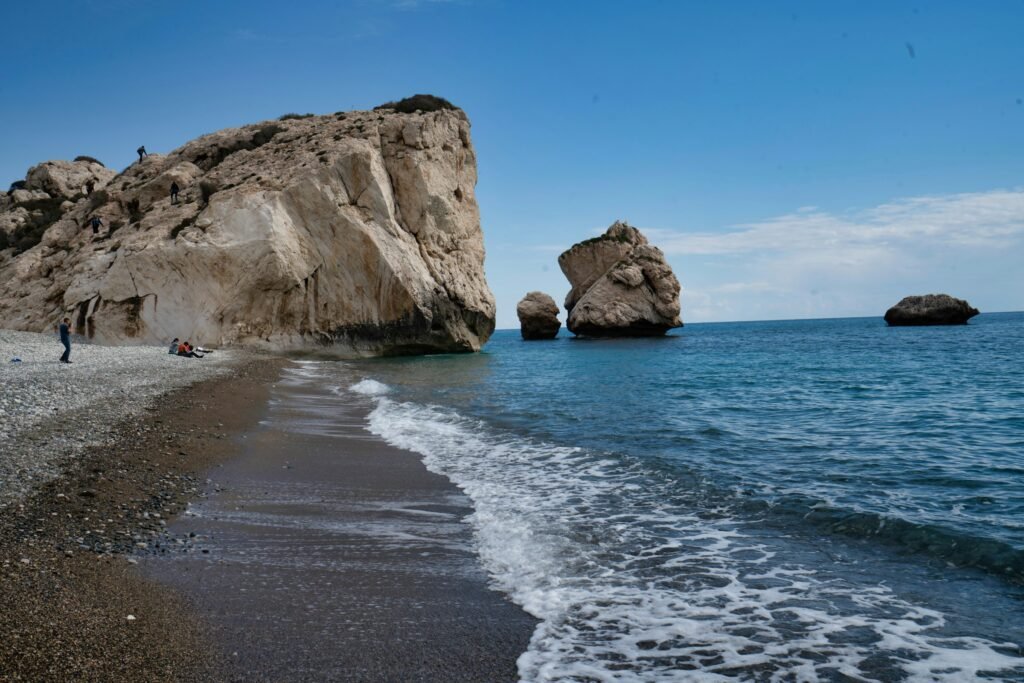
Cyprus is known above all for its layered antiquity. The Paphos archaeological area, on the island’s southwest coast, contains the Tombs of the Kings, an extensive underground necropolis of rock-cut Hellenistic and Roman tombs, along with the Roman-era House of Dionysos and its mosaic floors; UNESCO cites the site’s connection to the cult of Aphrodite as part of its justification for World Heritage status.[5] Nearby, the rock formation Petra tou Romiou, known in English as Aphrodite’s Rock, is the traditional site of the goddess’s mythical birth from the sea and one of the most photographed natural features in the eastern Mediterranean.
Nicosia, the capital, is frequently described as the last divided capital city in Europe, its old town still split by the UN buffer zone. Cyprus is also known for its copper deposits, which gave the island its name and supplied bronze-working civilizations across the ancient Mediterranean, and for its position as a strategic maritime and, more recently, energy hub between three continents.
Why Cyprus Matters
Cyprus matters as a live test of how the international community manages a frozen but unresolved territorial dispute inside the borders of the European Union. It is the only EU and eurozone member with a UN peacekeeping force still deployed on its territory and with a substantial part of its internationally recognized territory outside its practical control.[2] Its offshore gas discoveries have made it a focal point in disputes over maritime jurisdiction in the Eastern Mediterranean, drawing in Turkey, Greece, Israel, Egypt, and EU energy policy. At the same time, its deep archaeological record, spanning the Neolithic to the Roman era, makes it a significant reference point for understanding how eastern Mediterranean civilizations connected with one another over several millennia.
Key Takeaways
- Cyprus is the third largest island in the Mediterranean and an EU and eurozone member state, formally the Republic of Cyprus.[1]
- The island has been divided since the 1974 Turkish military intervention that followed a Greek-backed coup; a UN-monitored buffer zone separates the Republic-controlled south from the Turkish-Cypriot-administered north.[2]
- The self-declared “Turkish Republic of Northern Cyprus,” proclaimed in 1983, is recognized only by Turkey; the UN Security Council declared it legally invalid.[3]
- The Republic of Cyprus’s population was about 983,000 at the end of 2024, and its population is aging steadily.[4]
- UNESCO has inscribed three Cypriot sites as World Heritage properties: Paphos, the Painted Churches of the Troodos Region, and Choirokoitia.[5][6]
- Aphrodite’s Rock (Petra tou Romiou) and the Tombs of the Kings at Paphos are the island’s most widely recognized landmarks, both tied to the mythology and archaeology of Aphrodite.[5]
- Offshore natural gas discoveries have made Cyprus a focal point of Eastern Mediterranean maritime border disputes.
Sources
- European Union | “Cyprus” | Undated | https://european-union.europa.eu/principles-countries-history/eu-countries/cyprus_en | Accessed September 22, 2026
- United Nations Peacekeeping | “UNFICYP” | Undated | https://peacekeeping.un.org/en/mission/unficyp | Accessed September 22, 2026
- UN Security Council | “Resolution 541 (1983) on Cyprus” | 1983 | https://unscr.com/en/resolutions/541 | Accessed September 22, 2026
- Statistical Service of Cyprus (Cystat), reported by Cyprus Mail | “Cyprus population grows but continues to age, Cystat says” | December 20, 2025 | https://cyprus-mail.com/2025/12/20/cyprus-population-grows-but-continues-to-age-cystat-says | Accessed September 22, 2026
- UNESCO World Heritage Centre | “Paphos” | Undated | https://whc.unesco.org/en/list/79/ | Accessed September 22, 2026
- UNESCO World Heritage Centre | “Painted Churches in the Troodos Region” | Undated | https://whc.unesco.org/en/list/351/ | Accessed September 22, 2026
Key facts
- Third largest island in the Mediterranean, about 9,253 square kilometers1
- EU member since May 1, 2004; adopted the euro on January 1, 20081
- Population of the government-controlled area was about 983,000 at end of 20244
- Divided since 1974 by a UN-monitored buffer zone between the Republic-controlled south and the Turkish-Cypriot-administered north23
- Home to three UNESCO World Heritage Sites: Paphos, the Painted Churches of the Troodos Region, and Choirokoitia56
Quick checkWhy has Cyprus been divided since 1974?Show answer
A Greek-backed coup in July 1974 triggered a Turkish military intervention that led to the occupation of the northern third of the island; a UN-monitored buffer zone has separated the internationally recognized Republic of Cyprus in the south from the Turkish-Cypriot-administered north ever since.
Sources
- European Union. Cyprus. Undated (accessed Accessed September 22, 2026)
- United Nations Peacekeeping. UNFICYP. Undated (accessed Accessed September 22, 2026)
- UN Security Council. Resolution 541 (1983) on Cyprus. 1983 (accessed Accessed September 22, 2026)
- Statistical Service of Cyprus (Cystat), reported by Cyprus Mail. Cyprus population grows but continues to age, Cystat says. December 20, 2025 (accessed Accessed September 22, 2026)
- UNESCO World Heritage Centre. Paphos. Undated (accessed Accessed September 22, 2026)
- UNESCO World Heritage Centre. Painted Churches in the Troodos Region. Undated (accessed Accessed September 22, 2026)
Editorially reviewed by Specialty Digest Editorial TeamLast reviewed September 22, 2026Researched and drafted with AI assistanceReport an issue