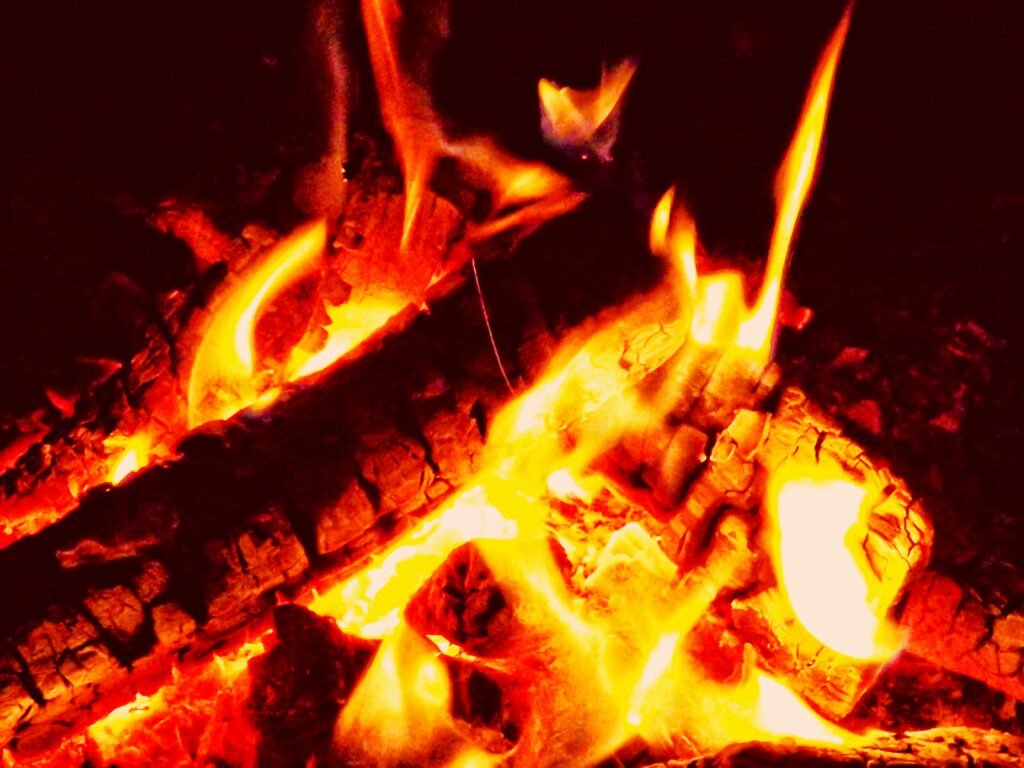
The fire triangle is a foundational concept in fire science that illustrates the three elements necessary for combustion to occur and continue: sufficient heat to raise fuel to its ignition temperature, a combustible fuel source, and an oxidizing agent, typically oxygen from the surrounding air. The model teaches that removing any one of these three elements will extinguish a fire, providing the conceptual basis for nearly every firefighting and fire prevention strategy.
n
The Three Elements
n
Heat provides the energy needed to raise fuel to a temperature at which it releases flammable vapors and sustains combustion. Fuel refers to any material capable of burning, including solids, liquids, and gases, with its availability and arrangement affecting how readily a fire spreads. Oxygen, present in ordinary air at roughly twenty-one percent concentration, serves as the oxidizing agent that combines with fuel during the combustion reaction, and most ordinary fires require only a modest reduction in oxygen concentration to be significantly slowed or extinguished.
n
The Fire Tetrahedron
n
Modern fire science often extends the triangle model into a fire tetrahedron by adding a fourth element, the self-sustaining chemical chain reaction that propagates combustion once it begins. This expanded model better explains how certain extinguishing agents, such as dry chemical powders, work primarily by interrupting this chain reaction at a molecular level rather than by cooling, smothering, or removing fuel, offering a more complete picture of how different suppression methods achieve their effect.
n
Practical Applications in Fire Prevention
n
The fire triangle concept underlies many everyday fire prevention practices, such as storing flammable liquids in sealed, approved containers to limit fuel availability, maintaining safe distances between heat sources and combustible materials, and using inert gas purging in industrial processes to reduce oxygen concentration below the level needed to sustain combustion. Recognizing which element of the triangle is most practical to control in a given situation often shapes the specific prevention measures adopted in a workplace or facility.
n
Educational Value
n
Because of its simplicity, the fire triangle remains a staple of basic fire safety education for both the general public and new firefighters, providing an accessible entry point before more complex fire dynamics concepts, such as heat release rate and flashover, are introduced. Its enduring use reflects a broader pattern in safety education, where a simplified but fundamentally accurate model can build intuition that more detailed technical knowledge later refines rather than replaces.
n
Limitations of the Simple Model
n
While useful for basic education, the fire triangle simplification does not fully capture the complexity of real fire behavior, including factors such as the specific chemical pathways of combustion, the role of radiant heat transfer in fire spread, and the behavior of smoldering combustion that can occur with limited oxygen over extended periods. Fire science professionals therefore use more detailed models, including the fire tetrahedron and quantitative heat release calculations, once analysis moves beyond basic conceptual understanding into engineering design or incident investigation.
n
Use in Hazard Assessment
n
Industrial hazard assessments frequently apply fire triangle thinking when evaluating a specific process or storage arrangement, systematically asking which combination of fuel, heat sources, and oxidizer could combine to create a fire hazard, and then identifying practical controls to separate or eliminate one of these elements. This structured approach helps ensure that fire prevention measures address the actual combination of factors present in a specific workplace rather than relying on generic precautions that may not match the particular hazards involved.
n
Enduring Relevance
n
Despite being one of the oldest and simplest models in fire science, the fire triangle continues to inform both professional practice and everyday safety decisions, from the design of industrial fire prevention programs to a homeowner decision to keep oily rags away from a furnace. Its lasting usefulness lies precisely in its simplicity, offering an intuitive framework that nearly anyone can apply correctly without specialized technical training.
n
Teaching the Concept Effectively
n
Fire safety educators often pair the fire triangle with simple demonstrations, such as showing how covering a small flame cuts off its oxygen supply, to make the abstract concept concrete and memorable for audiences ranging from schoolchildren to new industrial workers. This hands-on reinforcement helps ensure that the underlying principle is genuinely understood and retained, rather than simply memorized as an isolated fact disconnected from practical fire prevention behavior.
n
Connecting Theory to Daily Life
n
Everyday fire prevention habits, such as unplugging unused appliances, properly disposing of smoking materials, and maintaining clearance around space heaters, each represent an intuitive application of fire triangle thinking even when the person performing the habit has never formally studied fire science. This gap between formal theory and instinctive practice illustrates how foundational the underlying principle has become within broader public safety culture.
n
Closing Perspective
n
Whether applied by a trained industrial hygienist conducting a formal hazard assessment or by a homeowner simply keeping flammable materials away from an open flame, the fire triangle continues to translate complex combustion science into guidance that is immediately usable by nearly anyone.
n
That accessibility, more than any sophistication in the underlying science, explains why the model has endured for so long as a teaching tool.
n
A concept that can be taught in minutes yet applied correctly for a lifetime represents fire safety education at its most effective.
n
Few ideas in any technical field manage to remain this broadly useful for this long.
n
It remains, in a very real sense, the starting point for understanding fire itself.
n
Every more advanced concept in fire science ultimately builds on this basic foundation.
n
That enduring relevance is a quiet testament to good science communication.
Key facts
- Array
Sources
- Array
Editorially reviewed by Specialty Digest Editorial TeamLast reviewed November 3, 2026Researched and drafted with AI assistanceReport an issue