Passive fire protection encompasses building design and construction elements that resist the spread of fire and smoke through their inherent physical properties, rather than through detection and an active mechanical or electrical response. Because passive measures require no power, water supply, or activation to function, they provide a foundational layer of protection that remains effective even when active systems are compromised or delayed.
n
Core Strategies
n
The central strategy of passive fire protection is compartmentation, dividing a building into fire rated sections using rated walls, floors, and doors so that a fire originating in one area is contained and slowed before it can spread throughout the structure. This buys time for occupants to evacuate and for fire department response, even without any active suppression occurring. Structural fire resistance, achieved through fire resistant materials or protective coatings on structural elements, similarly aims to maintain a building structural integrity long enough to prevent collapse during a fire event.
n
Supporting Elements
n
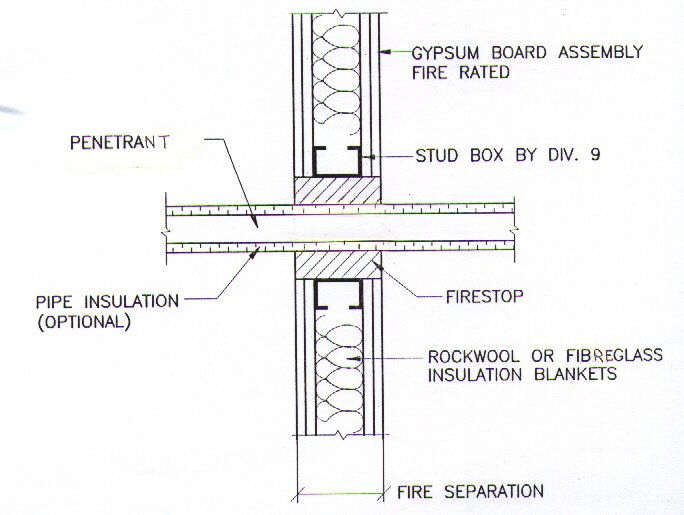
Firestopping systems seal penetrations made by pipes, cables, and ductwork through rated assemblies, preserving the intended fire resistance rating that would otherwise be compromised by an unsealed opening. Fire dampers automatically close ductwork penetrations through rated walls when triggered by heat, preventing fire and smoke from traveling through HVAC systems that would otherwise bypass compartmentation entirely. Together, these elements work to ensure that the passive protection strategy functions as a complete, coordinated system rather than a collection of isolated components.
n
Role in Overall Fire Strategy
n
Passive fire protection measures are typically evaluated together with active systems during the design and code review process, since codes often permit trade-offs between the two approaches, such as allowing somewhat reduced fire resistance ratings in buildings equipped with comprehensive automatic sprinkler protection. This integrated evaluation reflects the understanding that a building overall fire safety depends on the combined performance of passive and active measures working together rather than either category alone.
n
Common Compromises to Watch For
n
Passive fire protection can be silently compromised over a building service life through seemingly minor changes, such as propping open a rated door for convenience, removing or damaging firestopping during later renovation work, or installing new penetrations through rated walls without proper sealing. Because these compromises are often invisible during normal use and only become apparent during an actual fire, routine inspection and maintenance of passive fire protection elements is considered just as important as inspecting active systems like sprinklers and alarms.
n
Specification and Verification
n
Specifying passive fire protection correctly requires careful attention to how individual rated components will interact at their boundaries, since a wall tested in isolation may not perform as expected if adjoining floor assemblies, structural connections, or service penetrations are not detailed to maintain continuity of the fire-rated barrier. Fire protection engineers and code officials review these details during design and construction to confirm that the complete assembly of passive measures will function as an integrated whole rather than as disconnected components with hidden gaps at their junctions.
n
Cost and Design Trade-offs
n
Passive fire protection measures often carry different cost implications than active systems, with rated construction sometimes adding material and labor costs during initial construction but requiring comparatively little ongoing maintenance compared to mechanical and electrical active systems. Project teams frequently evaluate these trade-offs during design, balancing the upfront cost of more extensive passive protection against the long-term maintenance burden and potential failure modes of relying more heavily on active systems alone.
n
Looking Ahead
n
As building materials and construction methods continue to evolve, including increased use of engineered wood products and lightweight construction techniques, passive fire protection strategies must adapt to address the different fire behavior and structural performance these newer materials can exhibit compared to traditional heavy timber or masonry construction. Ongoing research and code development work to ensure that passive protection requirements keep pace with these changes in how buildings are actually built.
n
Coordination Across Design Disciplines
n
Effective passive fire protection design requires coordination among architects, structural engineers, and fire protection specialists, since decisions made by any one discipline, such as a structural connection detail or an architectural feature penetrating a rated wall, can inadvertently compromise fire performance if not reviewed with passive protection requirements in mind. This cross-disciplinary coordination has become increasingly formalized in project delivery processes as the consequences of overlooked conflicts have become better understood.
n
Role of Code Officials
n
Building and fire code officials play a central role in verifying passive fire protection during both new construction and later renovation, reviewing plans for compliance before construction begins and conducting field inspections to confirm that installed assemblies match approved designs. This oversight function helps catch potential gaps before a building is occupied, though ongoing vigilance throughout a building service life remains necessary since passive protection can still be compromised well after initial approval.
n
Closing Perspective
n
Because passive fire protection works silently and requires no activation to function, it is easy to overlook until a fire reveals exactly how well, or how poorly, it was specified, installed, and maintained throughout a building life.
n
Sustained attention from every party involved in a building life cycle is what ultimately closes that gap between intended and actual performance.
n
Treating passive protection as an ongoing responsibility rather than a one-time task is the clearest path to closing it.
n
The payoff, measured in lives and property saved, justifies that ongoing diligence many times over.
n
Few investments in a building offer protection that works as quietly or as consistently well.
n
That quiet reliability is precisely what makes it so valuable.
Key facts
- Array
Sources
- Array
Editorially reviewed by Specialty Digest Editorial TeamLast reviewed November 3, 2026Researched and drafted with AI assistanceReport an issue