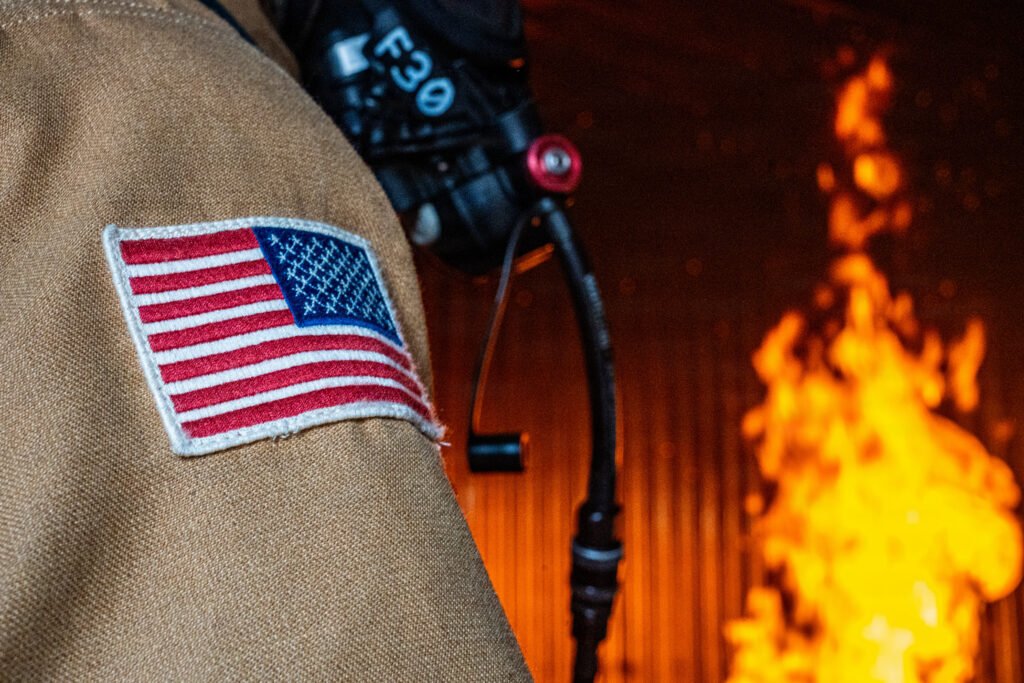
Flashover is a fire dynamics phenomenon in which nearly all exposed combustible materials within an enclosed space ignite almost simultaneously, occurring once accumulated heat raises the entire room to the ignition temperature of its contents. The transition from a localized fire to a fully involved room fire can happen within seconds, making flashover one of the most hazardous events in structural firefighting.
n
Conditions Leading to Flashover
n
Flashover typically develops as a fire burns within a closed or partially closed compartment, allowing heat to accumulate near the ceiling rather than escaping, and radiant heat from this hot upper layer progressively heats every surface in the room. As temperatures climb, unburned pyrolysis gases released from heated materials accumulate, and once the entire room reaches the ignition temperature of its combustible contents, these gases and surfaces ignite together rather than through gradual fire spread from the original source.
n
Warning Signs and Firefighter Response
n
Experienced firefighters are trained to recognize warning signs that flashover may be imminent, including rapidly intensifying heat that becomes uncomfortable even through protective gear, rollover or flaming ignition of gases along the ceiling, and thick, turbulent black smoke banking down toward the floor. Recognizing these signs allows firefighters to retreat or apply cooling water to the ceiling area before conditions become unsurvivable, a technique that has become a standard part of modern interior firefighting tactics following research into fire behavior in modern, heavily fueled residential contents.
n
Research and Modern Fire Behavior
n
Fire research conducted over recent decades has shown that flashover in modern residential settings, furnished heavily with synthetic materials, can occur considerably faster than in homes furnished predominantly with natural materials decades earlier, compressing the time available for occupant escape and firefighter entry. This research has driven changes in firefighting tactics, including greater emphasis on exterior fire attack and ceiling-level water application before firefighters enter a structure, specifically intended to cool conditions and delay or prevent flashover before committing personnel to an interior attack.
n
Related Fire Behavior Phenomena
n
Flashover is often discussed alongside related fire phenomena such as backdraft, which occurs when oxygen-starved superheated gases ignite explosively once fresh air is introduced, typically through opening a door or window into a sealed, smoke-filled space. While flashover results from accumulated radiant heat igniting an entire room contents, backdraft results from a sudden oxygen supply reaching gases already hot enough to ignite, and distinguishing between the warning signs of each is an important part of firefighter training in reading fire behavior.
n
Measuring and Predicting Flashover Risk
n
Fire protection engineers use computer modeling and standardized test data on the heat release rate of common furnishings to estimate how quickly flashover might occur in a given space, informing decisions about detector placement, suppression system design, and structural fire protection requirements. This predictive capability has become increasingly important as synthetic furnishing materials, which generally burn faster and release heat more rapidly than natural materials, have become dominant in most residential and commercial interiors.
n
Implications for Building Design
n
Understanding flashover dynamics has directly shaped building design requirements, including the push toward residential sprinkler systems in new construction, since suppressing a fire before it can grow large enough to trigger flashover dramatically improves survivability for anyone still inside the structure. Compartmentation strategies that limit the size of any single space also reduce flashover risk by limiting the total fuel load and heat accumulation possible within a confined area before fire can spread to adjacent spaces.
n
Summary of Significance
n
Flashover remains one of the central concepts firefighters must understand and respect, since it marks the point at which a room transitions from merely dangerous to immediately unsurvivable for anyone not fully protected and prepared to retreat. Continued research into modern fire behavior and furnishing materials ensures that training and tactics keep pace with a fire environment that has changed considerably from the conditions firefighting practices were originally developed to address.
n
Distinguishing Pre-Flashover Conditions
n
Firefighters are trained to continuously assess conditions such as heat intensity, smoke color and density, and visible fire behavior to judge how close a room may be to flashover at any given moment, since these indicators can change within seconds as a fire develops. This ongoing situational assessment, sometimes described as reading the fire, remains a core skill distinguishing experienced firefighters from those still developing the pattern recognition needed to anticipate dangerous transitions before they occur.
n
Role in Fire Investigation
n
Evidence of flashover, such as characteristic burn patterns and damage distribution, can provide important information during post-fire investigation, helping investigators reconstruct how a fire developed and spread even after the event itself cannot be directly observed. Understanding flashover indicators is therefore a valuable skill not only for active firefighting but also for the subsequent work of determining a fire origin and cause.
n
Closing Perspective
n
As both building materials and firefighting tactics continue to evolve in response to a changing fire environment, the fundamental danger flashover represents, a room transitioning from survivable to lethal in seconds, remains a constant that every generation of firefighters must learn to recognize and respect.
n
Training that keeps pace with current fire behavior research gives firefighters the best possible chance of recognizing the warning signs in time to act safely.
n
Departments that invest in this ongoing education consistently report better outcomes when crews encounter rapidly developing fire conditions in the field.
n
Respecting that danger, rather than growing complacent with experience, keeps firefighters safer over the course of a career.
n
It is a lesson paid for over many decades through hard experience in the field.
Key facts
- Array
Sources
- Array
Editorially reviewed by Specialty Digest Editorial TeamLast reviewed November 3, 2026Researched and drafted with AI assistanceReport an issue