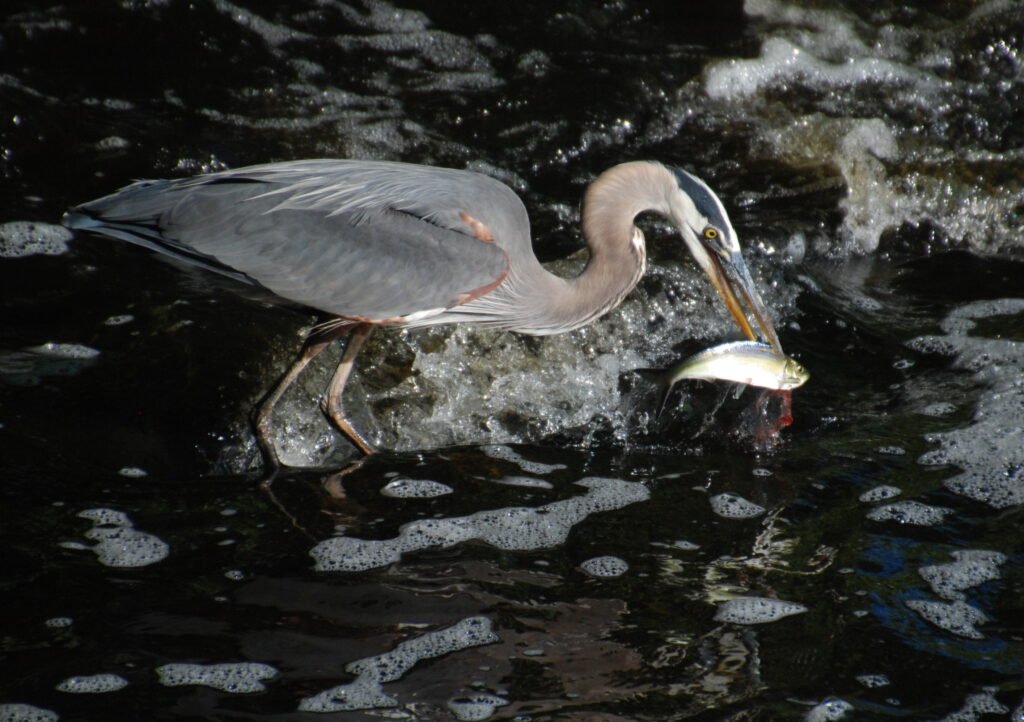
A food chain is the sequence by which energy and matter, in the form of food, pass from one organism to the next. Each organism in the sequence depends on the one before it, starting with a producer that captures energy directly from its environment and ending with the top predator or decomposer that closes the loop.
Trophic levels
Every link in a food chain occupies a trophic level, a rank defined by how an organism gets its energy rather than by what species it is. Producers, mainly green plants, algae, and some bacteria, sit at the first level and make their own food through photosynthesis or, less commonly, chemosynthesis. Primary consumers, the herbivores, occupy the second level by eating producers directly. Secondary consumers eat primary consumers, and tertiary consumers, often the chain’s apex predators, eat secondary consumers in turn. Decomposers and detritivores, including fungi and many bacteria, do not sit neatly on top of the chain; instead they break down dead organisms and waste at every level, recycling nutrients back into the system rather than passing energy further up it.
Types of food chains
Ecologists generally describe three overlapping patterns. A predator chain runs from plant to plant-eating animal to flesh-eating animal, the pattern most people picture first. A saprophytic, or detrital, chain instead starts with dead organic matter, which microorganisms and detritivores consume and break down, a pathway that handles far more of an ecosystem’s total biomass than most predator chains do. A parasite chain runs the pattern in reverse by size: a larger host organism supports a smaller parasite living on or in it, and that parasite can itself be host to even smaller hyperparasites. All three patterns can operate side by side within the same ecosystem, feeding into the same underlying web of relationships.
Energy loss between levels
A food chain rarely stretches beyond four or five links, and the reason is energetic rather than biological. At every transfer from one trophic level to the next, a large share of the energy an organism has consumed is lost as metabolic heat, used for movement, or spent on processes other than growth, so only a fraction becomes new tissue available to whatever eats it next. Ecologists commonly describe roughly ten percent of energy surviving each step, an approximation traced to the American ecologist Raymond Lindeman’s 1942 study of energy flow through a lake, though the real figure varies by ecosystem and species. The practical result is an energy pyramid that narrows sharply toward its apex, which is also why top predators are typically far less numerous than the producers supporting them several levels down.
Food chains versus food webs
A food chain is a simplification. Few real organisms eat only one kind of prey or are eaten by only one kind of predator, so in practice food chains overlap and interlock into a food web, a more realistic picture of how energy actually moves through a community. Ecologists still find individual food chains useful, however, because isolating one linear pathway makes it far easier to trace how energy, or a pollutant, moves step by step from one trophic level to the next.
Bioaccumulation and human impact
Because each trophic level concentrates whatever it consumes, substances that do not break down easily, certain pesticides and heavy metals among them, can become more concentrated at each step up a food chain, a process called biomagnification. Predators at the top of long chains, from ospreys to large fish-eating mammals, can end up carrying far higher contaminant loads than the organisms several levels below them, even when the surrounding water or soil holds only trace amounts. Food chain length also matters to human food supply: eating grain directly, rather than eating animals that were fed the grain, shortens the chain and leaves substantially more of the original energy available to people, a point Britannica’s own account of food chains singles out as one practical reason the concept matters well beyond the laboratory.
Examples of food chains
A grassland food chain might run from grass, the producer, to a grasshopper or mouse that eats it, to a snake that eats the mouse, to a hawk that eats the snake. An ocean food chain follows the same logic at a different scale: microscopic diatoms are consumed by shrimplike zooplankton, which are eaten by small fish, which are in turn eaten by larger predatory fish. Ecologists also distinguish an energy pyramid, which tracks how much usable energy exists at each trophic level, from a biomass pyramid, which tracks the total mass of living organisms at each level, and from a pyramid of numbers, which simply counts individual organisms; the three do not always narrow at the same rate, since a trophic level can hold relatively few individuals that are each large and long-lived, such as whales, rather than the huge numbers of small, short-lived organisms a simple energy pyramid might suggest.
Why food chains matter
Mapping a food chain lets ecologists predict how a change at one level ripples through the rest, whether that change is a new predator, a population crash, or a pollutant entering at the base. The same logic underlies fisheries management, pest control, and conservation planning, since protecting or disrupting a single link rarely stays contained to that link alone.
FAQs
Can a food chain have only two links? Yes, though it is unusual. A simple plant-to-herbivore relationship, such as grass eaten directly by a grazing animal with no further predator in the sequence being tracked, still counts as a short food chain, even though most real-world chains extend further.
Why do food chains rarely exceed four or five links? Because so much energy is lost as heat and metabolic activity at every transfer between trophic levels, there is typically too little energy left after four or five steps to support another level of consumers.
Key facts
- Each link occupies a trophic level, defined by how an organism gets its energy, not by its species.
- Ecologists describe three overlapping patterns: predator chains, saprophytic (detrital) chains, and parasite chains.
- Only about ten percent of energy typically survives each transfer between trophic levels, an approximation traced to Raymond Lindeman's 1942 lake study.
- Real ecosystems form food webs of overlapping chains; a single food chain is a simplified slice of that web.
- Biomagnification lets slow-degrading pollutants concentrate at higher trophic levels, even from trace amounts at the base.
Related concepts
Quick checkWhy do pollutants like certain pesticides end up more concentrated in top predators than in the water or soil around them?Show answer
Through biomagnification: slow-degrading substances consumed at one trophic level are passed on and concentrated further at each subsequent level, so organisms near the top of a food chain can accumulate far higher loads than what is present in the surrounding environment.
Sources
- Encyclopaedia Britannica. Food chain. 2024 (accessed 2026-11-01)
- Encyclopaedia Britannica. Ecosystem. 2024 (accessed 2026-11-01)
Editorially reviewed by Specialty Digest Editorial TeamLast reviewed November 1, 2026Researched and drafted with AI assistanceReport an issue