Hanoi is the capital of Vietnam, a nearly thousand-year-old city on the Red River in the country’s north that has served, through several dynasties and political systems, as the seat of Vietnamese power for most of the nation’s history.
Where Is Hanoi Located?
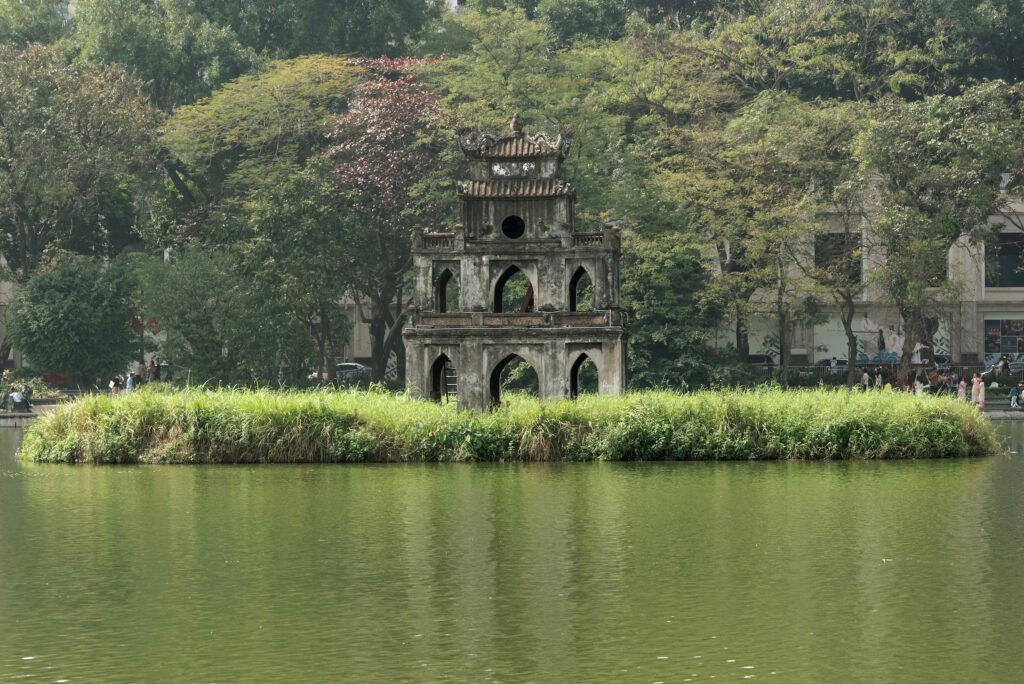
Hanoi sits on the right bank of the Red River in the Red River Delta of northern Vietnam. Its historic core, the Old Quarter, grew up around Hoan Kiem Lake, a small lake at the center of the city that remains the symbolic heart of Hanoi today. The wider municipality extends well beyond the old city into surrounding districts, but the lake and the dense, narrow streets around it still anchor the city’s identity.
A Brief History of Hanoi
Hanoi was founded as a capital in 1010, when Emperor Ly Thai To of the Ly dynasty established the citadel of Thang Long on the site, beginning roughly a thousand years of near-continuous use as a seat of government. The Imperial Citadel of Thang Long, the core of that site, is recognized by UNESCO as a World Heritage Site for the way it reflects successive layers of Vietnamese dynastic rule. The city was known as Thang Long, then later Dong Kinh, before taking the name Hanoi, meaning roughly “between the rivers,” in 1831 under the Nguyen dynasty. France made Hanoi the capital of French Indochina in the late 19th century, leaving a legacy of colonial-era boulevards and architecture still visible in the city today. Hanoi became the capital of the Democratic Republic of Vietnam in 1945 and, after the Vietnam War ended in 1975, the capital of a reunified Vietnam.
Culture, Economy and Daily Life in Hanoi
According to the World Bank, Vietnam was reclassified as an upper-middle-income country in July 2026, reflecting decades of rapid, export-driven growth in which Hanoi, as the political capital and a major manufacturing and services hub in the north, has played a central role. The city’s culture blends centuries of Confucian and Buddhist tradition with French colonial influence and a distinctly Hanoian street life built around its Old Quarter, where narrow streets historically named for the single trade once practiced on them still shape daily commerce and food culture.
Hanoi’s Most Famous Landmarks
The Turtle Tower, a small, weathered stone tower standing on an islet in Hoan Kiem Lake, is Hanoi’s most immediately recognizable landmark and a near-universal symbol of the city in photographs and local iconography, tied to the legend of a golden turtle that reclaimed a magic sword from a 15th-century Vietnamese emperor. Other major sites include the Temple of Literature, Vietnam’s first national university, founded in 1070, the Ho Chi Minh Mausoleum, and the UNESCO-listed Imperial Citadel of Thang Long.
What Is Hanoi Known For?
Hanoi is known internationally for Hoan Kiem Lake and its Turtle Tower, for its well-preserved Old Quarter, for its role as the political capital of both historic and modern Vietnam, and for a food culture built around dishes such as pho, which has roots in the city.
Why Hanoi Matters
Hanoi matters as the political capital of Vietnam and one of the longest continuously used capital sites in Southeast Asia, with roughly a thousand years of near-unbroken use since 1010. Its layered history, as a dynastic citadel, a French colonial capital, and the seat of the Democratic Republic of Vietnam during the Vietnam War, makes it central to how Vietnam understands its own national continuity.
Key Takeaways
- Hanoi was founded as the imperial capital Thang Long in 1010 by Emperor Ly Thai To.
- The Imperial Citadel of Thang Long is a UNESCO World Heritage Site.
- The city took the name Hanoi in 1831 and became the capital of French Indochina in the late 19th century.
- Hanoi became capital of the Democratic Republic of Vietnam in 1945 and of reunified Vietnam in 1975.
- The Turtle Tower on Hoan Kiem Lake is the city’s most recognized landmark.
Sources
- UNESCO World Heritage Centre, “Central Sector of the Imperial Citadel of Thang Long – Hanoi”, undated, https://whc.unesco.org/en/list/1328
- World Bank Group, “Viet Nam Overview”, 2026, https://www.worldbank.org/en/country/vietnam/overview
- Encyclopaedia Britannica, “Hanoi”, undated, https://www.britannica.com/place/Hanoi
Key facts
Quick checkIn what year was Hanoi founded as the imperial capital Thang Long?Show answer
1010, by Emperor Ly Thai To.
Sources
- UNESCO World Heritage Centre. Central Sector of the Imperial Citadel of Thang Long - Hanoi. Undated (accessed 2026-10-06)
- World Bank Group. Viet Nam Overview. 2026 (accessed 2026-10-06)
- Encyclopaedia Britannica. Hanoi. Undated (accessed 2026-10-06)
Editorially reviewed by Specialty Digest Editorial TeamLast reviewed October 6, 2026Researched and drafted with AI assistanceReport an issue