Manila is the capital of the Philippines, a historic port city on Manila Bay that served as the seat of Spanish and American colonial power in Asia for more than three centuries and remains the political heart of the country.
Where Is Manila Located?
Manila sits on the eastern shore of Manila Bay on the island of Luzon, at the mouth of the Pasig River. The city proper is only a small part of a much larger urban region, Metro Manila, which groups Manila together with Quezon City, Makati and more than a dozen other cities and municipalities into one of the most densely populated urban areas in the world.
A Brief History of Manila
A Muslim trading settlement existed at the site before Spanish conquistador Miguel López de Legazpi captured it in 1571 and made it the capital of the Spanish East Indies. Spain ruled the Philippines from Manila for more than 300 years, building the walled city of Intramuros as its administrative, religious and military center and using Manila as the hub of the Manila galleon trade across the Pacific to Mexico. The United States took control after the Spanish-American War in 1898 and administered the Philippines from Manila until independence in 1946, following the city’s near-total destruction during the Battle of Manila in 1945, one of the most devastating urban battles of the Second World War. Manila was rebuilt after the war and has remained the Philippines’ capital and primary port city since.
Culture, Economy and Daily Life in Manila
Manila and its metropolitan region form the economic core of the Philippines, home to government offices, major ports, and a large share of the country’s banking, retail and business-process outsourcing industry. According to the World Bank, the Philippines reached upper-middle-income status in 2025, a transition driven in large part by services growth concentrated in Metro Manila and by remittances from overseas Filipino workers. The city’s culture reflects its layered Spanish, American and Southeast Asian influences, visible in its Catholic traditions, its cuisine, and its widespread use of English alongside Filipino.
Manila’s Most Famous Landmarks
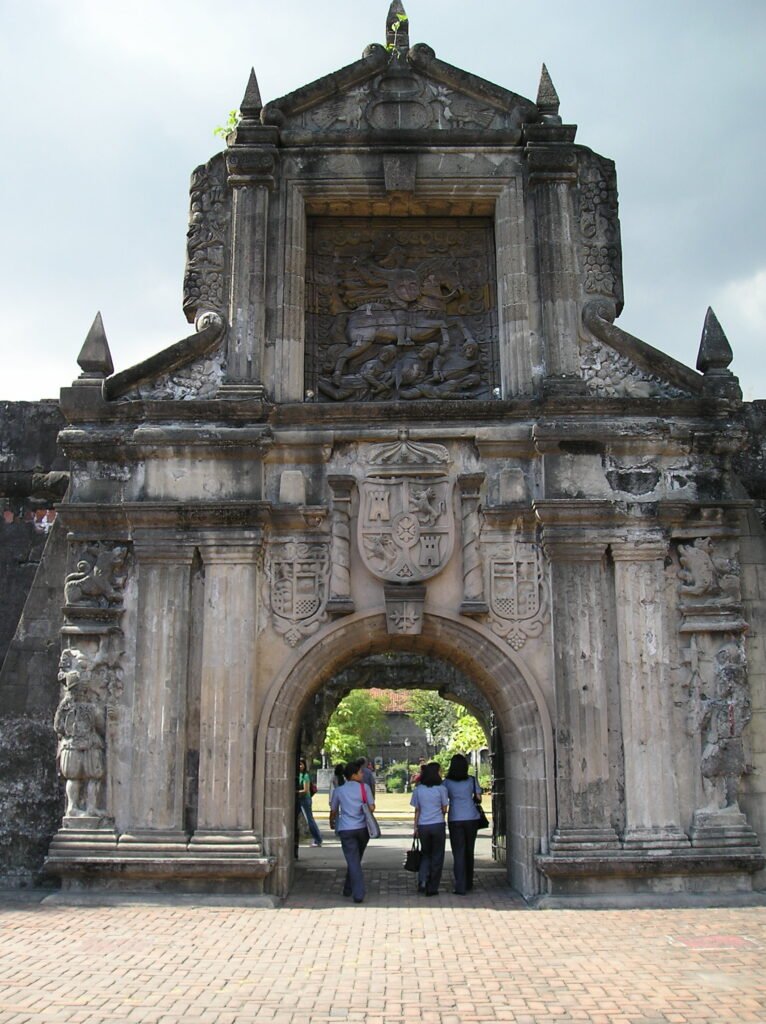
Intramuros, the walled Spanish colonial city, remains Manila’s most historically significant district, and within it, Fort Santiago is the single most recognized structure: a stone citadel and gate built by the Spanish in the 16th century that later served as a Japanese military prison during the Second World War and is where national hero José Rizal was held before his execution in 1896. Other notable landmarks include Manila Cathedral, San Agustin Church, a UNESCO World Heritage Site, and Rizal Park along the bay.
What Is Manila Known For?
Manila is known internationally for Intramuros and Fort Santiago, for its role in both Spanish and American colonial history in Asia, for the devastation and rebuilding of the Battle of Manila, and more recently for its business-process outsourcing industry.
Why Manila Matters
Manila matters as the political capital and historic gateway of the Philippines, a country of more than 7,000 islands that Manila has administered, in one form or another, since the 16th century. Its history as a colonial capital under two different empires, followed by wartime destruction and postwar reconstruction, makes it a central reference point for understanding the Philippines’ modern national identity.
Key Takeaways
- Spain made Manila the capital of the Spanish East Indies in 1571 and ruled the Philippines from there for over 300 years.
- The United States administered the Philippines from Manila from 1898 until independence in 1946.
- The Battle of Manila in 1945 devastated much of the city during the Second World War.
- Fort Santiago, within the walled city of Intramuros, is Manila’s most iconic historic landmark.
- The Philippines reached upper-middle-income status in 2025, with growth concentrated in Metro Manila.
Sources
- World Bank Group, “Philippines Overview”, 2026, https://www.worldbank.org/en/country/philippines/overview
- Encyclopaedia Britannica, “Manila”, undated, https://www.britannica.com/place/Manila
Key facts
Quick checkIn what year did Spain make Manila the capital of the Spanish East Indies?Show answer
1571.
Sources
- World Bank Group. Philippines Overview. 2026 (accessed 2026-10-06)
- Encyclopaedia Britannica. Manila. Undated (accessed 2026-10-06)
Editorially reviewed by Specialty Digest Editorial TeamLast reviewed October 6, 2026Researched and drafted with AI assistanceReport an issue