Johannesburg is South Africa’s largest city and the economic heart of the country, located on the high plateau of the Highveld in Gauteng province. Founded in 1886 after the discovery of gold on the Witwatersrand reef, it grew within a few decades from a mining camp into one of Africa’s largest cities, and it remains the country’s principal financial and commercial center even though it has never been South Africa’s capital.
Where Is Johannesburg Located?
Johannesburg sits on the Witwatersrand, a rocky ridge on South Africa’s interior plateau at an elevation of roughly 1,750 meters, in Gauteng province. Unlike many major world cities, it was not built on a river, coastline, or natural harbor; it exists because of the gold-bearing rock beneath it.
A Brief History of Johannesburg
Johannesburg was founded in 1886 after prospectors confirmed a major gold reef on the Witwatersrand, meaning “ridge of white waters,” triggering a gold rush that drew migrants from across southern Africa and overseas. The settlement grew so quickly that it became known as an “instant city,” reaching tens of thousands of residents within a decade of its founding.
Apartheid and Its Legacy
Johannesburg became a focal point of South Africa’s twentieth-century segregation policies: the township of Soweto, on the city’s southwestern outskirts, was the site of the 1976 student uprising against apartheid-era education policy, and it was home to Nelson Mandela before his imprisonment. The city’s history of forced removals and segregated development under apartheid continues to shape its urban geography today.
Johannesburg Today: Economy and Culture
Johannesburg, often called “Joburg” or “Jozi” and known in Zulu and Sotho as eGoli, meaning “place of gold,” remains South Africa’s largest city and its financial capital, hosting the Johannesburg Stock Exchange, the largest stock exchange in Africa.[1] It functions as the commercial hub for a wider metropolitan region that includes Pretoria, even though Pretoria, not Johannesburg, serves as South Africa’s administrative capital.
The Nelson Mandela Bridge
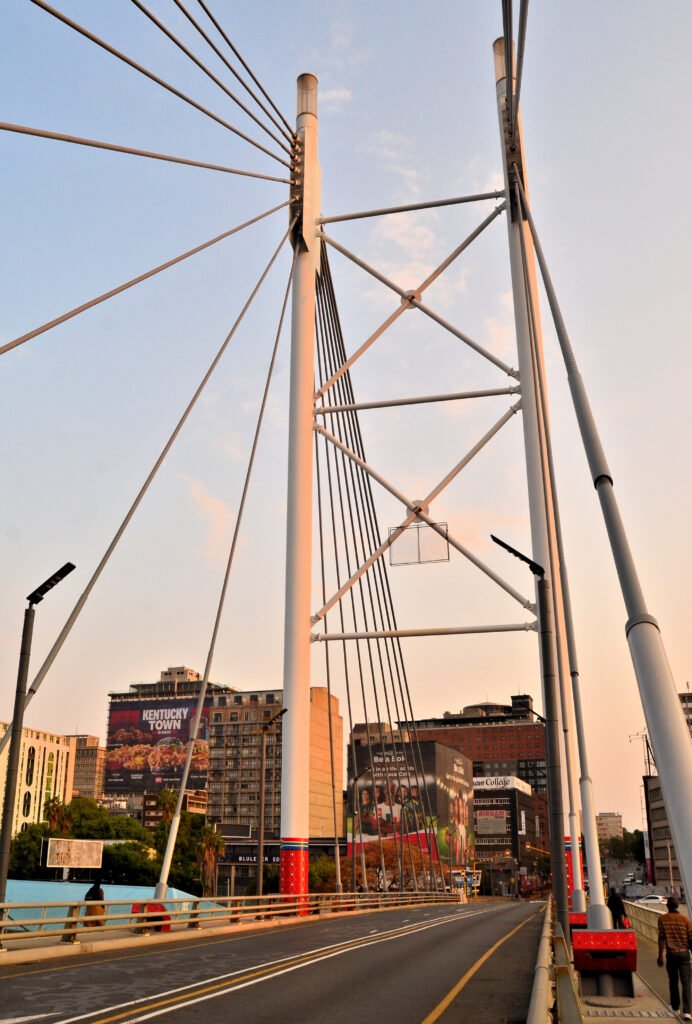
Johannesburg’s most recognizable modern landmark is the Nelson Mandela Bridge, a cable-stayed bridge opened in 2003 that links the Braamfontein district to Newtown across a wide expanse of railway lines. Named for South Africa’s first democratically elected president, the bridge has become one of the most frequently photographed symbols of the city’s post-apartheid skyline.
What Is Johannesburg Known For?
Johannesburg is known as South Africa’s economic engine and as a city shaped by the search for gold, from the historic mine dumps that still mark its skyline to museums such as the Apartheid Museum that document its more difficult history.
Why Johannesburg Matters
Johannesburg matters as the commercial and financial capital of South Africa and one of Africa’s most important economic centers, and as a city whose layout and institutions still bear the marks of the mineral discovery that created it and the segregation policies that shaped its growth.
Key Takeaways
- Johannesburg is South Africa’s largest city, founded in 1886 after the discovery of gold on the Witwatersrand.
- It grew rapidly from a mining camp into one of Africa’s major cities, without a natural river or harbor.
- The city was a center of apartheid-era segregation and resistance, including the 1976 Soweto uprising.
- Johannesburg is South Africa’s financial capital, home to the Johannesburg Stock Exchange, though Pretoria is the country’s administrative capital.
- The Nelson Mandela Bridge, opened in 2003, is Johannesburg’s most recognizable modern landmark.
Sources
- City of Johannesburg | official website | joburg.org.za
Key facts
- Johannesburg is South Africa's largest city, founded in 1886 after a gold discovery on the Witwatersrand.
- It is South Africa's financial capital, home to the Johannesburg Stock Exchange.1
- Pretoria, not Johannesburg, is South Africa's administrative capital.
- Soweto, on Johannesburg's outskirts, was the site of the 1976 student uprising against apartheid.
- The Nelson Mandela Bridge, opened in 2003, is the city's most recognizable modern landmark.
Quick checkIs Johannesburg the capital of South Africa?Show answer
No. Johannesburg is South Africa's largest city and financial capital, but Pretoria is the administrative capital, Cape Town the legislative capital, and Bloemfontein the judicial capital.
Sources
- City of Johannesburg. Official Website. Undated (accessed Accessed 2026-10-21)
Editorially reviewed by Specialty Digest Editorial TeamLast reviewed October 21, 2026Researched and drafted with AI assistanceReport an issue