Kampala is the capital and largest city of Uganda, built across a series of hills near the northern shore of Lake Victoria in south-central Uganda. Originally the royal and ceremonial heartland of the Buganda Kingdom, it became the administrative center of British colonial Uganda in the 1890s and has served as the country’s capital since Uganda’s independence in 1962.
Where Is Kampala Located?
Kampala sits in south-central Uganda, a few kilometers north of Lake Victoria’s shoreline, spread across more than twenty hills that give the city its characteristic undulating skyline. It is the seat of Uganda’s national government and the country’s commercial and administrative hub, governed today by the Kampala Capital City Authority (KCCA).[1]
A Brief History of Kampala
Before European contact, the hills now occupied by Kampala formed the royal and ceremonial core of the Kingdom of Buganda, one of the oldest and most centralized monarchies in the African Great Lakes region. The city’s name is widely said to derive from “Kasozi k’Empala,” Luganda for “hill of the impala,” after the antelope that grazed on one of its hills when a British colonial administrator established a fort there in the 1890s.
Colonial Administration and Independence
Britain built Kampala into the administrative and commercial center of the Uganda Protectorate, distinct from Entebbe, which served as the formal seat of colonial government on the shore of Lake Victoria. When Uganda became independent in 1962, Kampala was designated the national capital, and it has remained the country’s political and economic center ever since, while continuing to house the traditional seat of the Buganda Kingdom at Mengo.
Kampala Today: Government and Growth
Kampala is administered by the Kampala Capital City Authority, led by an appointed Executive Director and an elected Lord Mayor, with a Minister for Kampala sitting in Uganda’s national cabinet.[1] The city is also home to Makerere University, founded in 1922 and one of the oldest and most prominent universities in East Africa, and it has grown rapidly in recent decades into one of the largest urban centers in the African Great Lakes region.
The Kasubi Tombs
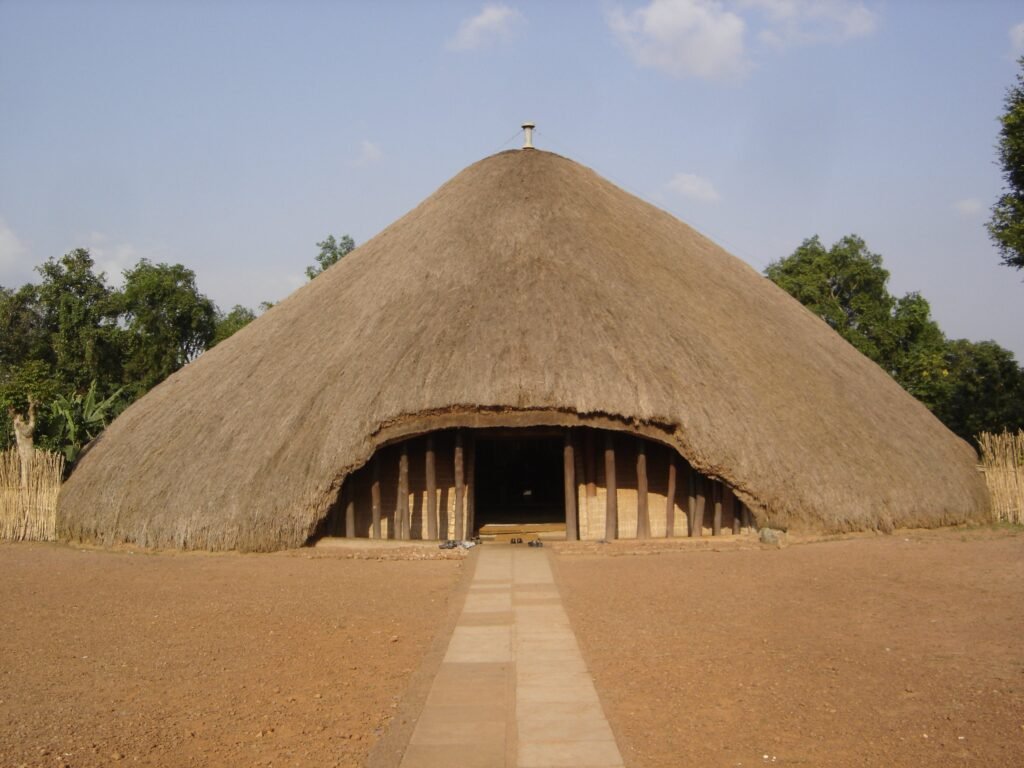
Kampala’s single most iconic site is the Kasubi Tombs, the burial grounds of four kings (kabakas) of Buganda, built on Kasubi Hill in 1882 as a royal palace before being converted into a royal burial site. Inscribed as a UNESCO World Heritage Site in 2001, the complex is centered on the Muzibu Azaala Mpanga, a large domed structure built from local organic materials in traditional Ganda architectural style, considered one of the most remarkable buildings of that technique anywhere in East Africa.[2] The main tomb building was severely damaged by fire in 2010, and its traditional reconstruction has continued since under heritage monitoring, underscoring the site’s continuing importance to Buganda’s royal tradition and to Uganda’s national heritage.
What Is Kampala Known For?
Beyond the Kasubi Tombs, Kampala is known as the seat of the Buganda Kingdom’s traditional institutions, including the Lubiri royal palace and the Bulange, Buganda’s parliament building, and as Uganda’s main commercial, educational and transportation hub.
Why Kampala Matters
Kampala matters as the political and economic heart of Uganda and as a living center of Buganda royal tradition, where a centuries-old African kingdom’s institutions continue to operate alongside the machinery of a modern national capital.
Key Takeaways
- Kampala is Uganda’s capital and largest city, built across hills near Lake Victoria in south-central Uganda.
- It grew from the royal heartland of the Buganda Kingdom into Uganda’s colonial and later national capital.
- Uganda became independent in 1962, with Kampala as its capital ever since.
- The city is governed by the Kampala Capital City Authority, led by an appointed Executive Director and an elected Lord Mayor.
- The Kasubi Tombs, a UNESCO World Heritage Site since 2001, are Kampala’s most iconic landmark and remain the royal burial ground of the Buganda kings.
Sources
- Kampala Capital City Authority | “About the Authority” | kcca.go.ug
- UNESCO World Heritage Centre | “Tombs of Buganda Kings at Kasubi” | whc.unesco.org/en/list/1022/
Key facts
- Kampala is Uganda's capital and largest city, built across hills near Lake Victoria.1
- It grew from the royal heartland of the Buganda Kingdom into Britain's colonial administrative center.2
- Uganda became independent in 1962, with Kampala as its capital ever since.
- The city is governed by the Kampala Capital City Authority, led by an Executive Director and an elected Lord Mayor.1
- The Kasubi Tombs, a UNESCO World Heritage Site since 2001, are Kampala's most iconic landmark.2
Quick checkWhat is the Kasubi Tombs site, and why is it significant to Kampala?Show answer
The Kasubi Tombs are the burial grounds of four kings of Buganda on Kasubi Hill, inscribed as a UNESCO World Heritage Site in 2001 and considered Kampala's most iconic landmark.
Sources
- Kampala Capital City Authority. About the Authority. Undated (accessed Accessed 2026-10-21)
- UNESCO World Heritage Centre. Tombs of Buganda Kings at Kasubi. Undated (accessed Accessed 2026-10-21)
Editorially reviewed by Specialty Digest Editorial TeamLast reviewed October 21, 2026Researched and drafted with AI assistanceReport an issue