In simple terms
A language family is a group of languages that all descend from one earlier language. Membership is a claim about history: these languages are relatives, not just neighbors that borrowed words from each other.
Glottolog, an academic catalogue of the world’s languages, sorts the 7,674 spoken first languages it listed as of March 2026 into 246 families plus 183 isolates, meaning languages with no known relatives.
How it works
Relatedness is argued from regular correspondences: sound-by-sound patterns and shared grammatical machinery too systematic to be chance or borrowing. From those patterns linguists reconstruct features of the common ancestor, and a family tree records which language split from which.
Family counts differ by publisher, and the gap is real rather than rounding. Ethnologue, published by SIL Global, counts 143 families. Glottolog counts 246 plus 183 isolates. The difference comes from where editors draw boundaries and how much evidence they demand, and Glottolog says plainly that for many groups there is little historical-comparative research, so its classification is a best guess that will change as scholarship grows. Read the totals as contested, and individual family membership as well supported where the comparative work exists.
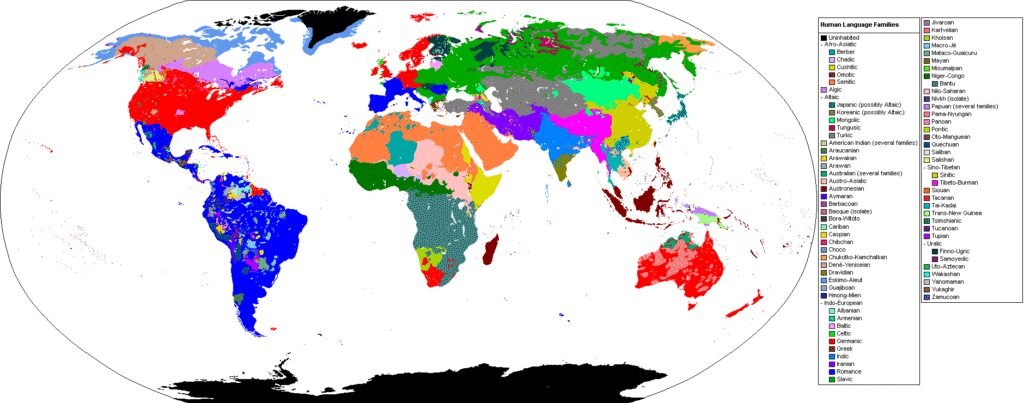
Scale is uneven. Ethnologue reports that six families, Niger-Congo, Austronesian, Trans-New Guinea, Sino-Tibetan, Indo-European and Afro-Asiatic, each contain at least 5 percent of the world’s languages, together account for nearly two thirds of all languages and cover five sixths of the world’s population. By speaker count, Indo-European and Sino-Tibetan lead with more than 4.8 billion speakers between them.
Why it matters
Family trees are one of the few records we have of prehistoric movement, so they feed archaeology and genetics as much as language teaching. They also carry a practical edge: dictionaries, literacy programs and translation tools are often built one family at a time, so a language in a small or poorly studied family waits longer for them.
Where you’ll see it
- World maps colored by language family
- Catalogues such as Glottolog and Ethnologue, which give each language an identifier
- Arguments about ancient migration and settlement
- Decisions about which languages get keyboards, spell checkers and machine translation
Example
English is classified as Indo-European and Mandarin Chinese as Sino-Tibetan, the two largest families by speaker count.
Often confused with
A family is not an isolate, which Glottolog treats as a one-member family, and not a group of languages that merely share a region or a script.
Key facts
- Glottolog listed 7,674 spoken first languages as of 2 March 2026, classified into 246 families and 183 isolates.1
- Ethnologue counts 143 language families, a materially different total from Glottolog's, because editors draw boundaries differently.2
- Glottolog states that for many language groups little historical-comparative research exists, so its classification is a best guess subject to change.1
- Six families account for nearly two thirds of all languages and cover five sixths of the world's population.2
- Indo-European and Sino-Tibetan are the largest families by speaker count, with more than 4.8 billion speakers between them.2
Related concepts
Quick checkWhat makes two languages members of the same family?Show answer
Descent from a shared ancestor language, shown by regular sound and grammar correspondences rather than borrowed words.
Sources
- Glottolog. About Languoids, Glottolog 5.3. Undated, figures dated 2 March 2026 (accessed Accessed 21 October 2026)
- Ethnologue, SIL Global. What are the largest language families?. Undated, 2026 edition (accessed Accessed 21 October 2026)
Editorially reviewed by Specialty Digest Editorial TeamLast reviewed October 21, 2026Researched and drafted with AI assistanceReport an issue