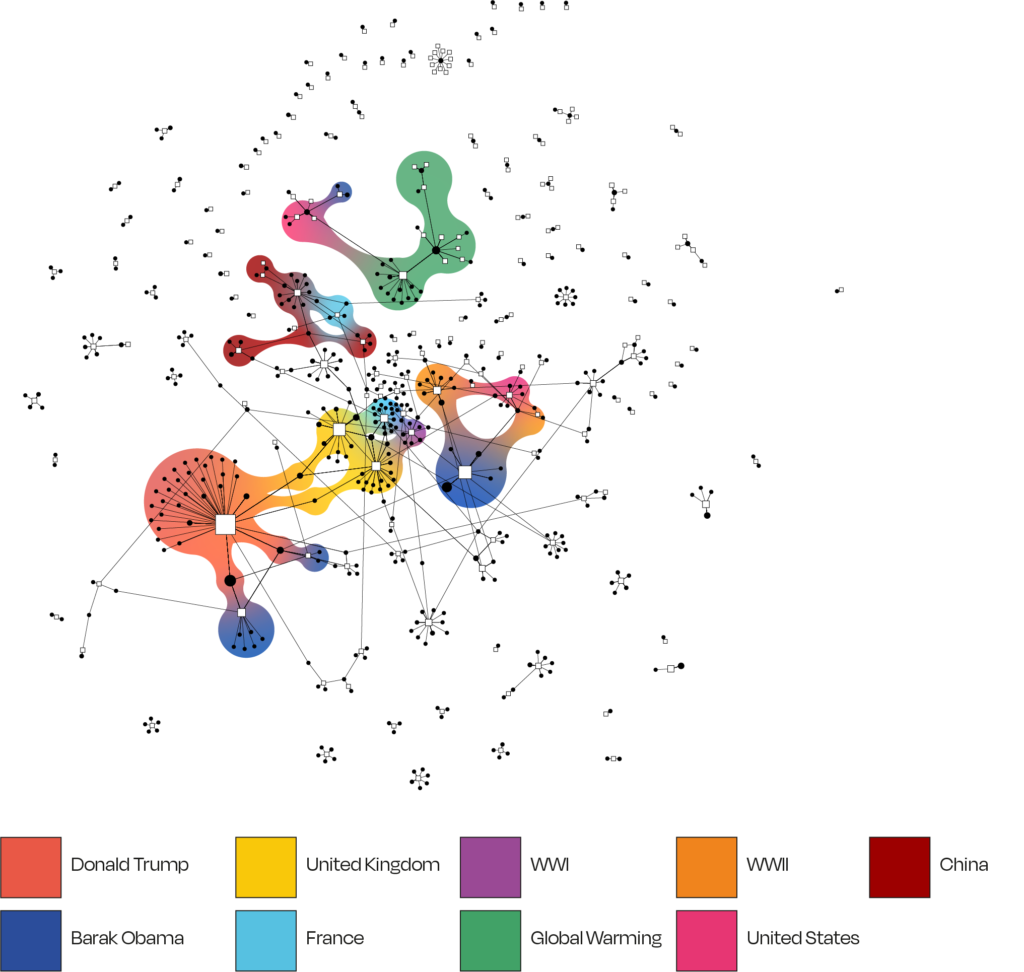
Linked data is a method of structuring and publishing data so that individual pieces of information are connected to related data across the web through standardized identifiers and relationship types, allowing both people and machines to follow connections between datasets.
The approach rests on a small set of principles: use web addresses, known as Uniform Resource Identifiers, to name things such as people, places, or concepts; make those identifiers resolvable so that looking them up returns useful information; and describe relationships between entities using a standard framework, most commonly the Resource Description Framework, so that statements like a particular book author is a particular person can be expressed in a machine-readable way that connects to other linked datasets describing that same person.
Library Applications
Libraries have been active adopters of linked data, particularly for authority records that identify people, organizations, and subjects consistently across catalogs. Projects to convert traditional library metadata formats into linked data aim to let a library catalog entry for an author connect directly to that same author entries in other libraries, archives, and general knowledge bases, rather than remaining an isolated text string that must be matched manually.
Relationship to the Semantic Web
Linked data is closely associated with the broader vision of the Semantic Web, an extension of the web in which data carries explicit meaning that software can process, not just display to human readers. Linked data provides the practical publishing method, using shared identifiers and vocabularies, through which this machine-readable web of meaning is built incrementally as more organizations publish their data in compatible form.
Challenges
Despite its technical promise, linked data adoption has been uneven, partly because converting legacy records into linked data form requires significant effort, and partly because the benefits only fully materialize once enough organizations participate to create a genuinely interconnected web of data rather than isolated islands using the same technical format without meaningful cross-linking.
Vocabularies and Standards
Publishing effective linked data requires using shared vocabularies, sets of agreed terms and relationship types, so that different organizations describe similar concepts in compatible ways. Widely used vocabularies in the cultural heritage sector include schemas for describing people, places, events, and bibliographic works, allowing a library linked data record to connect meaningfully with records published by museums, archives, or general knowledge bases using the same underlying vocabulary.
Economic Considerations
Converting existing catalog or archival data into linked data form requires significant upfront technical investment, including data modeling, software development, and quality review, which has slowed adoption at smaller institutions lacking dedicated technical staff. Some large national libraries and consortia have absorbed much of this cost by building shared infrastructure and tools that smaller institutions can then adopt at lower individual expense.
International Perspectives
Linked data adoption has progressed furthest among large national libraries and research institutions with substantial technical resources, while many smaller institutions and those in lower-resource settings have been slower to convert their metadata, creating an uneven global landscape in which some national collections are richly interconnected through linked data while others remain accessible mainly through traditional catalog search.
Practical Guidance
Institutions beginning a linked data project are generally advised to start with a focused pilot, such as converting authority records for people or subjects, rather than attempting to convert an entire catalog at once, since this allows staff to build expertise and demonstrate value before committing to a larger-scale conversion effort.
Looking Ahead
As more cultural heritage institutions, government agencies, and commercial organizations publish structured data in linked form, the overall density and usefulness of the linked data web continues to grow, with each new well-connected dataset increasing the potential value of all the datasets it links to, a dynamic sometimes described as a network effect.
Related Specialties
Linked data work overlaps with knowledge graph construction, ontology engineering, and metadata standards development, requiring practitioners to combine traditional cataloging and classification skills with newer technical competencies in data modeling and web technologies not traditionally part of library science training.
Querying Linked Data
Linked data is typically queried using a specialized query language designed for graph-structured data, allowing users to ask questions that traverse multiple relationships at once, such as finding all works by authors who were born in a particular city, in a single query, something considerably more cumbersome to express against a traditional relational database structured around fixed tables and columns.
This query flexibility is part of what makes linked data attractive for complex discovery scenarios, though it also requires specialized technical skills that differ from the query languages traditionally used in library and archival database systems, representing an additional training investment for staff adopting the technology.
Provenance and Trust
Because linked data allows anyone to publish statements about any entity, consumers of linked data must consider provenance, tracking which organization published a given statement and how trustworthy that source is, since the open, decentralized nature of linked data means not every connected statement carries equal reliability or authority.
Early Adoption in Government Data
Government open-data initiatives have also embraced linked data principles, publishing statistical and administrative datasets with persistent identifiers and standardized relationships, allowing researchers and developers to combine government data with other linked sources rather than working with isolated spreadsheet downloads that lack any connection to related datasets elsewhere.
These government linked-data initiatives have, in turn, encouraged further adoption by demonstrating practical, large-scale value beyond the academic and library contexts where linked data first gained traction.
Observers of the field generally expect this trend toward broader sector adoption to continue as publishing tools increasingly default to linked-data-compatible formats.
Key facts
- Array
Quick checkWhat makes linked data different from a traditional database record?Show answer
Linked data uses globally unique web identifiers and standardized relationship types so that a piece of information can be connected directly to related data in other datasets anywhere on the web, rather than being isolated inside one organization database.
Sources
- Array
Editorially reviewed by Specialty Digest Editorial TeamLast reviewed November 3, 2026Researched and drafted with AI assistanceReport an issue