Manchester is a city in northwest England that grew from a Roman fort into the world’s first major industrial city. Its rapid growth around cotton manufacturing in the eighteenth and nineteenth centuries made it a global symbol of the Industrial Revolution, and it later became a center of computing research and English football.
Where Is Manchester Located?
Manchester sits in Greater Manchester in northwest England, on the Rivers Irwell, Irk, and Medlock, inland from the Irish Sea. Its position close to the Pennine hills, which supplied both water power and a damp climate suited to cotton spinning, was central to its rise as an industrial center.
The Origins and History of Manchester
The Romans established a fort called Mamucium on the site around 79 CE, and a settlement grew around it through the medieval period as a market town. Manchester’s transformation began in the eighteenth century, when it became the leading center of Britain’s cotton textile industry, processing raw cotton imported largely from the United States into finished cloth on an industrial scale. By the nineteenth century, the city’s dense concentration of mills, warehouses, and factory labor had earned it the nickname Cottonopolis.
In 1819, a large crowd gathered in Manchester to demand parliamentary reform was charged by cavalry in what became known as the Peterloo Massacre, an event that killed several people and became a landmark moment in the British campaign for political reform. The Manchester Ship Canal, opened in 1894, gave the inland city direct access to the sea, reinforcing its role as an industrial and trading center even as cotton manufacturing itself eventually declined through the twentieth century.
Government and Economy
Manchester is governed as a city within Greater Manchester, which since 2017 has had a directly elected mayor overseeing transport, policing, and housing policy across the wider metropolitan area. The city’s economy, once built almost entirely on textiles, has diversified into finance, media, higher education, and technology, while retaining a strong manufacturing and engineering base in the wider region.
Culture and Daily Life in Manchester
Manchester holds a significant place in the history of computing: researchers at the University of Manchester built the Manchester Baby in 1948, one of the first electronic computers able to store and run a program in memory. The city is also widely known for its football clubs, Manchester United and Manchester City, and for a music scene that produced bands including Joy Division, The Smiths, and Oasis from the late twentieth century onward.
Manchester’s Most Famous Landmarks
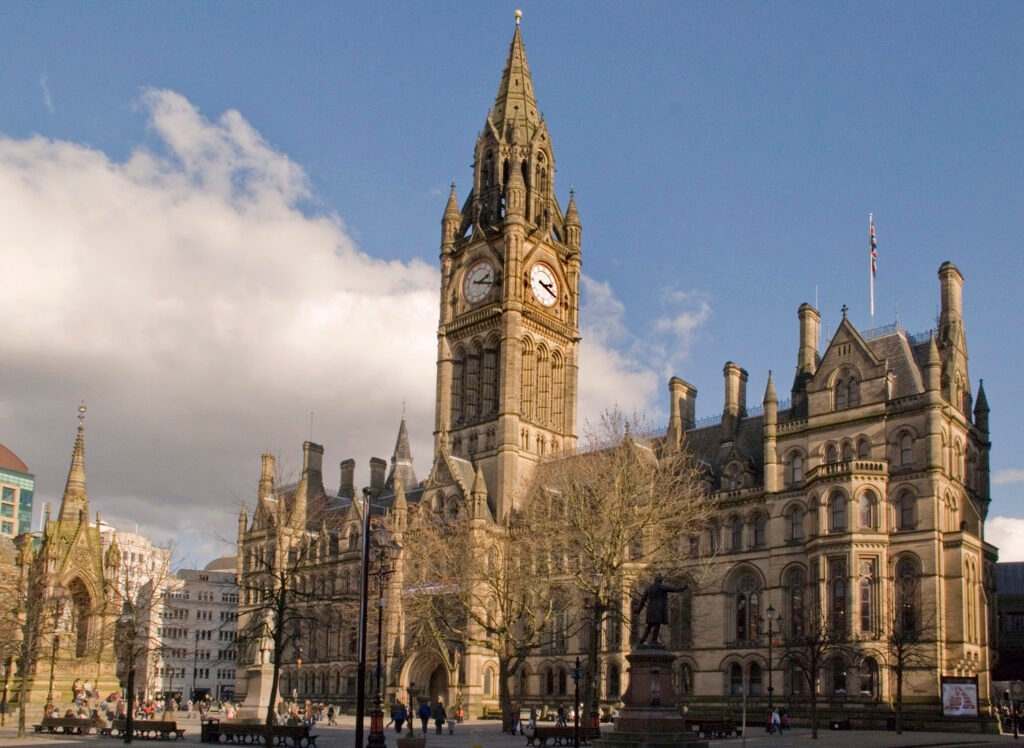
Manchester Town Hall, a Victorian Gothic building designed by architect Alfred Waterhouse and completed in 1877, remains the city’s most recognizable civic landmark, its clock tower rising above Albert Square in the city center. The Manchester Ship Canal and the restored Victorian warehouses of districts such as Castlefield still mark the city’s industrial history, while the Museum of Science and Industry documents the cotton trade and the Manchester Baby computer.
What Is Manchester Known For?
Manchester is known as the city where the Industrial Revolution’s factory system reached its most intense expression, for its two major football clubs, and for a music scene that shaped British popular culture from the 1970s onward. It is also known for Manchester Town Hall and for its role in early computer science.
Why Manchester Matters
Manchester matters as the city most closely associated with the rise of industrial capitalism, the factory system, and the social movements, including the campaign that followed the Peterloo Massacre, that responded to it. Its later contributions to computing and popular music extended that pattern of outsized global influence from a single mid-sized city.
Key facts
Quick checkWhy was Manchester nicknamed Cottonopolis?Show answer
Manchester earned the nickname because it became the world's leading center of cotton textile manufacturing during the Industrial Revolution.
Sources
- Encyclopaedia Britannica. Manchester. Undated (accessed Accessed 2026-10-06)
Editorially reviewed by Specialty Digest Editorial TeamLast reviewed October 6, 2026Researched and drafted with AI assistanceReport an issue