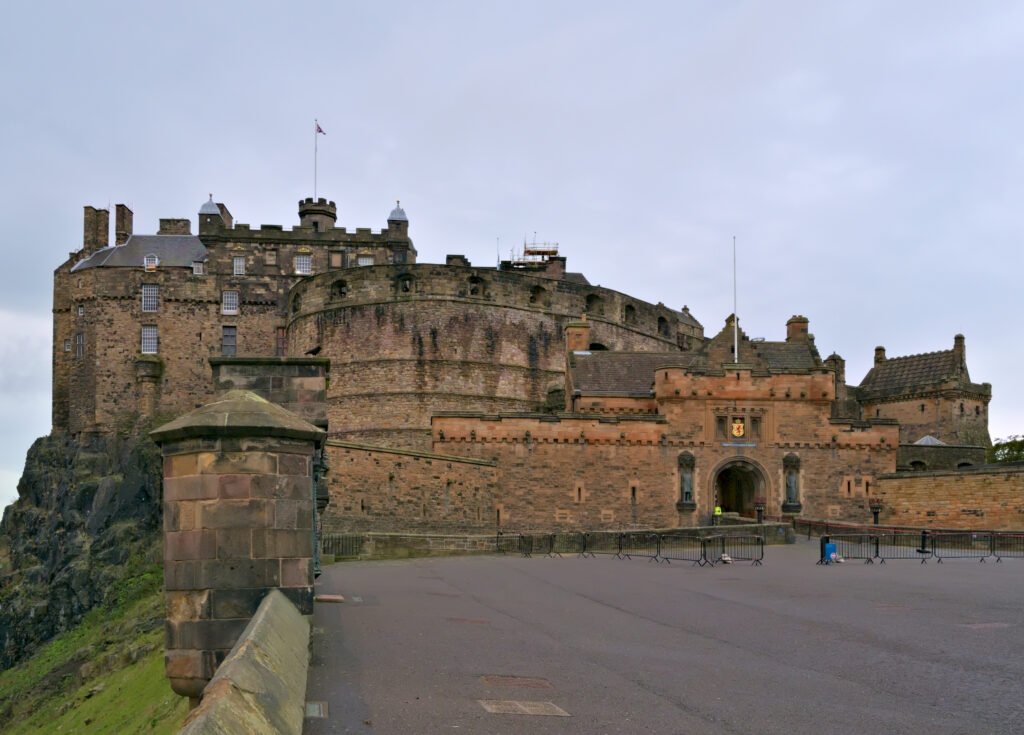
Edinburgh is the capital of Scotland, built around a volcanic rock formation that has supported a fortress since at least the Iron Age. It is best known for Edinburgh Castle, for the contrasting medieval Old Town and Georgian New Town that together form a UNESCO World Heritage Site, and for the Edinburgh Festival Fringe, the largest arts festival in the world.
Where Is Edinburgh Located?
Edinburgh sits on the southern shore of the Firth of Forth in southeastern Scotland, within the United Kingdom. The city is built across a series of hills and ridges formed by ancient volcanic activity, the most prominent of which, Castle Rock, carries Edinburgh Castle at its summit above the city center.
The Origins and History of Edinburgh
Castle Rock has been fortified since at least the Iron Age, and archaeological evidence points to settlement on the site reaching back further still. The city that grew up around it became an important royal center in medieval Scotland and was formally established as the kingdom’s capital by the fifteenth century, following centuries in which Scottish kings had used the castle as a residence and stronghold.
Edinburgh became a center of the Scottish Enlightenment in the eighteenth century, when thinkers including the philosopher David Hume and the economist Adam Smith worked in the city and helped make it one of Europe’s leading centers of intellectual life. In 1707, the Acts of Union merged the Scottish and English parliaments into a single Parliament of Great Britain based in London, ending Edinburgh’s role as home to an independent legislature. That changed again in 1999, when a devolved Scottish Parliament reconvened in Edinburgh for the first time in nearly three hundred years.
Government Today
Edinburgh is the seat of the Scottish Parliament and the Scottish Government, which hold devolved authority over areas including health, education, justice, and the environment within Scotland, while matters such as defense, foreign policy, and the overall constitution remain the responsibility of the UK Parliament in London. The city functions both as Scotland’s political capital and as a major finance and higher education center, anchored by the University of Edinburgh, founded in 1583.
Culture and Daily Life in Edinburgh
Edinburgh hosts the Edinburgh Festival Fringe each August, an open-access arts festival founded in 1947 that has grown into the largest arts festival in the world by number of performances, running alongside the more selective Edinburgh International Festival. The city’s Old Town, with its narrow medieval lanes, sits beside the New Town, a planned Georgian district of wide streets and classical architecture built from the 1760s onward, and the contrast between the two remains one of the most distinctive features of the urban landscape.
Edinburgh’s Most Famous Landmarks
Edinburgh Castle, perched on Castle Rock, houses the Honours of Scotland, the country’s crown jewels, and the Stone of Destiny, historically used in the coronation of Scottish and later British monarchs. The Royal Mile runs from the castle down to the Palace of Holyroodhouse, the monarch’s official residence in Scotland. In 1995, UNESCO inscribed the Old and New Towns of Edinburgh together as a single World Heritage Site, recognizing the two contrasting districts as a unified record of the city’s historical development.
What Is Edinburgh Known For?
Edinburgh is known for its castle on an ancient volcanic rock, for the planned Georgian New Town set against its medieval Old Town, and for the Festival Fringe each summer. It is also known as a center of the Scottish Enlightenment and as the home of Scotland’s devolved parliament.
Why Edinburgh Matters
Edinburgh matters as both a working seat of government and a largely intact record of several distinct periods of urban planning, from Iron Age fortification through medieval growth to deliberate Georgian design. Its role in the Scottish Enlightenment also gives it a lasting place in the history of European philosophy and economics.
Key facts
- Castle Rock has been fortified since at least the Iron Age1
- Became a center of the Scottish Enlightenment in the eighteenth century2
- Old and New Towns of Edinburgh inscribed as a UNESCO World Heritage Site in 19951
- Seat of the devolved Scottish Parliament, reconvened in 19993
- University of Edinburgh founded in 15832
Quick checkWhat is Edinburgh Castle built on?Show answer
Edinburgh Castle sits atop Castle Rock, an ancient volcanic formation that has been fortified since at least the Iron Age.
Sources
- UNESCO World Heritage Centre. Old and New Towns of Edinburgh. Undated (accessed Accessed 2026-10-06)
- Encyclopaedia Britannica. Edinburgh. Undated (accessed Accessed 2026-10-06)
- Scottish Government. About the Scottish Government. Undated (accessed Accessed 2026-10-06)
Editorially reviewed by Specialty Digest Editorial TeamLast reviewed October 6, 2026Researched and drafted with AI assistanceReport an issue