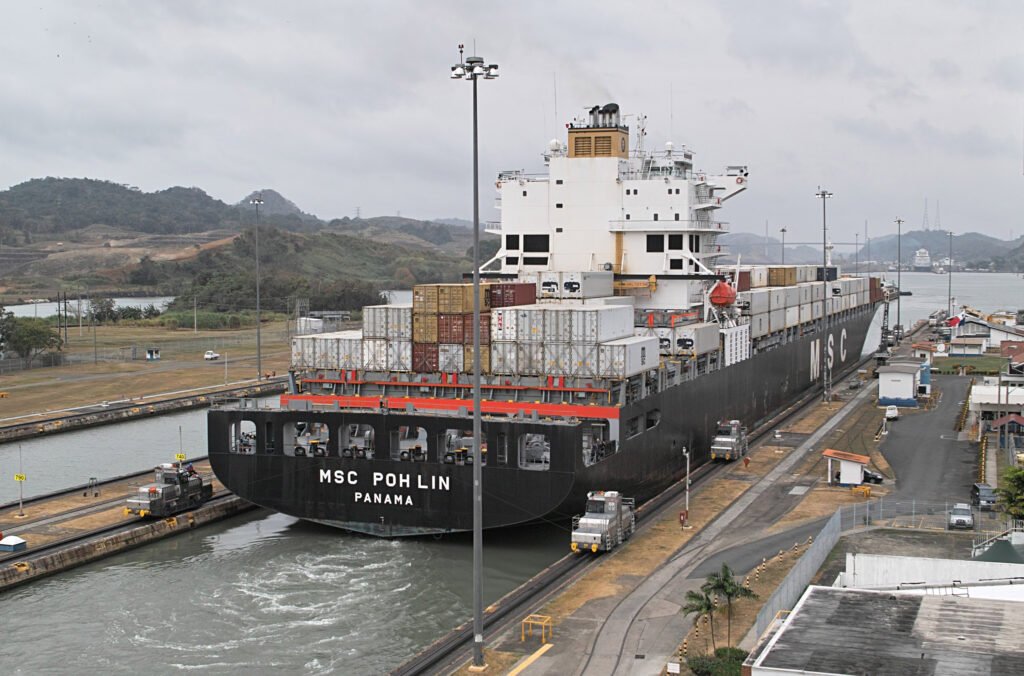
What Panamax Means
Panamax describes the maximum vessel length, width, and draft that can pass through the original locks of the Panama Canal. For decades, this size standard significantly influenced ship design, since shipping lines often built vessels as close as possible to the maximum Panamax dimensions to maximize cargo capacity while retaining the ability to transit the canal between the Atlantic and Pacific oceans.
Panama Canal Expansion and Neopanamax
A major expansion of the Panama Canal, completed in the 2010s, added a new set of larger locks, creating a bigger size class commonly called Neopanamax or New Panamax. This expansion allowed significantly larger container ships to transit the canal, reshaping shipping routes and vessel design standards that had been built around the original, smaller Panamax limits for most of the twentieth century.
Impact on Global Shipping Routes
The Panama Canal’s capacity constraints have historically shaped global trade routes, since vessels too large to fit through the canal must instead sail around South America or use alternative routes, adding significant time and cost. The canal expansion reduced this constraint for many vessels but did not eliminate size limits entirely, since even larger ships still exceed Neopanamax dimensions.
Other Canal Size Standards
Panamax is one of several canal-based vessel size standards in global shipping, alongside standards tied to other major waterways such as the Suez Canal. These size classifications remain useful shorthand in the shipping industry for describing a vessel’s general capacity and which major waterways and ports it can access.
Panama Canal History
The Panama Canal, completed in the early twentieth century after a famously difficult construction effort, dramatically shortened shipping routes between the Atlantic and Pacific oceans by eliminating the need to sail around the southern tip of South America, reshaping global shipping patterns from the moment it opened.
Canal Tolls and Transit Scheduling
Vessels transiting the Panama Canal pay tolls based on vessel size and cargo carried, with transit scheduling coordinated carefully given the canal’s limited lock capacity, and vessels sometimes facing significant wait times during periods of high transit demand or when drought conditions have required the canal authority to restrict vessel draft or transit frequency.
Neopanamax Vessels and Trade Patterns
The larger Neopanamax vessels enabled by the canal expansion have reshaped shipping patterns on major trade routes, particularly between Asia and the United States East Coast, allowing shipping lines to use larger, more cost-efficient vessels on routes that previously required either smaller Panamax ships or longer alternative routings.
Draft Restrictions and Water Levels
The Panama Canal’s capacity depends partly on adequate water levels in the lakes that feed its lock system, and periods of drought have at times forced canal authorities to impose draft restrictions limiting how heavily loaded vessels can be, directly affecting how much cargo ships can carry through the canal during such periods.
Panamax Ships Beyond the Canal
Even as larger vessels have become common on major trade routes, many Panamax-sized ships remain in active service, often redeployed to secondary trade routes or smaller ports that cannot accommodate the largest Neopanamax or ultra-large container vessels now common on the busiest global shipping lanes.
Competing Canal Routes
The Panama Canal competes with alternative shipping routes including the Suez Canal and, for some cargo, intermodal rail and trucking routes across land bridges, with shippers choosing among these options based on total transit time, cost, and reliability for their specific origin and destination combination.
Beyond Panamax: Alternative Size Classes
The expansion of the Panama Canal in 2016 introduced a new size class, often called Neopanamax or New Panamax, with locks able to accommodate vessels up to roughly forty-nine meters in beam and considerably greater length and draft than the original Panamax limits allowed. This expansion was driven largely by the container shipping industry’s shift toward ever-larger vessels, since pre-expansion Panamax container ships had become a shrinking share of the global container fleet as carriers ordered bigger ships to capture economies of scale on major trade routes. Other canal-driven size classes exist elsewhere, including Suezmax, defined by the draft and dimension limits of the Suez Canal, and Malaccamax, defined by the depth constraints of the Strait of Malacca, each shaping vessel design decisions for ships expected to transit those specific waterways regularly.
Design Trade-offs Within the Panamax Envelope
Naval architects designing a Panamax vessel must work within the fixed beam constraint while still maximizing cargo capacity, typically producing hull forms that are proportionally longer and narrower relative to their displacement than a non-canal-constrained vessel of similar carrying capacity would be. This narrower beam can affect a ship’s stability characteristics and its container stowage efficiency, since container ships in particular lose flexibility in how many containers can be arranged side by side across the deck compared with a wider post-Panamax hull. Shipowners ordering new Panamax-class vessels today do so primarily for trade routes and secondary canals where the Panamax envelope still represents the practical size ceiling, rather than for the main Panama Canal trade itself, which has shifted decisively toward Neopanamax tonnage since the locks expansion opened.
Shipyards building Panamax and Neopanamax vessels must also account for drydock and crane capacity limits at their own facilities, since constructing a hull near the upper bound of a size class requires infrastructure capable of handling its dimensions throughout the build process.
Insurance underwriters and port authorities also track vessel size classes closely, since Panamax and Neopanamax dimensions directly inform berth allocation, pilotage requirements, and tug assistance planning at terminals handling these vessels.
Charter party agreements for Panamax vessels often specify canal transit as a contractual condition, affecting voyage routing decisions.
Key facts
- Array
Quick checkWhy did Panamax become such an important ship size standard?Show answer
Because it defined the largest vessel size that could pass through the Panama Canal, shipping lines designed many vessels specifically to this maximum size to maximize cargo capacity while retaining canal access.
Sources
- Array
Editorially reviewed by Specialty Digest Editorial TeamLast reviewed November 4, 2026Researched and drafted with AI assistanceReport an issue