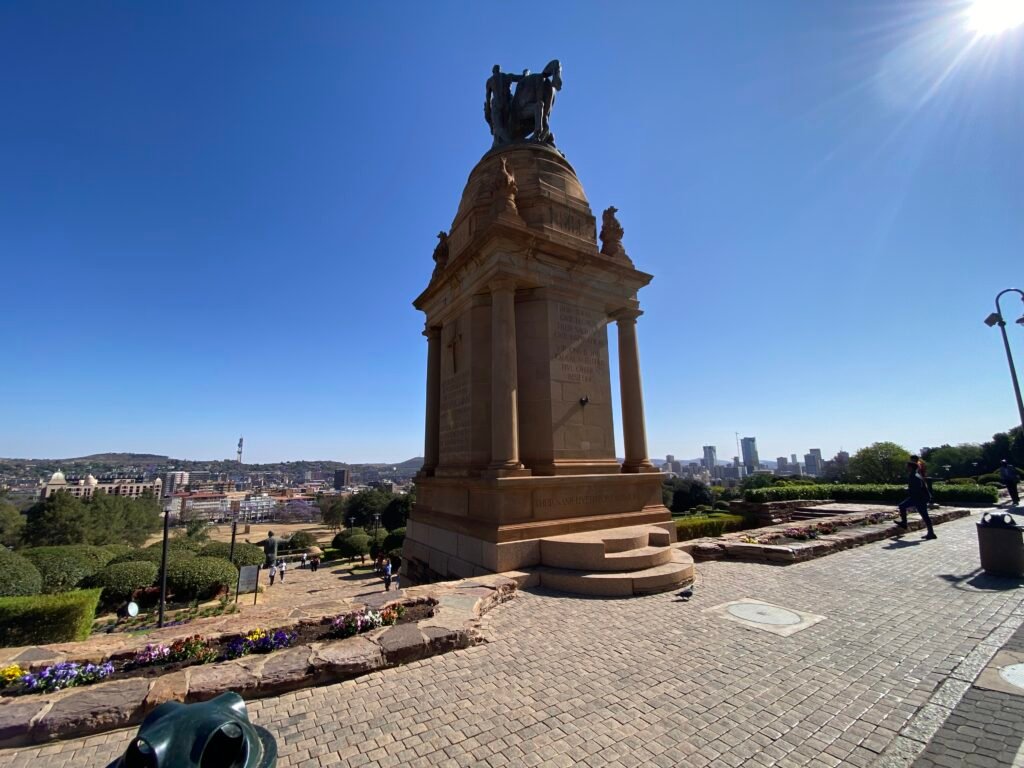
Pretoria is South Africa’s administrative capital, seat of the national executive government, located in Gauteng province a short distance north of Johannesburg. Founded in 1855 and named for Boer leader Andries Pretorius, it became the capital of the Transvaal Republic and, after the 1910 Union of South Africa, the country’s executive seat of government.
Where Is Pretoria Located?
Pretoria lies in Gauteng province in northeastern South Africa, part of the City of Tshwane metropolitan municipality, roughly 50 kilometers north of Johannesburg within the same broader urban region.
A Brief History of Pretoria
Pretoria was founded in 1855 and named after Andries Pretorius, a Boer military and political leader, becoming the capital of the South African Republic, also known as the Transvaal, in 1860. After the Second Boer War and the 1910 formation of the Union of South Africa, Pretoria was designated the country’s administrative capital, a role it has held ever since, while Cape Town and Bloemfontein serve as the legislative and judicial capitals respectively.[1]
A City of Government and Jacarandas
Because it houses the offices of the President and the national executive, Pretoria’s identity has long been tied to government administration. It is also widely nicknamed the “Jacaranda City” for the tens of thousands of purple-flowering jacaranda trees planted along its streets, which bloom each year in the Southern Hemisphere spring.
The Union Buildings
Pretoria’s single most iconic landmark is the Union Buildings, the official seat of the South African government, completed in 1913 to a design by the British architect Sir Herbert Baker. Built from sandstone in a sweeping amphitheater form overlooking terraced gardens, the complex is where Nelson Mandela was inaugurated as South Africa’s first democratically elected president in 1994, and where his body lay in state after his death in 2013.
Pretoria Today
Pretoria functions primarily as a seat of government and a major educational center, home to the University of Pretoria, one of South Africa’s largest universities, as well as numerous foreign embassies given its role as the country’s diplomatic capital.
What Is Pretoria Known For?
Pretoria is known chiefly for the Union Buildings and for its role as the administrative heart of the South African government, as well as for its jacaranda-lined avenues and its universities.
Why Pretoria Matters
Pretoria matters as the seat of South Africa’s national executive government and as the site, in the Union Buildings, of some of the country’s most significant political moments, from the Union of 1910 to Mandela’s 1994 inauguration.
Key Takeaways
- Pretoria is South Africa’s administrative capital, seat of the national executive government.
- It was founded in 1855 and named after Boer leader Andries Pretorius.
- Pretoria became capital of the Transvaal Republic in 1860 and South Africa’s administrative capital after the 1910 Union.
- The Union Buildings, completed in 1913, are Pretoria’s most iconic landmark and the official seat of government.
- Nelson Mandela was inaugurated as president at the Union Buildings in 1994.
Sources
- South African Government | “About Government” | gov.za/about-government
Key facts
- Pretoria is South Africa's administrative capital, seat of the national executive government.1
- It was founded in 1855 and named after Boer leader Andries Pretorius.
- Pretoria became capital of the Transvaal Republic in 1860 and South Africa's administrative capital after the 1910 Union.
- The Union Buildings, completed in 1913, are Pretoria's most iconic landmark.
- Nelson Mandela was inaugurated as president at the Union Buildings in 1994.
Quick checkWhat role does Pretoria play among South Africa's capital cities?Show answer
Pretoria is South Africa's administrative capital, housing the national executive government, while Cape Town is the legislative capital and Bloemfontein the judicial capital.
Sources
- South African Government. About Government. Undated (accessed Accessed 2026-10-21)
Editorially reviewed by Specialty Digest Editorial TeamLast reviewed October 21, 2026Researched and drafted with AI assistanceReport an issue