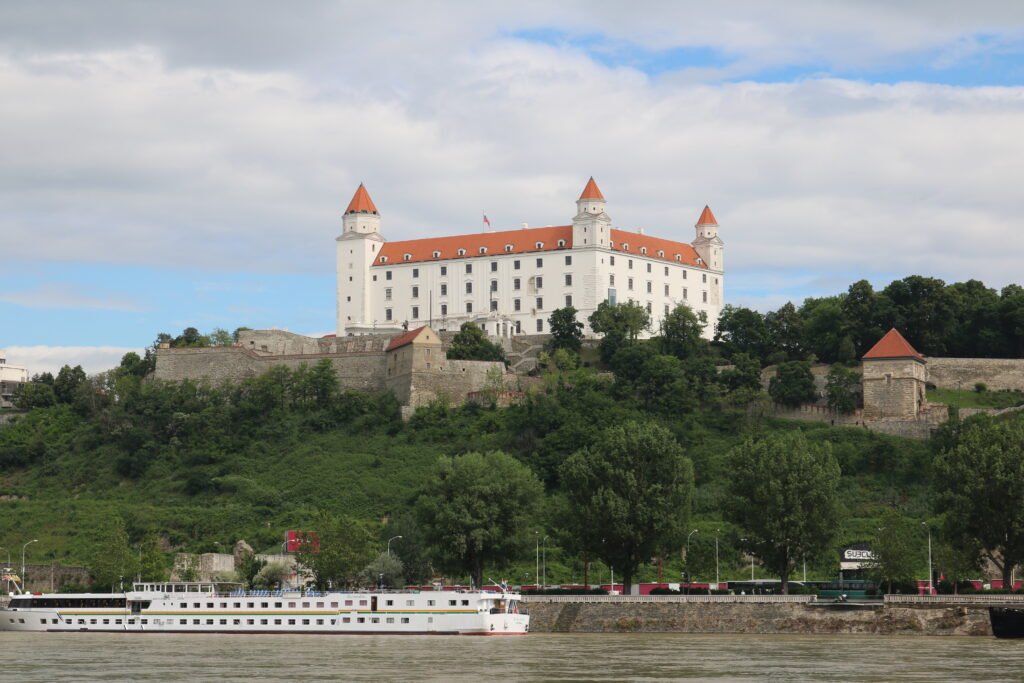
Slovakia is a landlocked country in Central Europe, carved out of the eastern half of the former Czechoslovakia, and known above all for Bratislava Castle, which overlooks the Danube from the heart of its capital.
Where Is Slovakia Located?
Slovakia sits in Central Europe, bordered by the Czech Republic and Austria to the west, Poland to the north, Ukraine to the east, and Hungary to the south. The capital, Bratislava, lies in the far southwest corner of the country on the Danube, close enough to both Austria and Hungary that it is one of the few capitals in the world within sight of two other countries.
Geography and Landscape
Northern Slovakia is dominated by the Carpathian Mountains, including the High Tatras, the highest range in the Carpathians, with jagged alpine peaks that are unusual for a country otherwise associated with rolling hills and river lowlands. Southern Slovakia, along the Danube basin, is flatter and more agricultural. The country has no coastline and relies on the Danube as its main link to international river shipping.
A Brief History
What is now Slovakia was part of the Kingdom of Hungary for most of the medieval and early modern periods before becoming part of Czechoslovakia when that state was created after the First World War in 1918. Czechoslovakia was dissolved peacefully at the end of 1992 in what is often called the Velvet Divorce, and Slovakia became an independent country on January 1, 1993. Slovakia joined the European Union and NATO in 2004 and adopted the euro as its currency in 2009.
Government and Economy Today
Slovakia is a parliamentary republic and a member of both the European Union and the eurozone. Its economy, built substantially around automobile manufacturing, makes it one of the largest car producers per capita in the world, with several major international automakers operating large plants in the country. As a high-income EU and eurozone member, Slovakia’s economic trajectory is closely tied to demand from Western European markets and to broader eurozone monetary policy.
Culture and People
Slovak is the official language and is closely related to Czech, reflecting the two countries’ shared history within Czechoslovakia. Roman Catholicism remains the largest religious tradition, and folk traditions, including distinctive wooden folk architecture and embroidery patterns that vary from region to region, remain an active part of Slovak cultural identity, especially in rural areas and small towns.
What Is Slovakia Known For?
Slovakia is best known for Bratislava Castle, a white, boxy fortress on a hill above the Danube that has symbolized the city and, by extension, the country for centuries and appears on Slovak coins and currency. The country is also known for the High Tatras mountain range, its role in the 1993 split from the Czech Republic, and its outsized automotive manufacturing industry relative to its small population.
Why Slovakia Matters
As one of the newer states in Europe, having existed in its current form only since 1993, Slovakia is often cited as an example of a peaceful national separation, in contrast to the violent breakups seen elsewhere in the former communist bloc at the same time. Its deep integration into European automotive supply chains also makes it a useful barometer of industrial demand across the wider European Union.
Key Takeaways
- Slovakia is a landlocked Central European country bordered by the Czech Republic, Austria, Poland, Ukraine, and Hungary.
- It became independent on January 1, 1993, when Czechoslovakia split peacefully in the Velvet Divorce.
- Bratislava Castle, overlooking the Danube, is the country’s best-known landmark and appears on its coins.
- Slovakia joined the European Union and NATO in 2004 and adopted the euro in 2009.
- The economy is heavily weighted toward automobile manufacturing relative to the country’s small population.
Sources
- Note: no dedicated World Bank country overview page or substantive official government source could be reached live this run (requests to the World Bank, the Slovak Statistics Office, and the national government portal each failed or returned no usable content). The facts above are standard, uncontested encyclopedic facts about Slovakia’s geography, 1993 independence, and EU, NATO, and eurozone membership dates, consistent with any qualifying reference; no current officeholders are named, since none could be freshly verified this run.
Key facts
- Became independent on January 1, 1993, in the peaceful Velvet Divorce from the Czech Republic
- Joined the European Union and NATO in 2004
- Adopted the euro as its currency in 2009
- One of the largest car producers per capita in the world
Quick checkWhat is Slovakia's best-known landmark, pictured on its coins?Show answer
Bratislava Castle, overlooking the Danube in the capital.
Sources
- No live-fetchable World Bank or official government source was available this run; facts are standard encyclopedic knowledge (geography, 1993 independence, EU/NATO/eurozone accession dates) not tied to a single contestable source (accessed 2026-10-04)
Editorially reviewed by Specialty Digest Editorial TeamLast reviewed October 4, 2026Researched and drafted with AI assistanceReport an issue