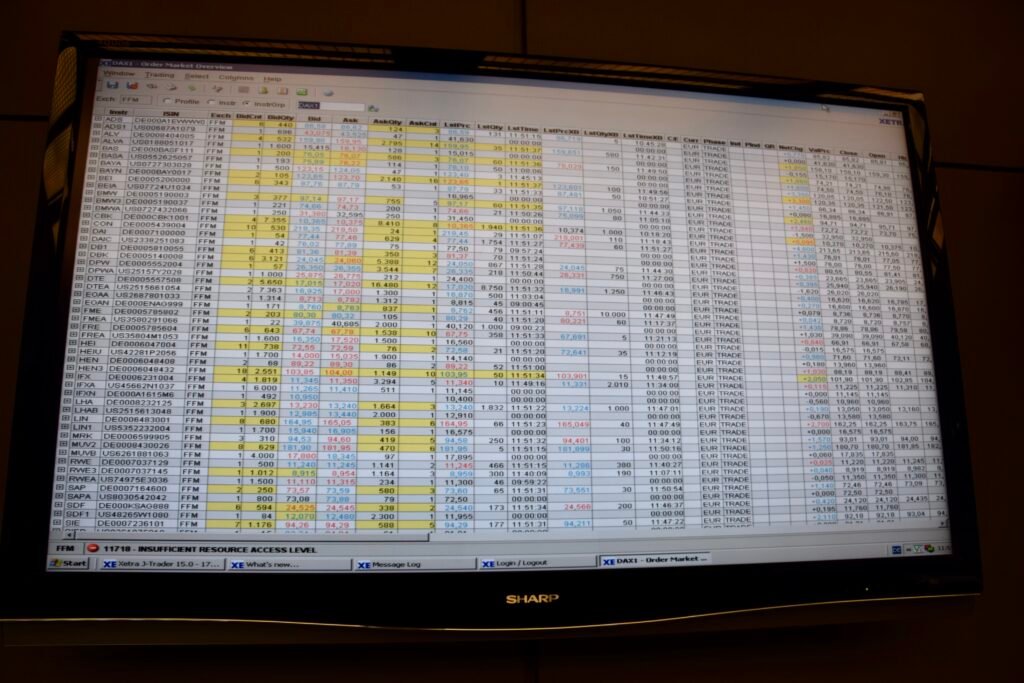
Supply and demand is the economic model describing how the price and quantity of a good or service are determined by the interaction of buyers and sellers in a market. It is one of the most fundamental frameworks in economics, used to explain everything from grocery prices to housing markets to the price of oil.
The law of demand
The law of demand states that, holding other factors constant, the quantity of a good consumers are willing to buy falls as its price rises, and rises as its price falls. Plotted on a graph with price on the vertical axis and quantity on the horizontal axis, this relationship produces a downward-sloping demand curve. The intuition is straightforward: as something becomes more expensive, buyers substitute toward cheaper alternatives or simply buy less of it.
The law of supply
The law of supply works in the opposite direction: holding other factors constant, the quantity producers are willing to sell rises as price rises, and falls as price falls. This produces an upward-sloping supply curve. Higher prices make it more profitable for producers to bring additional units to market, including from producers whose costs are higher and who would not participate at a lower price.
Market equilibrium
The point where the supply curve and demand curve intersect is called market equilibrium. At this price, the quantity buyers want to purchase exactly matches the quantity sellers want to offer, so there is no inherent pressure for price to rise or fall further. If the price is set above equilibrium, a surplus results, quantity supplied exceeds quantity demanded, and unsold inventory tends to push the price back down. If the price is set below equilibrium, a shortage results, and competition among buyers tends to push the price back up.
Shifts versus movements along the curve
Economists distinguish between a movement along an existing curve, caused purely by a price change, and a shift of the entire curve, caused by some other factor changing. Demand can shift due to changes in consumer income, tastes, population, or the price of substitute and complementary goods. Supply can shift due to changes in production costs, technology, the number of sellers, or input prices. A shift in either curve moves the equilibrium price and quantity to a new point, distinct from simply moving along the original curve.
Elasticity
Not all goods respond to price changes the same way. Elasticity measures how sensitive quantity demanded or supplied is to a change in price. Necessities such as insulin tend to have inelastic demand, meaning quantity purchased changes relatively little even when price rises sharply, because buyers have few substitutes. Luxury goods and goods with many close substitutes tend to have more elastic demand, where small price increases cause buyers to switch away in larger numbers.
Historical articulation and real-world examples
Adam Smith’s 1776 book The Wealth of Nations is often cited as an early articulation of how prices coordinate the independent decisions of buyers and sellers, though the formal graphical supply-and-demand apparatus used today was developed by economists in the 19th century, most notably Alfred Marshall. Real-world supply shocks illustrate the model clearly: when oil-producing nations restrict output, the supply curve shifts left, and prices rise even though nothing about consumer demand has changed. Housing markets in supply-constrained cities show a similar dynamic, where limited new construction keeps the supply curve steep relative to a growing population’s demand.
Price controls and their effects
Governments sometimes intervene directly in markets through price controls. A price ceiling, a maximum legal price set below equilibrium, such as rent control, tends to create persistent shortages because quantity demanded at the artificially low price exceeds quantity supplied. A price floor, a minimum legal price set above equilibrium, such as agricultural price supports or a minimum wage, tends to create persistent surpluses, including unsold crops or reduced hiring, because quantity supplied exceeds quantity demanded at the elevated price.
Market disequilibrium in practice
Markets rarely sit at a perfect, static equilibrium for long; new information, weather events, policy changes, and shifting tastes constantly nudge supply and demand curves in one direction or another. Economists describe this as a continuous process of adjustment rather than a single fixed outcome. A sudden freeze that damages an orange crop shifts the supply curve for orange juice left, raising prices even though nothing about how much juice people want to drink has changed. Conversely, a viral social media trend that makes a particular sneaker fashionable shifts its demand curve right, raising both price and quantity sold until production catches up.
Consumer and producer surplus
The supply and demand framework also explains the concept of economic surplus, the total benefit markets generate for participants. Consumer surplus is the difference between what buyers would have been willing to pay and what they actually pay at the equilibrium price. Producer surplus is the difference between the price sellers receive and the minimum price at which they would have been willing to sell. Economists often point to the sum of these two surpluses, maximized at the free-market equilibrium absent other distortions, as one argument for why markets tend to allocate resources efficiently when functioning well.
FAQs
What happens to equilibrium price if demand increases but supply stays the same? The demand curve shifts right, and both the equilibrium price and equilibrium quantity rise.
Why do price ceilings tend to cause shortages? Because the price is held below the level where supply and demand would naturally balance, so more buyers want the good than sellers are willing to provide at that price.
Key facts
- The law of demand holds that, other things equal, a price rise reduces quantity demanded; the law of supply holds that a price rise increases quantity supplied; the point where the two curves intersect is called market equilibrium; the model is foundational to classical economics, with roots often traced to Adam Smith's 1776 The Wealth of Nations.
Related concepts
In the news
Quick checkWhat is market equilibrium in the supply and demand model?Show answer
The price and quantity at which the supply curve and demand curve intersect, where the amount producers want to sell equals the amount consumers want to buy.
Sources
- Wikipedia (Law of demand); Smith, The Wealth of Nations (1776); standard introductory economics textbooks
Editorially reviewed by Specialty Digest Editorial TeamLast reviewed November 2, 2026Researched and drafted with AI assistanceReport an issue