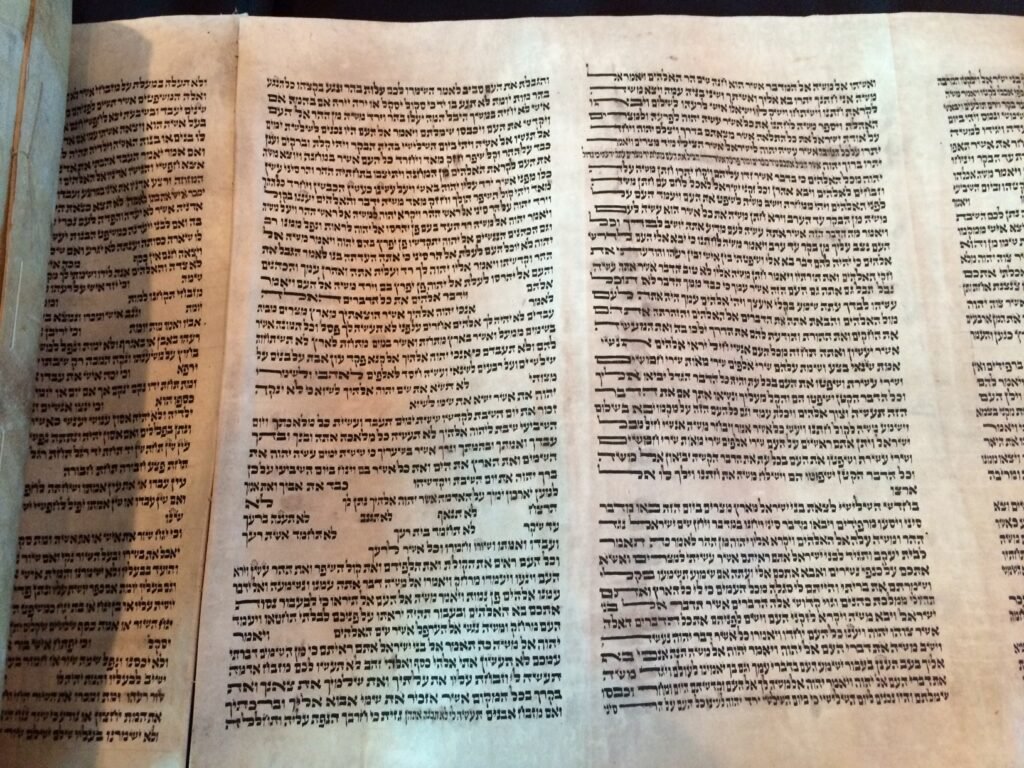
Overview
The Torah is the central and most sacred text of Judaism, comprising the first five books of the Hebrew Bible: Genesis, Exodus, Leviticus, Numbers, and Deuteronomy. Traditionally understood as having been revealed by God to Moses at Mount Sinai, the Torah occupies a place of unparalleled authority within Jewish religious life, serving as the foundation for Jewish law, theology, and communal identity.
Contents and Structure
The Torah narrates the creation of the world, the stories of the patriarchs and matriarchs, the enslavement and exodus of the Israelites from Egypt, the giving of the law at Sinai, and the wilderness journey toward the promised land. Interwoven with this narrative is an extensive body of legal and ethical instruction, covering matters ranging from ritual practice to civil and criminal law.
Transmission and Scribal Tradition
Torah scrolls used in synagogue worship are copied by hand according to exacting scribal standards, preserved and transmitted through a specialized tradition of trained scribes known as sofrim. This meticulous copying process has helped maintain a remarkably consistent text across many centuries and widely dispersed Jewish communities.
Interpretation and Commentary
Jewish tradition places enormous weight on the interpretation of the Torah, producing an extensive body of commentary, legal analysis, and homiletical reflection across many centuries, from ancient rabbinic literature through medieval and modern scholarship. This interpretive tradition, often called the Oral Torah, is considered by many within Judaism to be inseparable from the written text itself.
Liturgical Use
The Torah is read publicly in the synagogue according to a structured annual or triennial cycle, with the text divided into weekly portions studied and discussed by congregations around the world. This practice ensures that observant Jews engage repeatedly and systematically with the entire text over the course of each year, reinforcing its centrality to communal religious life.
Role Today
The Torah remains the foundational text of Jewish religious identity, studied intensively in religious schools, seminaries, and congregational settings, and continuing to shape Jewish law, ethics, and practice worldwide. Its influence also extends well beyond Judaism, having profoundly shaped the development of Christianity and, to a lesser extent, Islam.
Manuscript Tradition
The text of the Torah has been preserved through an exceptionally rigorous manuscript tradition. Scribes trained in the discipline of sofrut follow detailed rules governing letter formation, column width, and spacing, with a single error in certain passages sufficient to disqualify an entire scroll from ritual use. This precision has kept the consonantal text remarkably stable across many centuries and across distant Jewish communities that had little direct contact with one another.
Alongside the consonantal text, a system of vowel markings and cantillation signs known as the Masoretic tradition was developed in the first millennium of the common era to standardize pronunciation and chanting. Masoretic scholars also added marginal notes recording variant readings and statistical checks designed to safeguard the accuracy of future copies, producing one of the most carefully monitored textual traditions from the ancient world.
Division into Portions
For liturgical purposes, the Torah is divided into weekly portions read in sequence over the course of a year in synagogue services, with the full cycle completed and restarted annually during the festival of Simchat Torah. Communities following different calendrical customs sometimes divide the text into a longer triennial cycle instead. This structured public reading has long served as a central mechanism for transmitting the text to each new generation.
Comparative Religious Context
Because the Torah forms the opening section of the wider Hebrew scriptures and is also incorporated into the Christian Old Testament, it occupies a position of shared significance across multiple religious traditions, even as each tradition approaches its interpretation and legal authority differently. Islamic tradition likewise recognizes earlier revelation given to Moses, drawing a connecting thread across the Abrahamic religions while maintaining distinct doctrinal emphases.
Legal Content
Much of the Torah consists of legal material covering ritual practice, civil regulation, and ethical conduct, traditionally counted by rabbinic scholars as containing 613 distinct commandments. These laws address matters ranging from dietary regulation and festival observance to property disputes and social justice provisions, forming the foundation on which later rabbinic legal development was built across many subsequent centuries of interpretation and application.
Jewish legal tradition treats the written Torah as inseparable from an accompanying oral tradition of interpretation, later recorded in works such as the Mishnah and Talmud. This relationship between written text and ongoing interpretive tradition allowed Jewish law to adapt to changing circumstances while maintaining continuity with its foundational scriptural source across a long and varied history.
Modern biblical scholarship has examined questions of composition history through methods such as source criticism, which explores how distinct textual strands may have been combined into the text as it exists today. These academic approaches exist alongside, and often in productive tension with, traditional religious accounts of the text origin, and both continue to shape rich and active scholarly conversation.
Education centered on the Torah begins early in Jewish communities, with structured study continuing throughout life in many traditional settings. This emphasis on lifelong engagement with the text reflects a broader cultural value placed on learning and interpretation as central religious activities in their own right, not merely preparatory steps toward some other form of practice.
It remains a wellspring for ongoing religious reflection and communal identity.
Communities around the world continue to draw renewed insight from careful, repeated reading of its narratives and laws.
It remains the single most studied document within Jewish tradition as a whole.
It continues to shape law, ethics, and worship across the full breadth of the Jewish world today without interruption.
Key facts
- Array
Quick checkWhat distinguishes the Torah from the rest of the Hebrew Bible?Show answer
The Torah refers specifically to the first five books of the Hebrew Bible, traditionally understood as the direct revelation given to Moses at Mount Sinai and carrying the highest level of sanctity and authority within Judaism, whereas the remaining books of the Hebrew Bible, the Prophets and the Writings, are regarded as divinely inspired but theologically secondary to the Torah itself.
Sources
- Array
Editorially reviewed by Specialty Digest Editorial TeamLast reviewed November 4, 2026Researched and drafted with AI assistanceReport an issue