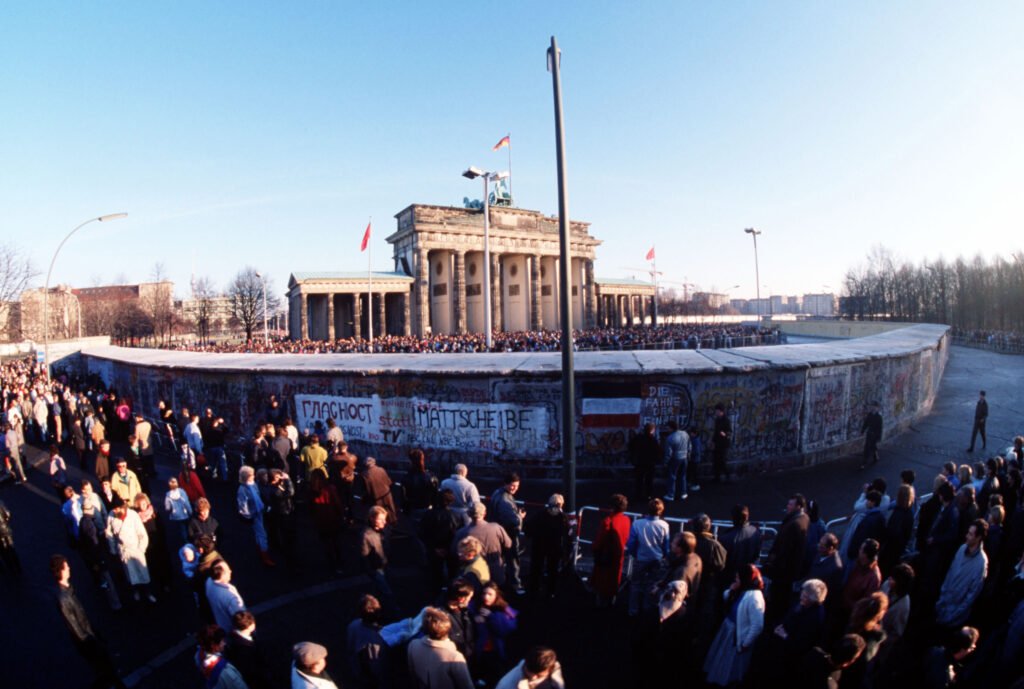
The Berlin Wall didn’t fall because any government decided to open it. It fell because a confused answer to a reporter’s question, on the night of November 9, 1989, collided with years of Soviet retreat, mass defections and street protests that had already pushed East Germany to the edge. The popular image is a triumphant, planned moment of liberation. What actually happened was messier, and stranger — a bureaucratic mistake that a crowd took literally before anyone could correct it.
How Moscow’s grip loosened years before the Wall came down
The chain of events stretches back to 1985, when Soviet leader Mikhail Gorbachev introduced glasnost (openness) and perestroika (restructuring) to save a stagnating Soviet economy. Those policies had an unintended consequence far beyond Soviet borders: Gorbachev signaled that Moscow would no longer send tanks to prop up unpopular communist governments elsewhere in Eastern Europe, a sharp break from the precedents set by Soviet military crackdowns in Hungary in 1956 and Czechoslovakia in 1968. That single shift in Soviet policy mattered enormously, because it meant East Germany could no longer count on Moscow to save it from its own people. Without the guarantee of Soviet military backing, East Germany’s aging leadership under Erich Honecker found itself increasingly isolated as reform movements gained ground next door in Poland and Hungary.
The first hole in the Iron Curtain opened in Hungary, not Berlin
In May 1989, Hungary began dismantling its own border fortifications with Austria, and by August it allowed East German vacationers to cross into the West rather than forcing them home. That decision turned Hungary into an escape valve: tens of thousands of East Germans used Hungary, and later Czechoslovakia, as a route west that summer and fall, a hemorrhage of skilled workers and young families that East Germany’s government could neither stop nor explain away. Every family that left made the ones still living under the regime ask, more openly, why they were staying, and every empty desk at a factory or classroom was a fact the government couldn’t paper over with a broadcast.
While some fled, others stayed and marched
Starting in September 1989, weekly “Monday Demonstrations” in Leipzig grew from a few hundred participants to crowds estimated at several hundred thousand by early November, with protesters chanting “Wir sind das Volk” (“We are the people”) — a direct challenge to a government that claimed to rule in the people’s name. The scale of the demonstrations, combined with Gorbachev’s refusal to intervene on the regime’s behalf, forced East Germany’s Communist Party to remove Honecker on October 18, 1989, replacing him with Egon Krenz, who scrambled to offer reforms that might satisfy the public without dismantling the system entirely. By the start of November, the party was reacting to events rather than controlling them — a government that spends weeks answering protests instead of setting the agenda has, in practice, already lost the initiative, even if no one has said so out loud yet.
The press conference that got away from everyone in the room
On the evening of November 9, 1989, party spokesman Gunter Schabowski held a televised press conference to announce a modest new travel regulation, one intended to ease, not eliminate, restrictions on emigration. Handed a note about the policy just before the briefing and unfamiliar with its details, Schabowski was asked when it would take effect. He hesitated, shuffled his papers, and answered, “immediately, without delay.” He almost certainly meant the paperwork process, not the border itself — but reporters and East German citizens watching on television took it to mean the border was open now, that night. Crowds began gathering at checkpoints within the hour, acting on a policy that didn’t actually exist yet in the form they believed it did.
A single checkpoint commander made the call no one above him would
Border guards had received no orders to open anything. At the Bornholmer Strasse crossing, checkpoint commander Harald Jager phoned superiors repeatedly for instructions as the crowd swelled into the thousands, but no one would authorize force against unarmed civilians and no one would authorize opening the gate either — the chain of command had simply frozen. Shortly before midnight, with the crowd pressing forward and no directive coming, Jager made the decision himself and ordered the barrier raised. Other checkpoints followed within minutes. Berliners began climbing onto the Wall and chipping it apart with hammers that same night.
None of this makes the Wall’s fall an accident in the sense of being meaningless — the pressure that forced that moment was real, sustained and years in the making. But the specific night it happened, and the reason it happened that particular night rather than some other one, came down to the frantic improvisation of one overwhelmed press officer and one checkpoint commander, layered on top of years of Soviet retreat and East German unrest. That combination, not a planned handover of power, is what actually caused the fall of the Berlin Wall.