The Pythagorean theorem says that for any right triangle, the square of the longest side equals the sum of the squares of the other two: a^2 + b^2 = c^2. It looks like a bare formula from a whiteboard, but it is really a statement about space itself, one precise enough to guide GPS satellites and video-game engines, and old enough that at least three ancient civilizations found it independently, long before Pythagoras.
What the Theorem Actually Says
Take any right triangle — one with a 90-degree angle. Call the two shorter sides, the legs, a and b, and the longest side, the hypotenuse opposite the right angle, c. The theorem states that c^2 always equals a^2 + b^2. A 3-4-5 triangle shows it plainly: 3^2 + 4^2 = 9 + 16 = 25, and 25 is 5^2. Give the theorem any two sides of a right triangle and it hands back the third, which is what makes it one of the oldest and most-used results in all of mathematics, not a classroom curiosity confined to a textbook chapter.
It Is Older Than Pythagoras
Despite the name, the relationship was documented long before Pythagoras lived in the 6th century BCE. Babylonian clay tablets dating to roughly 1800 BCE, including one known as Plimpton 322, list sets of numbers that satisfy the theorem, evidence that Babylonian mathematicians understood the relationship well over a thousand years earlier. Ancient Egyptian builders are believed to have used 3-4-5 triangles — the same ratio above — to lay out right angles for construction, stretching a knotted rope into that shape to check a corner was square. Chinese mathematicians recorded a version of it, called the Gougu theorem, in the Zhoubi Suanjing, a text compiled over several centuries starting around 1000 BCE. What Pythagoras and his followers likely contributed was not the discovery but one of the first general proofs: a logical argument showing the relationship holds for every right triangle, not just a handful of convenient whole-number examples.
Why It Is True: The Rearrangement Proof
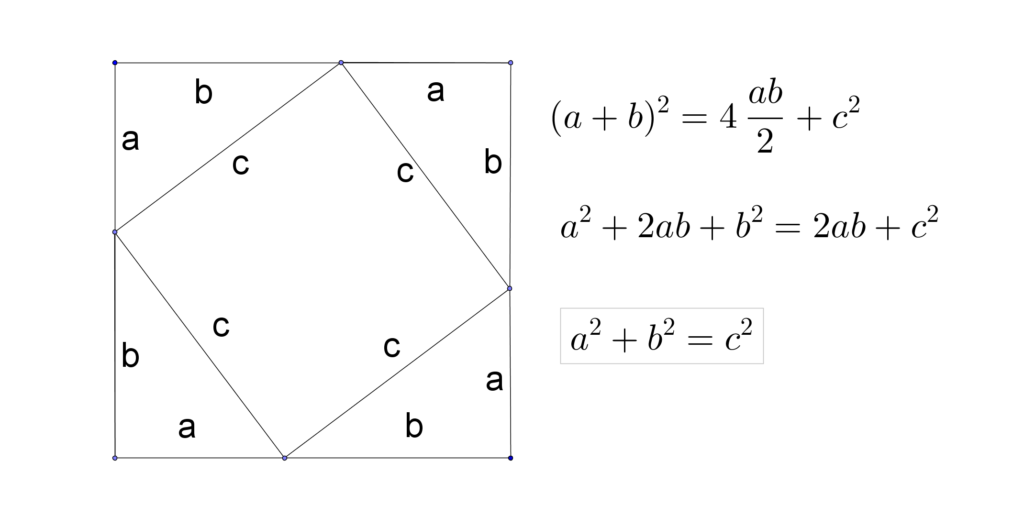
Of the hundreds of known proofs, one of the clearest works entirely by rearranging shapes rather than manipulating equations. Draw a large square with side length (a + b). Inside it, place four identical copies of the right triangle so their hypotenuses form a smaller, tilted square in the center with area c^2. The big square’s total area, (a + b)^2, has to equal the area of that tilted square plus the four triangles around it: (a + b)^2 = c^2 + 4(½ab). Expand the left side to a^2 + 2ab + b^2, and the 2ab terms on both sides cancel out, leaving a^2 + b^2 = c^2. Nothing is assumed except basic area — the same space, measured two different ways, forces the equation to be true, which is why the proof needs no algebra beyond arithmetic to be convincing.
Why It Only Works for Right Triangles
The theorem is specific to triangles with a 90-degree angle because that is precisely the condition that lets the areas line up this way in the proof above. For any other triangle, the relationship breaks in a predictable direction: if the angle opposite side c is less than 90 degrees, a^2 + b^2 turns out greater than c^2; if it is more than 90 degrees, a^2 + b^2 comes out less than c^2. That sensitivity is not just a limitation — it is useful, because it means the theorem can run in reverse. A carpenter or a math student can test whether an unknown triangle is a right triangle at all simply by checking whether its measured side lengths satisfy the equation, no protractor required.
Where It Shows Up Today
The theorem’s reach goes well past geometry class. GPS receivers use three-dimensional versions of it to calculate distance from satellite signals, turning timing data into a physical location on a map. Carpenters and surveyors still use 3-4-5 triangles to square corners on job sites, the same trick Egyptian builders likely relied on thousands of years earlier, because it is faster and more reliable than eyeballing a right angle. In physics, it underlies how vector components combine into a single force, velocity, or displacement. In computer graphics, it is the basis for calculating distances between pixels or points in 3D space, which is why nearly every rendering engine and physics simulation leans on it constantly without anyone noticing. Few results in mathematics have proven so durable, or so quietly load-bearing under the built world — a piece of ancient geometry still doing practical work every time a phone locates itself or a builder squares a wall.