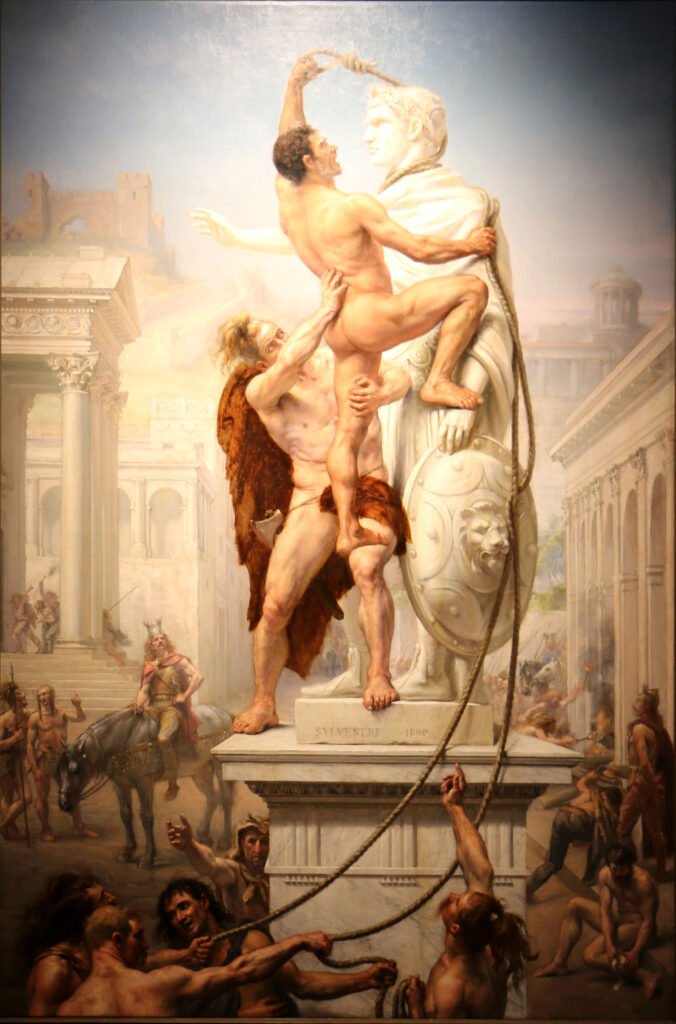
The Western Roman Empire did not fall to a single invasion or a single bad emperor — it collapsed under a century of political dysfunction, economic strain, and military overreach that finally let a Germanic officer named Odoacer depose a teenage emperor in 476 CE without much of a fight. The famous image of barbarians storming the gates is real, but it is the last chapter of a much longer story, not the whole plot.
Rome Was Already Unraveling From the Inside
Long before any foreign king reached the city, Rome was destabilizing itself. During the third century, more than 20 men claimed the imperial throne in roughly 75 years, and most were murdered by their own soldiers or by the Praetorian Guard, the emperor’s personal bodyguard, which at times auctioned the position to the highest bidder. That constant turnover made any long-term policy nearly impossible — an empire that changes leadership every few years can’t plan for a crisis that takes decades to solve. Around 285 CE, Emperor Diocletian tried to fix the chaos by splitting the empire into Western and Eastern halves so each would be easier to govern. It worked, but unevenly: Constantinople, better fortified and economically stronger, went on to thrive for another thousand years, while Rome, in the west, was left to absorb outside pressure largely on its own.
The Economy Was Buckling Just as Quietly
Centuries of warfare and lavish public spending had drained the treasury, and emperors answered by raising taxes and debasing the currency — shrinking the amount of real silver in each coin to stretch the budget. That triggered inflation, and inflation hits the poorest households hardest, since wages rarely rise as fast as prices. Rome’s economy also depended heavily on enslaved labor captured during military conquest; once territorial expansion slowed in the second century, that supply dried up, and both farming and manufacturing output suffered as a result. By the fifth century, Vandal control of North Africa — the empire’s primary grain supplier — cut off shipments that Rome relied on to feed its own population, turning a financial problem into a food-security one.
One Battle Broke the Army’s Backbone
In 376 CE, the Thervingi Goths, fleeing invasion by the Huns out of Central Asia, asked Emperor Valens for permission to settle inside Roman territory along the Danube. Corrupt Roman officials mistreated the new arrivals so badly that the Goths revolted, and in 378 CE they crushed a Roman army at the Battle of Adrianople, killing roughly two-thirds of the eastern field army along with Valens himself. It was Rome’s worst military defeat in centuries, and it exposed a deeper problem: the empire had grown dependent on Germanic soldiers and mercenaries who felt little loyalty to the state paying them.
Rome Was Sacked Twice Before the Empire Actually Ended
What followed was a fast unraveling, not a sudden one. In 410 CE, the Visigothic king Alaric marched on Rome after Emperor Honorius refused to grant his people land and formal recognition, and let his army plunder the city for three days — the first time in nearly 800 years that Rome itself had been sacked by a foreign force. The Vandals sacked it a second time in 455 CE. By 475 CE, Roman authority effectively extended no further than Italy.
The final blow, in 476 CE, was almost anticlimactic. Odoacer, a Germanic officer serving in the Roman army, led a revolt of allied soldiers demanding land in Italy; when Rome refused, he deposed the reigning emperor, a teenager named Romulus Augustulus, and simply sent him into retirement instead of executing him. Odoacer never crowned a replacement Western emperor — he ruled Italy as king and shipped the imperial regalia off to Constantinople. Historians mark that quiet handover as the end of the Western Roman Empire. The Eastern half, the Byzantine Empire, kept going for another thousand years, until Constantinople itself fell in 1453.
So the honest answer to what caused Rome’s fall is that no single cause did. Political instability made the empire slow to react, economic strain made it poorer and hungrier, and repeated military defeats stripped away its ability to defend itself — and by the time Odoacer arrived, there was barely an empire left to conquer.