Time zones exist because clocks set to the exact position of the sun made coordinated travel and communication impossible once people started moving faster than a horse. For most of history that didn’t matter; once railroads and telegraphs connected distant towns on shared schedules, it mattered enormously.
Local Solar Time Worked Fine Until Trains Arrived
Two hundred years ago, every town set its own clocks by local solar time — noon was simply whenever the sun sat directly overhead in that particular place. Boston, New York, and Philadelphia were all a few minutes apart from each other, and nobody noticed. The problem started with the railroad: a train moves faster than a patchwork of hyperlocal clocks can track, and by the 1870s the United States had roughly 300 different local time standards, each set independently by a city or a railroad company. A timetable trying to account for all of them was nearly unreadable, and worse, it was dangerous — trains running on conflicting local times occasionally collided on shared track because dispatchers could not be sure exactly when a train from the next town over would actually arrive.
How the Railroads Created the First Time Zones
Rather than wait for the government to act, the major American and Canadian railroads solved the problem themselves. On November 18, 1883, at exactly noon Eastern time, they rolled out a system of four continental zones — Eastern, Central, Mountain, and Pacific — essentially the same divisions still in use today. Towns were not required to adopt this new “railway time,” but most did within a few years simply because tracking one shared clock beat juggling a dozen local ones.
Greenwich Becomes the World’s Reference Point
The railroad zones fixed an American problem, but global travel and telegraphy needed a shared reference point too. Canadian railway engineer Sandford Fleming had proposed dividing the entire world into hourly zones radiating out from a single prime meridian, an agreed-upon starting line of zero degrees longitude that every other zone’s offset is measured against. In October 1884, delegates from 25 nations met in Washington, D.C., for the International Meridian Conference and voted to put that line through the Royal Observatory in Greenwich, England. That is the meaning behind “Greenwich Mean Time”: not that Greenwich has special clocks, but that the rest of the world agreed to count from there.
Congress Makes the System Law
For 35 years, standard time zones in the U.S. ran purely on the railroads’ own authority, with no law behind them at all. That changed with the Standard Time Act of 1918, which wrote the railroad zones into federal law, placed them under the Interstate Commerce Commission and later the Department of Transportation, and introduced daylight saving time in the same bill.
Why the System Has Stuck
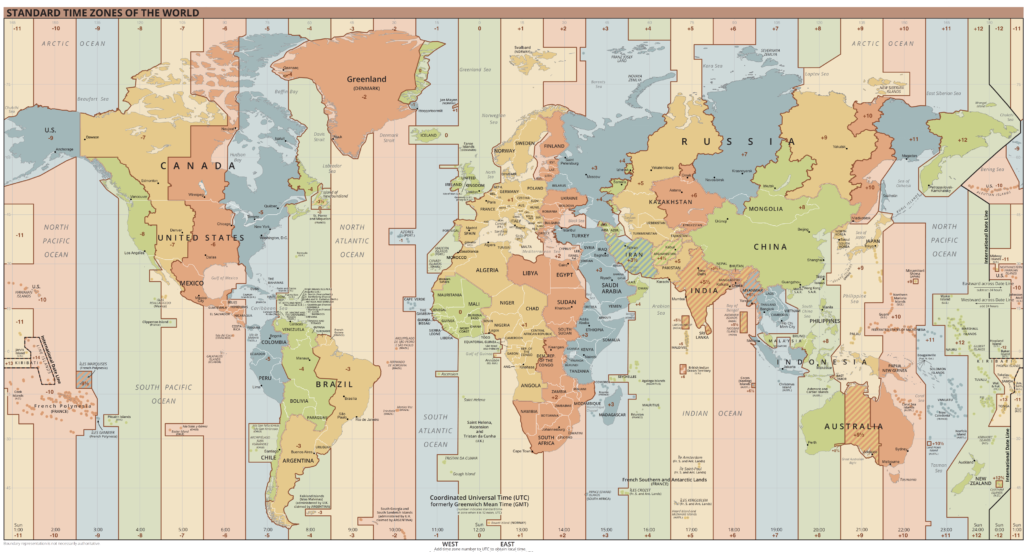
The world today is divided into roughly 24 principal time zones stretching out from Greenwich, though the actual map is messier than that: national borders, political choices, and a handful of 30- or 45-minute offsets (India and Nepal, among others) bend the lines that pure longitude alone would draw. The logic from 1883 has not really changed. Clocks that stay close to the sun’s position overhead are convenient for daily life, but everyone agreeing on a small, fixed number of shared clocks is what actually lets trains, flights, markets, and phone calls run on schedule across a planet that never stops turning.