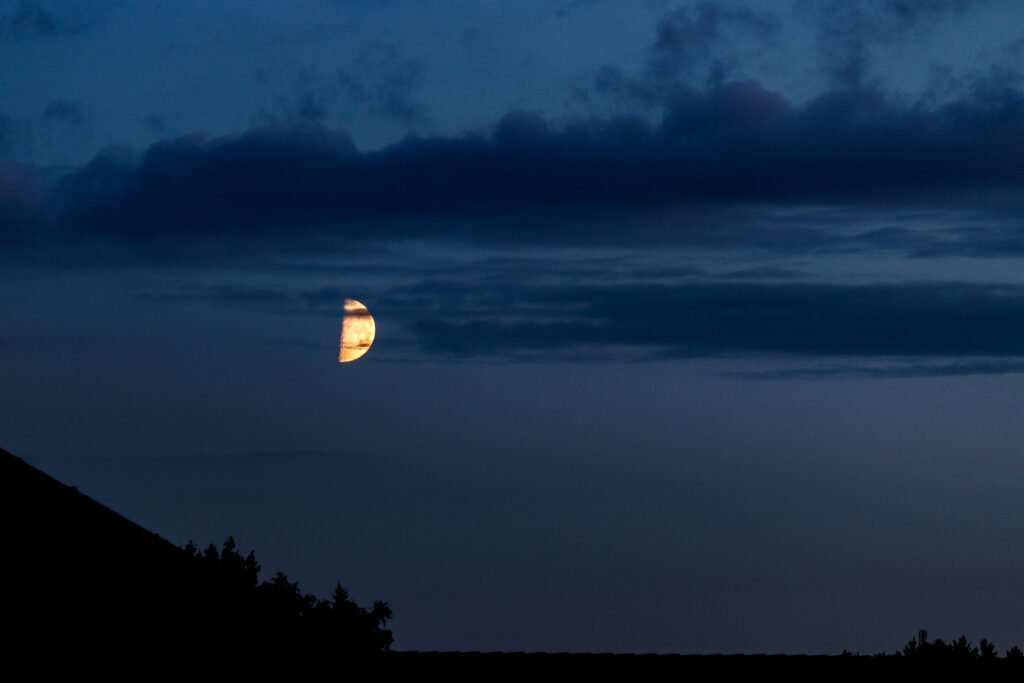
The Moon changes shape because it doesn’t produce any light of its own — what we’re actually seeing is sunlight hitting different parts of its surface as the angle between Earth, the Moon, and the Sun shifts over the Moon’s 27.3-day orbit. The Moon itself never physically changes; only how much of its sunlit half faces us does.
It’s About Sunlight, Not a Changing Moon
At any given moment, the Sun illuminates exactly half of the Moon while the other half sits in darkness, the same way the Sun always lights half of Earth at once. What changes isn’t how much of the Moon is lit, but how much of that lit half we can actually see from here. As the Moon travels around Earth, our viewing angle on its sunlit side constantly shifts, and that shifting angle — not any transformation of the Moon itself — is the real reason it seems to change shape night to night.
How the Orbit Sets Up Each Phase
Earth, the Moon, and the Sun are constantly rearranging themselves in space relative to one another. When the Moon sits between Earth and the Sun, its lit half faces away from us, leaving a dark or barely-there disk called a new Moon. Two weeks later, when the Moon is on the opposite side of Earth from the Sun, its fully sunlit face points directly at us and we get a full Moon. Every phase in between is a snapshot of the Moon at a different point along that same orbital path, showing a growing or shrinking sliver of its lit half.
The Eight Phases, New Moon to New Moon Again
Astronomers break the cycle into eight recognizable phases: new Moon, waxing crescent, first quarter, waxing gibbous, full Moon, waning gibbous, third quarter, and waning crescent. “Waxing” means the visible sliver is growing night by night; “waning” means it’s shrinking. A full cycle from one new Moon to the next takes about 29.5 days — slightly longer than the Moon’s actual 27.3-day orbit around Earth, because Earth is moving around the Sun at the same time, so the Moon needs a bit of extra travel to line back up the same way with the Sun.
Why We Always See the Same Face
No matter what phase it’s in, the Moon always shows Earth the same side. That’s because the Moon is tidally locked to Earth: its rotation period matches its orbital period almost exactly, so it spins once on its axis in the same time it takes to circle Earth once. It’s a coincidence of gravity, not a mysterious force holding the Moon still. The Moon’s famous “far side,” hidden from direct view, goes through the very same cycle of sunlight and shadow as the near side — we just never get to watch it happen from the ground.
A Rhythm People Have Tracked for Thousands of Years
Long before telescopes or spacecraft, people used the predictable rhythm of lunar phases to build calendars, plan planting seasons, and time religious festivals. Many calendars still in use today, including the Islamic and Hebrew calendars, are based partly or entirely on the Moon’s 29.5-day cycle. That predictability comes directly from orbital mechanics: because the Moon’s path around Earth is remarkably steady, its phases arrive with clockwork reliability, which is what let ancient skywatchers forecast the night sky just by counting days.