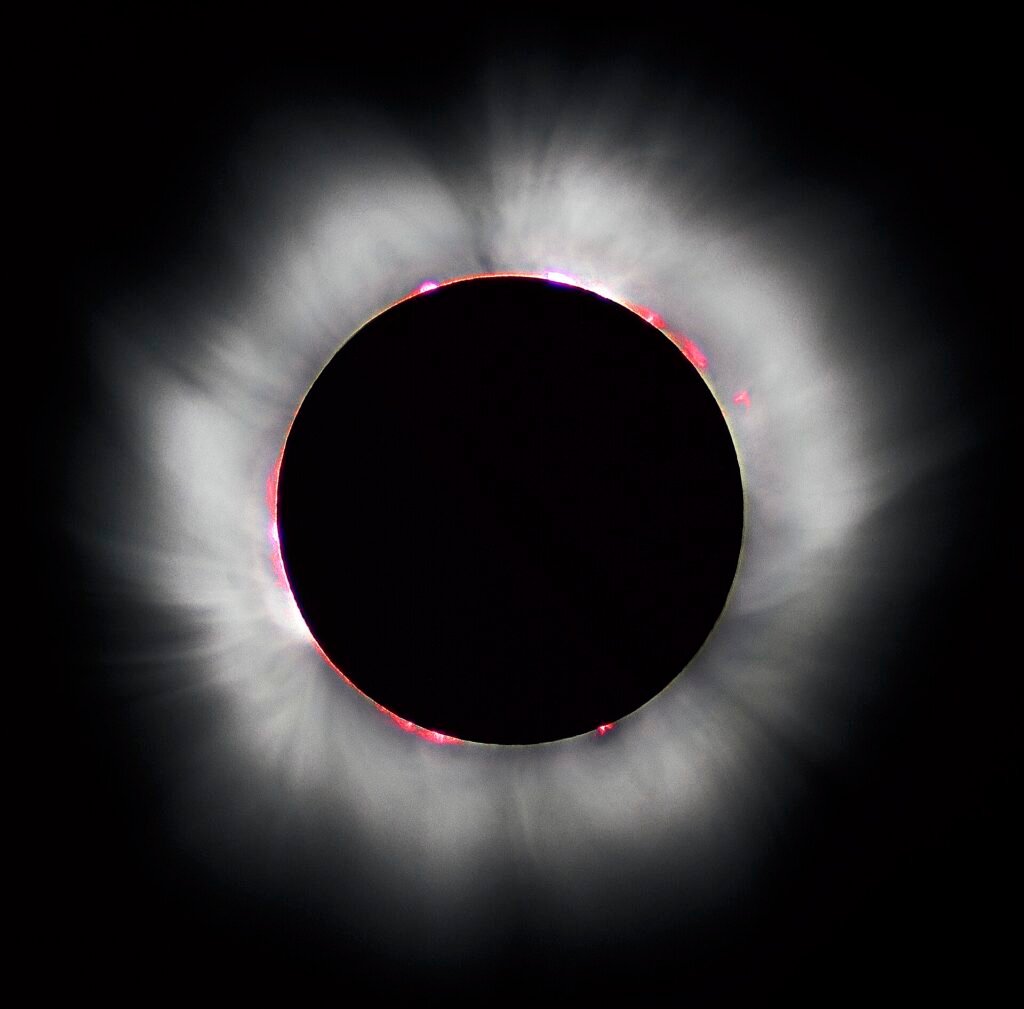
On August 12, 2026, the Moon’s shadow swept across the Arctic, Greenland, Iceland and Spain, turning day into twilight for a few minutes along a narrow path. Much of that path ran over open ocean, so the places where people could stand and watch were limited. Here is how a total solar eclipse works, what the 2026 path looked like and why eye protection matters.
What is a total solar eclipse?
A solar eclipse happens when the Moon passes between the Sun and Earth and casts its shadow on part of our planet. In a total eclipse, the Moon completely covers the Sun, but only for people standing within a narrow strip called the path of totality. Everyone else nearby sees a partial eclipse, where the Moon covers only part of the Sun. The Moon’s changing position in its orbit also explains why the Moon changes shape, and our guide to the science behind the eclipse of the Sun explains the geometry in more detail.
What was the path of the August 12, 2026 eclipse?
According to Spain’s National Geographic Institute (IGN), totality crossed the Arctic Ocean, northeastern Greenland, the extreme west of Iceland and the Atlantic Ocean before entering the Iberian Peninsula. In Spain, the path ran from west to east, from A Coruña to Palma. A partial eclipse was visible across northern North America, much of Europe and western Africa. ISO, the International Organization for Standardization, adds that the path also crossed parts of Russia and a very small part of Portugal.
How long did totality last?
The longest totality was 2 minutes and 18 seconds, near Iceland, at the eclipse’s maximum at 19:46 on official mainland Spain time. The whole phenomenon, from first contact to last, lasted 264 minutes. Totality is far shorter than the full eclipse, because the Moon’s shadow moves quickly across the ground.
What did viewers in Spain see?
The IGN published times for several Spanish cities, all in official Spanish time. Because the eclipse happened in the evening, the Sun was very low in the sky across the country, so a clear western horizon was the most important factor for a good view.
- A Coruña: eclipse began at 19:31, maximum at 20:28, ended at 21:22, with totality lasting 76 seconds and the Sun about 12 degrees above the horizon
- Burgos: began at 19:33, maximum at 20:29, with totality lasting 104 seconds and the Sun about 8 degrees high
- Madrid: Madrid saw only a partial eclipse, with maximum at 20:32 and the Sun about 7.2 degrees high
- Palma de Mallorca: began at 19:38, with maximum at 20:32 and the Sun about 2 degrees high
Totality covered much of the northern half of mainland Spain and the Balearic Islands, while the southern half saw a partial eclipse. The IGN advises choosing an observing site with a clear western horizon free of hills, buildings and trees.
Total vs. partial solar eclipse
The difference between the two is dramatic. In a partial eclipse, the Sun is never fully covered, and ordinary daylight continues. In a total eclipse, the Sun is covered completely for a short time and the sky darkens. Because the Moon’s shadow is small, standing inside the path of totality is essential for the total experience. A location only a short distance outside it will see a partial eclipse. ISO notes that the partial eclipse was visible over a much wider area, including large parts of Europe, so far more people could see some of the event than could see totality.
How to watch a solar eclipse safely
ISO, which publishes the international standard for solar-viewing filters, states that looking directly at the Sun without protection can cause temporary or permanent eye damage, sometimes called eclipse blindness. Damage can occur without immediately causing pain, and during partial phases the remaining visible portion is bright enough to damage the retina. ISO recommends the following:
- Use eclipse glasses or handheld viewers that reference the ISO 12312-2 standard
- Inspect them first, and do not use them if they are scratched, torn, punctured or otherwise damaged
- Follow the manufacturer’s instructions
- Do not use ordinary sunglasses, however dark, since they are not sufficient
- Do not use homemade filters, smoked glass or photographic film
- Do not look through cameras, telescopes or binoculars with eclipse glasses, because those devices need solar filters mounted on the optics
ISO does not certify products itself. Third parties carry out certification, so check the seller and the markings.
When is it safe to look without protection?
Only during totality, when the Moon completely covers the Sun, and only inside the path of totality. ISO says that as soon as any part of the bright surface of the Sun becomes visible again, appropriate eye protection must be used. Anyone outside the path of totality needs protection throughout, since they will only see a partial eclipse.
Frequently asked questions
Where was the August 12, 2026 total eclipse visible?
Along a path crossing the Arctic Ocean, northeastern Greenland, western Iceland, the Atlantic and northern Spain. A partial eclipse was visible across a much wider area.
What time did the eclipse happen in Spain?
In the cities listed by the IGN, the eclipse began between 19:31 and 19:38 official time, with the maximum between 20:28 and 20:32.
How long did totality last?
The longest was 2 minutes and 18 seconds near Iceland. In A Coruña it lasted 76 seconds and in Burgos 104 seconds.
Is it ever safe to look at the Sun during an eclipse?
Only during totality, inside the path of totality. As soon as any bright part of the Sun reappears, eye protection must be used again.
Are sunglasses enough to watch an eclipse?
No. ISO says ordinary sunglasses are not sufficient, however dark.
Can I use eclipse glasses with a camera or telescope?
No. Those devices need solar filters mounted on the optics.