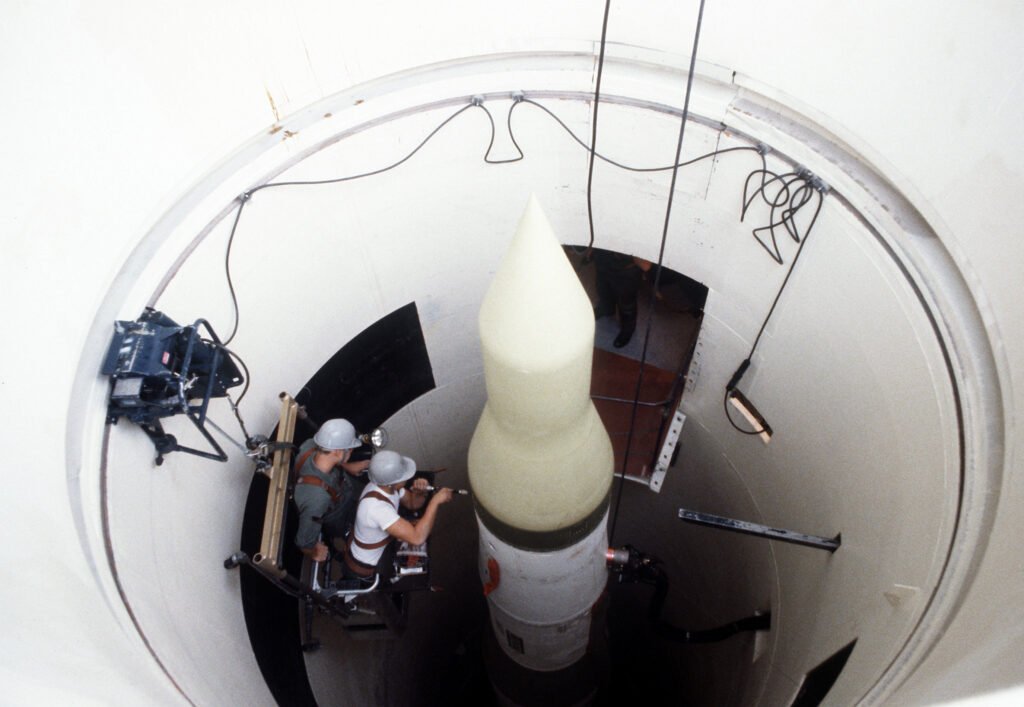
Overview
Nuclear deterrence is a strategic concept in which the possession of nuclear weapons is used not primarily to fight wars but to prevent them, by threatening an adversary with retaliation so severe that any attack becomes irrational. The strategy depends less on the weapons themselves than on an adversarys belief that they would actually be used in response to an attack.
Mutually assured destruction
During the Cold War, the strategic relationship between the United States and the Soviet Union came to be described through the concept of mutually assured destruction, often abbreviated MAD. Under this logic, each side possessed enough nuclear weapons to annihilate the other even after absorbing a first strike, making a deliberate nuclear attack by either side essentially suicidal and therefore, in theory, irrational.
Key concepts
Deterrence theorists distinguish between several related ideas, including first strike capability, the ability to destroy an opponents weapons before they can be used, and second strike capability, the ability to absorb an attack and still retaliate. Credible deterrence generally depends on maintaining a survivable second strike capability, often achieved through dispersed, mobile, or submarine based nuclear forces.
Continuing relevance and risks
Nuclear deterrence remains central to the security strategies of nuclear armed states. Critics point to the risks of accidental escalation, miscalculation, and the proliferation of nuclear weapons to additional states, which could undermine the stability that deterrence theory assumes between a small number of established nuclear powers.
Extended deterrence
Beyond deterring attacks on their own territory, nuclear armed states sometimes extend deterrent guarantees to allies, promising to respond to an attack on an ally as though it were an attack on themselves. This concept, known as extended deterrence, underpinned much of the security architecture of the Cold War, including the American nuclear umbrella extended over NATO allies in Western Europe and other partners in Asia.
Stability and arms control
Concerns about the risks inherent in nuclear deterrence, including accidental launch, miscalculation during a crisis, and the costs of maintaining large arsenals, led to a series of arms control agreements between major nuclear powers beginning in the later twentieth century. These agreements have sought to limit the number and type of weapons deployed, establish verification mechanisms, and reduce the likelihood that a crisis could escalate into unintended nuclear conflict.
Proliferation concerns
The spread of nuclear weapons to additional states raises distinct concerns beyond the original two power framework of Cold War deterrence theory. With more nuclear armed states, the number of potential crisis dyads increases, regional deterrence relationships become more complex, and the established assumptions of mutual deterrence between a small number of well resourced powers may not translate reliably to newer or smaller nuclear arsenals.
Tactical versus strategic weapons
Nuclear arsenals are often divided into strategic weapons, designed for long range use against an adversarys homeland, and smaller tactical or battlefield weapons intended for more limited use against military targets closer to the front line. The existence of tactical nuclear weapons introduces additional complexity into deterrence theory, since their use might be seen as a less drastic step than a full strategic exchange, potentially lowering the threshold at which nuclear weapons could plausibly be employed in a conflict.
Crisis stability
Deterrence theorists pay close attention to crisis stability, meaning whether a tense standoff between nuclear armed states is likely to remain under control or risks spiraling toward unintended escalation. Factors such as the vulnerability of nuclear forces to a first strike, the speed of decision making required, and the clarity of communication channels between rival governments all influence whether a crisis is likely to be managed successfully or could tip into catastrophic miscalculation.
Non proliferation efforts
International efforts to prevent the further spread of nuclear weapons, most notably the Treaty on the Non-Proliferation of Nuclear Weapons, attempt to balance the interests of established nuclear powers with the security concerns of non nuclear states, an inherently difficult balance that continues to generate diplomatic friction over perceived double standards in how proliferation is addressed.
Doctrine of no first use
Some nuclear armed states have adopted formal no first use policies, publicly committing not to be the first to employ nuclear weapons in a conflict, while others maintain deliberate ambiguity about the conditions under which they might use nuclear weapons first, believing that such ambiguity itself strengthens deterrence by leaving an adversary uncertain about where exactly a conventional conflict might escalate into a nuclear one.
Lasting significance
Even as the international security environment continues to change, nuclear deterrence remains a foundational element of the strategic calculations of nuclear armed states, and the theory surrounding it continues to be refined as new technologies and new nuclear armed actors reshape the strategic landscape it was originally designed to explain.
Role of missile defense
The development of missile defense systems designed to intercept incoming nuclear weapons introduces additional complexity into deterrence calculations, since a state that believes it can reliably defend against an adversarys retaliatory strike might be tempted to act more aggressively, potentially undermining the stability that mutual vulnerability was originally thought to provide between rival nuclear powers.
Closing note
These dynamics are expected to remain central to great power security relationships for the foreseeable future.
Analysts continue to debate how emerging technologies such as hypersonic weapons and cyber capabilities might further complicate these long standing deterrence calculations.
These questions remain unresolved and continue to occupy strategists studying the future of great power rivalry.
They are likely to remain central to strategic studies for the indefinite future.
It continues to be studied, debated, and refined by strategists around the world.
Key facts
- Array
Quick checkWhat is the basic logic behind nuclear deterrence?Show answer
The logic is that if a state can credibly threaten to respond to a nuclear attack with devastating retaliation, a rational adversary will be discouraged from attacking in the first place, since the costs of doing so would vastly outweigh any possible gain.
Sources
- Array
Editorially reviewed by Specialty Digest Editorial TeamLast reviewed November 4, 2026Researched and drafted with AI assistanceReport an issue