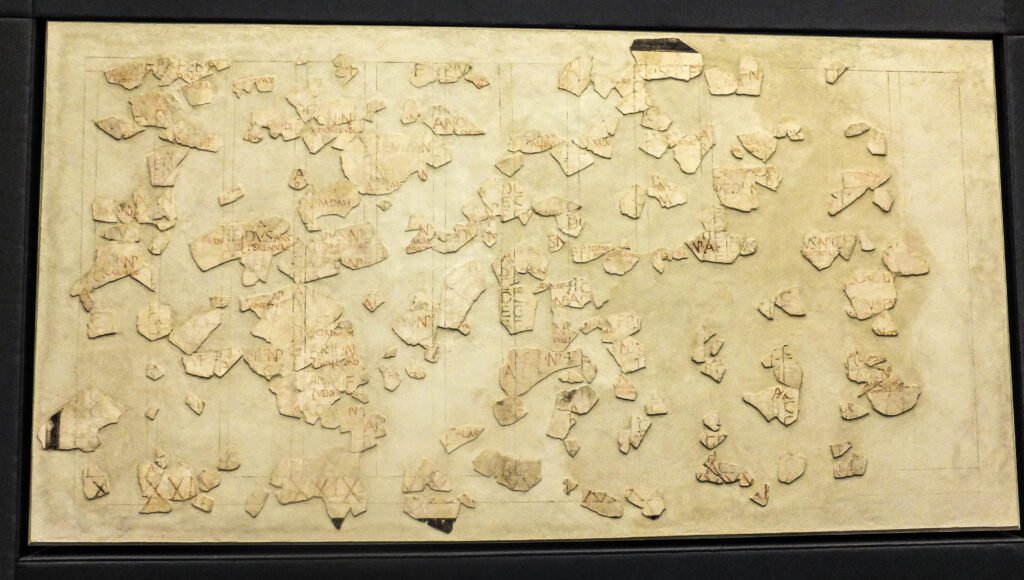
The year has 12 months for no astronomical reason at all: neither the moon’s roughly 29.5-day cycle nor the sun’s 365.25-day orbit divides evenly into 12. The number survives instead because of a messy chain of Roman political decisions, patched together over centuries and never seriously renegotiated since.
Rome’s first calendar only had 10 months
The earliest Roman calendar, traditionally attributed to the city’s founder Romulus, ran just 10 months and 304 days, from March through December. The roughly 61 days of winter that followed weren’t assigned a month at all — with no planting or campaigning to schedule, Romans simply didn’t bother tracking them.
Two new months filled the winter gap
Tradition credits Rome’s second king, Numa Pompilius, with adding January and February to cover that missing stretch, bringing the year to 12 months and about 355 days — a length chosen to stay close to a count of lunar cycles, since each month roughly tracked a moon phase. That still left the calendar drifting out of sync with the actual seasons, so priests periodically inserted an extra leap month called Mercedonius after February to correct it. Because those priests were also politicians, the insertions became a tool for lengthening an ally’s term in office or cutting a rival’s short. By the first century B.C., the manipulation had pushed the Roman calendar roughly two to three months out of alignment with the actual seasons.
Julius Caesar cut the moon out of it
Julius Caesar ended the drift by abandoning the lunar system altogether. Working with the Alexandrian astronomer Sosigenes, he adopted a purely solar calendar modeled on Egyptian practice, fixed to the roughly 365.25-day solar year. To resynchronize the calendar with the actual seasons, he stretched 46 B.C. to 445 days — a stretch Romans afterward called “the year of confusion.” The Julian calendar that took effect on January 1, 45 B.C. kept the existing 12 months and their names, added a leap day every fourth year, and severed the connection to the moon, even though several month names stayed lunar in origin.
Why 12 never got replaced
Caesar could have redesigned the calendar around any number of months. He kept 12 because the structure — and the religious festivals, market days, and civic rhythms built on top of it — was already woven into Roman life, and there was no practical reason to disrupt it. Pope Gregory XIII’s 1582 correction, the Gregorian calendar still used today, adjusted leap-year rules and the length of the year but left the 12-month structure untouched.
That’s the real answer to a question people often assume has an astronomical basis: there’s no law of physics behind 12 months. Various reform proposals over the centuries have floated 10-, 13-, and even 28-day-month systems, and none stuck. What did stick was a Roman political fix, inherited by the rest of the world through the spread of the Roman and later Christian calendar.