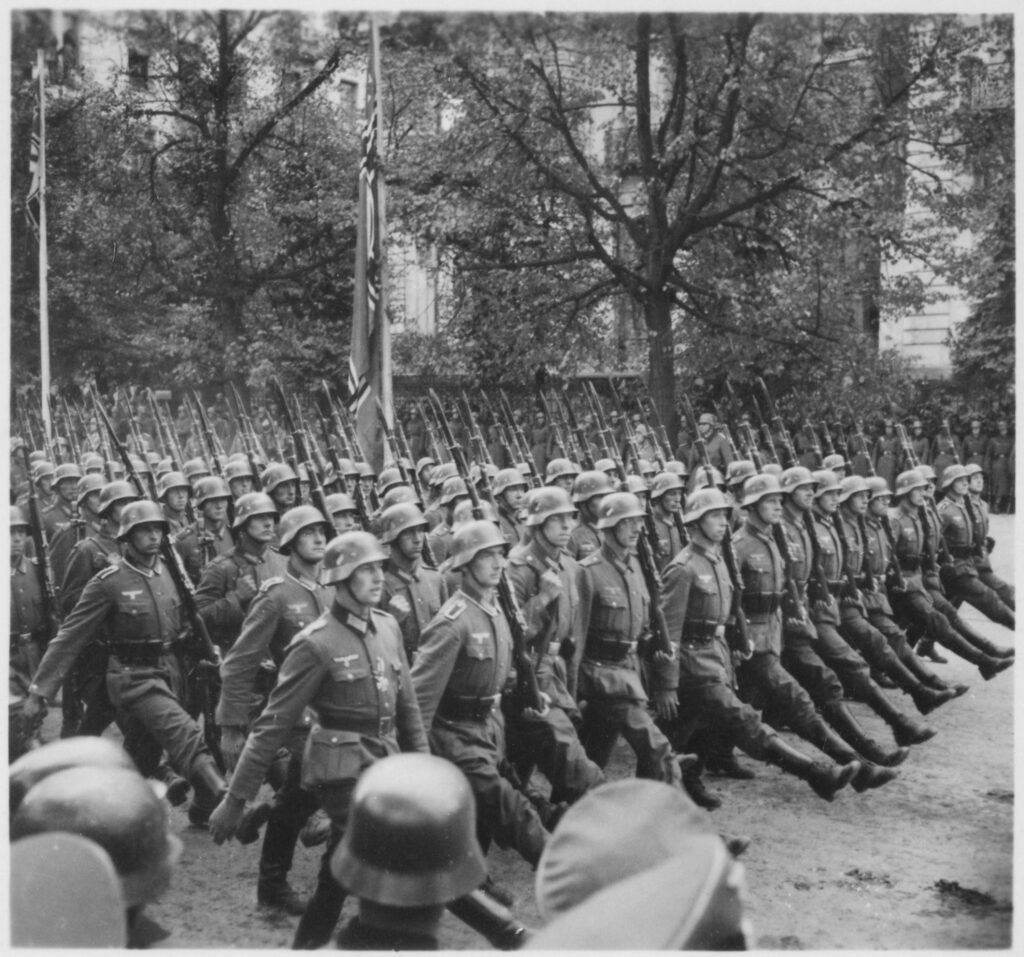
World War II’s European conflict was triggered when German tanks crossed into Poland on September 1, 1939, but that invasion was the end point of two decades of unresolved grievances, failed diplomacy, and a series of gambles that Western democracies kept declining to stop, capped by a secret deal signed just days beforehand that made the invasion possible.
A punishing peace set the stage
The Treaty of Versailles, signed in 1919, forced Germany to accept territorial losses, drastic military restrictions, and heavy reparations payments as the price of losing World War I. The treaty was meant to prevent future German aggression, but it instead fueled deep, lasting resentment across German society, which experienced the terms as a national humiliation. Combined with the economic devastation of the Great Depression in the early 1930s, that resentment created fertile ground for extremist politics, and gave a rising Nazi movement a grievance it could exploit. Historians still debate how much weight to put on the treaty itself versus the choices German leaders made afterward, but few dispute that Versailles supplied the resentment Hitler later mobilized.
Hitler rose and tested the world’s response
Adolf Hitler became German chancellor in January 1933 and rapidly built the Nazi Party into a one-party totalitarian state, openly vowing to tear up the Treaty of Versailles. He began rearming Germany in defiance of the treaty and, in March 1936, sent troops to remilitarize the Rhineland, a region the treaty had specifically demilitarized. Around the same time, fascist Italy under Benito Mussolini invaded Abyssinia, modern Ethiopia, in October 1935. Both moves broke international agreements outright, and both went unpunished, because the League of Nations had no way to force consequences on a major power. Each unanswered violation taught Hitler that the next one would likely go unanswered too.
Appeasement bought time, then ran out
Eager to avoid a repeat of World War I’s carnage, Britain and France pursued a policy of appeasement, conceding to German demands in the hope of preserving peace. That approach peaked in September 1938, when British Prime Minister Neville Chamberlain and French leaders signed the Munich Agreement, letting Hitler annex the Sudetenland, a German-speaking region of Czechoslovakia, without Czechoslovak consent. Chamberlain called it “peace for our time.” Instead, in March 1939, Hitler seized the rest of Czechoslovakia outright, a move with no ethnic-German pretext at all, which finally convinced Britain and France that appeasement had failed and that his ambitions had no natural limit.
The secret pact that cleared the way
With Poland now the evident next target, Britain and France pledged to defend Polish independence, but Hitler still faced the risk of a two-front war against the Western powers and the Soviet Union at once. He removed that risk on August 23, 1939, when German Foreign Minister Joachim von Ribbentrop and Soviet Foreign Minister Vyacheslav Molotov signed the Molotov-Ribbentrop Pact in Moscow, a nonaggression treaty between Nazi Germany and the USSR. A secret protocol attached to the pact carved up Eastern Europe into spheres of influence, promising the Soviet Union eastern Poland, Lithuania, Latvia, and Estonia once Germany moved on the rest. With his eastern flank secured on paper, Hitler had removed the one deterrent left that might have stopped him.
Invasion, and a war that outgrew its start
With that flank secured, Hitler ordered the invasion of Poland on September 1, 1939. Britain and France, honoring their guarantee to Poland, declared war on Germany on September 3, 1939, formally starting World War II in Europe. The Soviet Union invaded Poland from the east on September 17 under the pact’s secret terms. That German-Soviet alignment did not last: on June 22, 1941, Hitler broke the pact entirely and launched Operation Barbarossa, a massive invasion of the Soviet Union, pulling the USSR into the war on the Allied side alongside Britain and, from December 1941, the United States. The war that began as a European border dispute over Poland ended up drawing in most of the world’s major powers, on both fronts, within two years of its start.