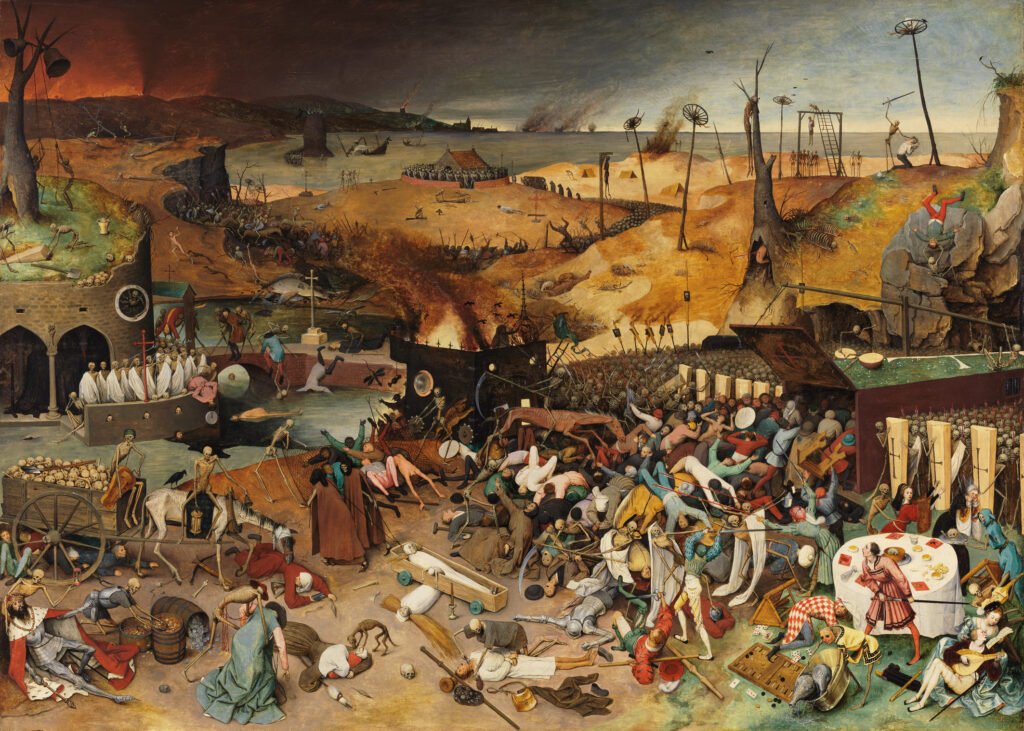
The Black Death was caused by the bacterium Yersinia pestis, spread by infected fleas riding on rats, and it reached Europe by traveling the same trade routes that carried silk and spices out of Central Asia. Within about five years of its arrival, roughly a third of Europe’s population was dead, faster than medieval society could comprehend or contain.
The biology behind the disease
Yersinia pestis normally circulates among wild rodent populations in Central Asia without causing mass die-offs, meaning the bacterium and its usual hosts had reached a kind of uneasy balance long before it ever reached Europe. It spreads through the bite of infected fleas, most notably the Oriental rat flea, which fed on infected rodents and then transferred the bacteria to new hosts, including the black rats that traveled aboard virtually every merchant ship and caravan of the medieval world. When flea-infested rats died off in large numbers, hungry fleas turned to humans instead, and a routine rodent disease became a human pandemic — the mass rat die-off, in other words, is what turned an animal disease into a civilization-altering one.
From the Central Asian steppe to the Black Sea
Genetic and historical evidence points to Central Asia as the plague’s origin point, with climate shifts likely disrupting rodent populations and pushing infected fleas toward human settlements sometime in the early 1340s. From there the disease moved west along the same overland and maritime trade routes that had connected Asia to Europe for centuries, reaching Crimea by 1346. According to the contemporary chronicler Gabriele de’ Mussi, the Mongol army besieging the Genoese trading post of Caffa in Crimea that year was itself ravaged by plague, and catapulted infected corpses over the city walls in an early attempt at biological warfare. Most historians now think that story overstates its own importance: trade traffic and infected rats moving in and out of the besieged port were the more decisive route of transmission than the catapulted bodies themselves, since fleas do not need a corpse lobbed over a wall to travel with cargo, sailors, and rats that were already crossing in and out of the port daily.
The ships that carried the plague to Europe
Genoese ships fleeing Caffa carried the disease into the Mediterranean, and in October 1347 a fleet from the Black Sea put in at Messina, Sicily, with much of the crew already dead or dying. Sicilian authorities ordered the ships away, but it was too late; the disease had already reached shore. Within weeks it spread to Genoa, Marseille, and Tunis, and by 1348 it had reached Rome, Florence, Paris, and London, moving along the same trade shipping lanes and overland roads that carried grain, wool, and wine across medieval Europe — the very infrastructure of medieval commerce became the infrastructure of the pandemic’s spread.
How the disease actually spread from person to person
The plague took three overlapping forms, and the differences between them matter for understanding how it moved. Bubonic plague, the most common, caused the swollen, blackened lymph nodes, or buboes, that gave the disease its name, and spread primarily through flea bites. Septicemic plague infected the bloodstream directly and was almost always fatal. Pneumonic plague, the most contagious form, settled in the lungs and could pass directly from person to person through coughing, without any fleas or rats required at all, which helps explain how the disease tore through crowded medieval towns and monasteries even after rat populations had been decimated and the original flea-and-rat chain of transmission had largely broken down.
The death toll and its lasting aftermath
Between 1347 and 1352, the Black Death killed an estimated 25 to 30 million people in Europe alone, roughly a third to half of the continent’s population, with comparably devastating outbreaks across the Middle East, North Africa, and Asia. The sudden, catastrophic labor shortage that followed reshaped European economies: with far fewer laborers available, surviving peasants and workers gained new bargaining power over wages and land, a shift that helped erode the rigid feudal structures of the medieval period. The disease never fully vanished afterward, recurring in waves for centuries, and its persistence prompted cities such as Ragusa, now Dubrovnik, to pioneer the practice of quarantine, isolating arriving sailors for 30 to 40 days before they were allowed ashore — a public-health tool born directly out of the Black Death that is still recognizable in disease control today.