Bangladesh is a densely populated country in South Asia that occupies the active delta where the Ganges, Brahmaputra and Meghna rivers empty into the Bay of Bengal. Bordered by India on three sides and by Myanmar in the southeast, it is home to an estimated 175.7 million people as of 2025 on a landmass of roughly 147,570 square kilometers, making it one of the most densely settled large countries in the world.
Where Is Bangladesh Located?
Bangladesh sits in the northeastern corner of South Asia, bordered by India to the west, north and east, and by Myanmar along a short border in the southeast, with the Bay of Bengal forming its entire southern coastline. Its capital and largest city is Dhaka, near the geographic center of the country on the Buriganga River. At about 147,570 square kilometers, Bangladesh is smaller than the U.S. state of Iowa, yet according to World Bank data, it carries a population of roughly 175.7 million, giving it one of the highest population densities of any sizable nation on Earth.
Geography and Rivers of Bangladesh
Almost the entire country lies on the floodplain formed where the Ganges, known locally as the Padma, the Brahmaputra, known as the Jamuna, and the Meghna rivers converge before reaching the sea. This confluence creates the Ganges-Brahmaputra-Meghna delta, the largest river delta in the world. The land is flat and low-lying, crossed by hundreds of rivers and channels, and a monsoon climate brings heavy seasonal rainfall between June and October. That combination of flat terrain, high river discharge and coastal exposure makes Bangladesh highly vulnerable to flooding and tropical cyclones, a vulnerability the World Bank identifies as one of the country’s central long-term development challenges.
The Sundarbans: The World’s Largest Mangrove Forest
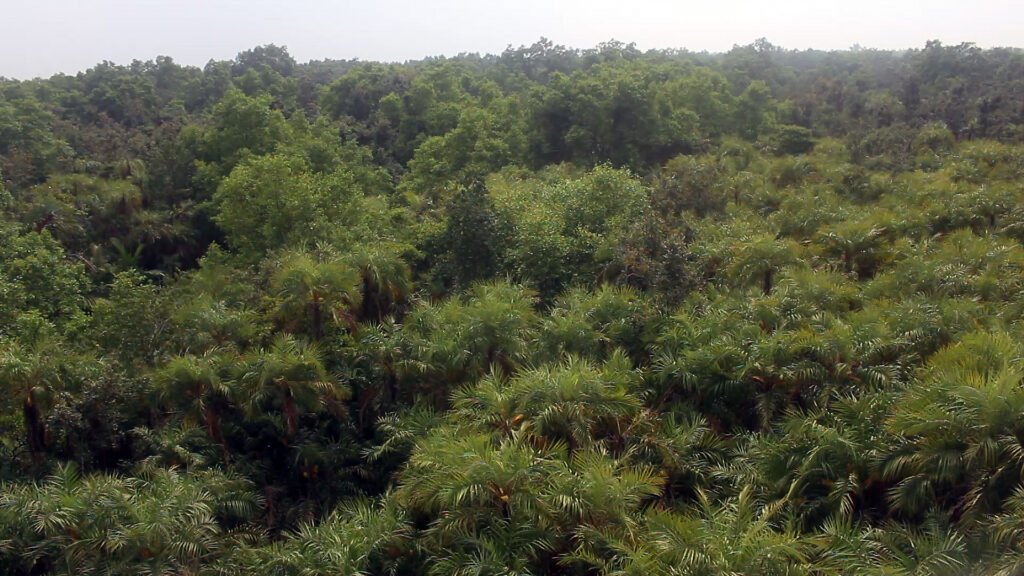
At the southwestern edge of the delta, where fresh river water meets the tidal Bay of Bengal, lies the Sundarbans, the largest single stretch of mangrove forest in the world. The Bangladesh portion of the forest, covering roughly 139,500 hectares, was inscribed as a UNESCO World Heritage Site in 1997 for the ongoing ecological processes visible in its network of tidal waterways, mudflats and salt-tolerant mangrove stands. It is the only mangrove habitat in the world that supports a wild population of the Bengal tiger, and it shelters more than 260 recorded bird species along with estuarine crocodiles and the Indian python.
A Brief History of Bangladesh
The region now called Bangladesh has been a center of settlement, trade and successive empires for centuries, forming the eastern part of historical Bengal under Mauryan, Gupta, Sultanate and Mughal rule before coming under British colonial administration in the 18th and 19th centuries.
From British Bengal to East Pakistan
When British India was partitioned in 1947, the mostly Muslim eastern part of Bengal became East Pakistan, a province of Pakistan separated from the country’s western wing by more than 1,600 kilometers of Indian territory. Political, economic and linguistic tensions between the two wings grew over the following two decades, sharpened by the movement to have Bengali recognized as a state language alongside Urdu, which produced fatal clashes in Dhaka in 1952. That movement is why UNESCO, acting on a proposal originally put forward by Bangladesh, designated February 21 as International Mother Language Day in 1999, observed worldwide since 2000.
The 1971 Liberation War and Independence
Escalating political conflict led to the Bangladesh Liberation War in 1971, and the country declared and secured its independence from Pakistan on December 16, 1971, becoming the People’s Republic of Bangladesh. The new nation began among the poorest in the world, a starting point the World Bank has since described as one of the most difficult postwar recoveries of any country.
Government and Economy of Bangladesh
Bangladesh is a parliamentary republic with a unicameral legislature, the Jatiya Sangsad, or National Parliament. Executive authority rests with a prime minister who leads the majority in parliament, while a president serves a largely ceremonial head-of-state role.
Economically, Bangladesh has moved from one of the world’s poorest countries at independence in 1971 to lower-middle-income status within about four decades, and it is now counted among the world’s fastest-growing economies, according to the World Bank. Its gross domestic product reached an estimated $456.3 billion in 2025. Much of that growth has been driven by the ready-made garment sector, which has made Bangladesh the world’s second-largest exporter of ready-made garments and employs large numbers of rural women in particular. Life expectancy at birth has risen from 46.5 years in 1972 to nearly 75 years by 2024, and the World Bank credits investment in human development and women’s empowerment, including early progress toward gender parity in school enrollment, as central to that shift.
The same low-lying delta geography that shapes Bangladesh’s landscape also shapes its economic risk. The World Bank identifies Bangladesh as highly exposed to climate change, flooding and cyclones, though it also notes that the country has cut cyclone-related deaths roughly a hundredfold since 1970 through investment in early-warning systems and coastal shelters, a record widely cited as a model for climate adaptation and disaster preparedness. Continuing challenges include institutional capacity, the need to diversify the economy beyond garments, and the task of creating enough jobs for the roughly two million young people entering the labor force each year.
Culture and People of Bangladesh
Bengali, known locally as Bangla, is the official and dominant language, spoken by the great majority of the population and central to national identity, a status reinforced by the 1952 Language Movement described above. Islam is the majority religion, with a significant Hindu minority and smaller Buddhist and Christian communities. Bengali culture carries a long literary and artistic tradition, including poetry, music and a strong tradition of festivals tied to the agricultural and lunar calendar.
What Is Bangladesh Known For?
- The Sundarbans and the Bengal tiger, the only wild tiger population adapted to a mangrove habitat.
- A globally significant ready-made garment industry that makes it the world’s second-largest exporter of ready-made clothing.
- Being one of the most densely populated large countries in the world, with roughly 175.7 million people on a land area smaller than Iowa.
- Three UNESCO World Heritage Sites: the Sundarbans, the Historic Mosque City of Bagerhat and the Ruins of the Buddhist Vihara at Paharpur.
- Originating the proposal behind International Mother Language Day, rooted in the 1952 Bengali Language Movement.
- A deltaic geography defined by the Ganges, Brahmaputra and Meghna rivers, and by recurring monsoon flooding and cyclones.
Why Bangladesh Matters Globally
Bangladesh matters to the global economy as a central node in the international garment supply chain, clothing consumers worldwide through a manufacturing base built up over the past four decades. It matters to global development policy as a widely cited case study in poverty reduction, having moved from one of the poorest countries at independence to lower-middle-income status within a single generation. And it matters to the global conversation on climate change as one of the countries most exposed to sea-level rise, river flooding and tropical cyclones, while also serving as a widely studied model for cutting cyclone-related deaths. With a population of more than 175 million, a natural environment anchored by the Sundarbans, and a modern history built around a hard-won linguistic and political identity, Bangladesh remains one of the most consequential countries in South Asia.
Key Takeaways
- Bangladesh occupies the delta of the Ganges, Brahmaputra and Meghna rivers in South Asia, bordered by India and, briefly, Myanmar.
- It became independent from Pakistan on December 16, 1971, following the Bangladesh Liberation War.
- The Sundarbans, the world’s largest mangrove forest, is a UNESCO World Heritage Site and the only wild habitat of the Bengal tiger.
- Bangladesh is the world’s second-largest exporter of ready-made garments and has grown from one of the world’s poorest countries in 1971 to lower-middle-income status.
- With roughly 175.7 million people on about 147,570 square kilometers, it is among the most densely populated large countries on Earth.
- Bangladesh has cut cyclone-related deaths roughly a hundredfold since 1970, a record widely cited as a model for climate adaptation.
Sources
- World Bank, Bangladesh Overview, accessed September 22, 2026.
- World Bank, World Development Indicators, Bangladesh (population, GDP, surface area and life expectancy data), accessed September 22, 2026.
- UNESCO World Heritage Centre, The Sundarbans, accessed September 22, 2026.
- UNESCO World Heritage Centre, Bangladesh, World Heritage properties, accessed September 22, 2026.
- UNESCO, International Mother Language Day, accessed September 22, 2026.
Key facts
Quick checkWhat is the world's largest mangrove forest, located mostly in Bangladesh?Show answer
The Sundarbans, a UNESCO World Heritage Site on the Bay of Bengal delta and the only wild habitat of the Bengal tiger.
Sources
- World Bank. Bangladesh Overview. Undated (2026 update) (accessed 2026-09-22)
- World Bank. World Development Indicators, Bangladesh (population, GDP, surface area, life expectancy). 2025-2026 data (accessed 2026-09-22)
- UNESCO World Heritage Centre. The Sundarbans. Undated (accessed 2026-09-22)
- UNESCO World Heritage Centre. Bangladesh, World Heritage properties. Undated (accessed 2026-09-22)
- UNESCO. International Mother Language Day. Undated (accessed 2026-09-22)
Editorially reviewed by Specialty Digest Editorial TeamLast reviewed September 22, 2026Researched and drafted with AI assistanceReport an issue