Where Is Azerbaijan Located?
Azerbaijan is a country in the South Caucasus region, positioned where Eastern Europe meets Western Asia on the western shore of the Caspian Sea. It shares borders with Armenia and Georgia to the west, Russia to the north, Iran to the south, and Turkiye by way of its Nakhchivan exclave to the southwest. According to the World Bank, Azerbaijan’s capital and largest city is Baku, a port on the Caspian Sea and the country’s political, economic, and cultural center.
The World Bank classifies Azerbaijan as an upper middle income economy within its Europe and Central Asia region. Its population was estimated at approximately 10.2 million people in 2025, making it one of the more populous countries of the South Caucasus.
Geography of Azerbaijan
Azerbaijan’s landscape ranges from the Greater Caucasus mountains along its northern border to the fertile Kur-Araz lowland at its center, where the Kura and Aras rivers meet before draining into the Caspian Sea. The World Bank describes the country’s geography as encompassing mountainous regions, fertile plains, and substantial natural resources, particularly oil and gas concentrated both onshore and in the Caspian’s offshore fields.
The country also contains one of the world’s densest concentrations of mud volcanoes, a geological feature tied to the same subsurface hydrocarbon deposits that have shaped its economy. Near Baku, natural gas seeping through the ground has burned for generations at sites such as Yanar Dag, a detail that helped give Azerbaijan its long-standing reputation as a land associated with fire.
A Brief History of Azerbaijan
The territory of modern Azerbaijan has been shaped for centuries by its position along historic trade and migration routes linking Persia, the Caucasus, and the Eurasian steppe. It passed through Persian, Russian imperial, and Soviet control before the modern republic took shape. Azerbaijan declared independence from the Soviet Union in 1991, becoming one of the fifteen post-Soviet states to emerge that year.
Soviet Era and Independence
Azerbaijan was incorporated into the Soviet Union in the early 1920s and remained one of its constituent republics for roughly seven decades. Soviet-era industrialization, especially around Baku’s oil fields, built much of the infrastructure the modern economy still relies on. Since regaining independence in 1991, Azerbaijan has developed as a presidential republic and pursued closer economic ties with Europe, Turkiye, and Gulf states alongside its traditional relationship with Russia.
The Nagorno-Karabakh Dispute
Azerbaijan and Armenia have disputed control of Nagorno-Karabakh, a mountainous area within Azerbaijan’s internationally recognized borders that was home mainly to ethnic Armenians for much of the twentieth century. Armed conflict broke out between the two countries in the late 1980s and flared again in 2020, when fighting escalated to a level that drew direct UN involvement: the UN Secretary-General called for an end to hostilities and the UN human rights chief warned of possible war crimes before a ceasefire was reached following talks held in Russia. Azerbaijan and Armenia have continued to negotiate over a lasting settlement in the years since, and the dispute remains one of the most sensitive and closely watched issues in the South Caucasus.
Government and Economy in Brief
Azerbaijan is a presidential republic. Its economy has long depended on hydrocarbons, and according to the World Bank, oil and gas remain central to national output even as the government pursues diversification. World Bank data show real GDP growth slowing to 1.4 percent in 2025, with hydrocarbon output contracting by 2 percent year over year while non-hydrocarbon sectors grew more modestly amid softer construction, transport, and agricultural activity. Inflation rose to 5.5 percent in 2025, driven in part by food prices and higher administered tariffs for electricity, gas, and heating, prompting the Central Bank of Azerbaijan to adjust its policy rate downward as price pressures eased later in the year.
The World Bank also reports that Azerbaijan is working to embed climate risk into its financial system and to expand renewable energy and green infrastructure as part of a longer-term shift away from hydrocarbon dependence, alongside ongoing post-conflict recovery and regional connectivity efforts.
Culture and People of Azerbaijan
Azerbaijani is the official language, and the majority of the population is ethnically Azerbaijani, a Turkic people whose language, cuisine, and music reflect a mix of Turkic, Persian, and Caucasian influences built up over centuries at this crossroads. Islam is the predominant religion, though the country’s modern legal system is secular. Azerbaijani culture places a strong emphasis on hospitality, carpet weaving traditions recognized internationally, classical mugham music, and a literary tradition that includes the poet Nizami Ganjavi, whose work is claimed as part of the shared heritage of the wider Persianate world.
What Is Azerbaijan Known For?
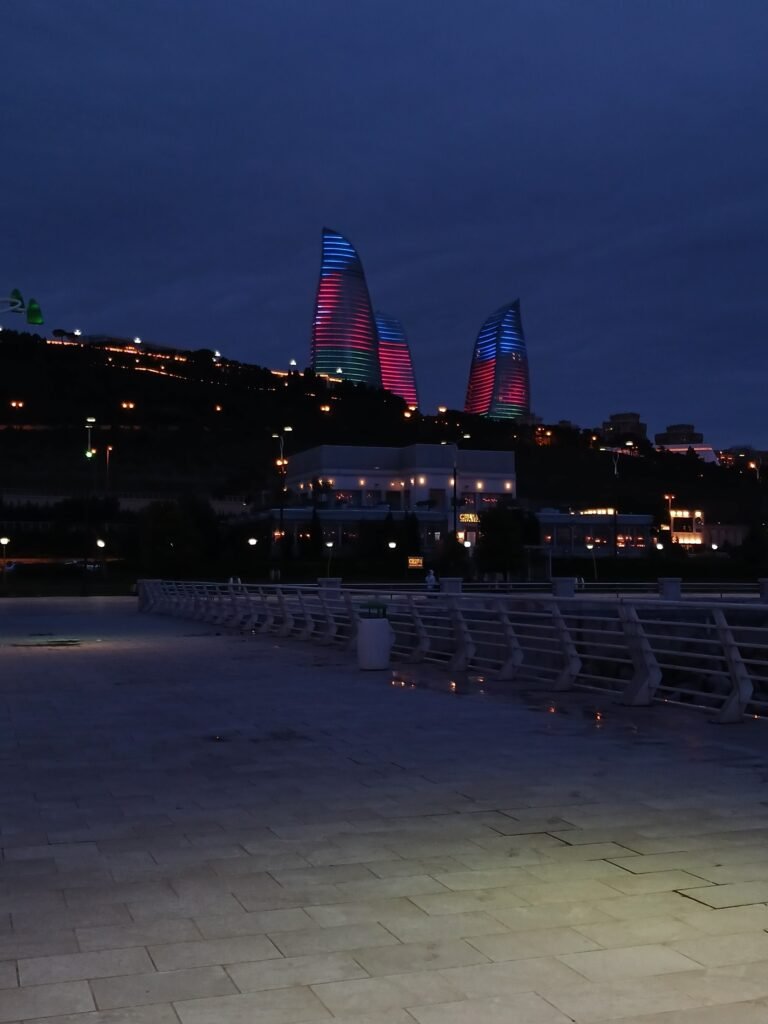
Azerbaijan is most widely recognized for Baku’s modern skyline, anchored by the Flame Towers, a trio of flame-shaped skyscrapers completed in 2012 that have become the country’s most photographed and internationally recognized landmark. The capital’s older core, the Walled City of Baku, is separately recognized by UNESCO as a World Heritage Site for its Maiden Tower and the Palace of the Shirvanshahs, both dating to the medieval period. Southwest of Baku, the Gobustan Rock Art Cultural Landscape, also a UNESCO World Heritage Site, preserves thousands of prehistoric petroglyphs along with its own mud volcanoes.
Azerbaijan is also known for its role as a Caspian Sea energy producer, its mud volcano fields, and its self-description as the Land of Fire, a phrase rooted in its natural gas seeps and its historical association with Zoroastrian fire veneration.
Why Azerbaijan Matters
Azerbaijan’s position on the Caspian Sea and at the edge of Europe and Asia gives it outsized importance for regional energy supply and transit routes connecting Europe, Central Asia, and the wider Middle East. Its hydrocarbon exports have made it a significant, if smaller, player in global oil and gas markets, and its ongoing dispute with Armenia over Nagorno-Karabakh continues to shape security and diplomacy across the South Caucasus. As the country works to diversify its economy and expand renewable energy, its choices carry weight for regional stability and for the broader effort to move energy-exporting economies toward lower-carbon growth.
Key Takeaways
- Azerbaijan is a South Caucasus country on the Caspian Sea, bordered by Armenia, Georgia, Iran, Russia, and Turkiye.
- Its population was estimated at approximately 10.2 million in 2025, with Baku as the capital and largest city.
- The World Bank classifies Azerbaijan as an upper middle income economy that still depends heavily on oil and gas.
- The Walled City of Baku and the Gobustan Rock Art Cultural Landscape are both UNESCO World Heritage Sites.
- Azerbaijan and Armenia have a long running, unresolved dispute over Nagorno-Karabakh that has drawn direct UN involvement.
- Azerbaijan declared independence from the Soviet Union in 1991 and is now a presidential republic pursuing economic diversification.
Sources
- World Bank: Azerbaijan Overview
- World Bank Open Data: Azerbaijan (Country API)
- UNESCO World Heritage Centre: Walled City of Baku with the Shirvanshah’s Palace and Maiden Tower
- UNESCO World Heritage Centre: Gobustan Rock Art Cultural Landscape
- UN News: Nagorno-Karabakh coverage archive
Key facts
- Azerbaijan's population was estimated at approximately 10.2 million in 2025.1
- Baku, the capital and largest city, is a port on the Caspian Sea.1
- The World Bank classifies Azerbaijan as an upper middle income economy.1
- Azerbaijan borders Armenia, Georgia, Iran, Russia, and Turkiye.1
- The Walled City of Baku and the Gobustan Rock Art Cultural Landscape are UNESCO World Heritage Sites.34
Quick checkWhat is the capital of Azerbaijan, and on what body of water does it sit?Show answer
Baku, which sits on the Caspian Sea.
Sources
- World Bank. Azerbaijan Overview. Updated September 2026 (accessed 2026-09-22)
- World Bank. World Bank Open Data: Azerbaijan (Country API). 2026 (accessed 2026-09-22)
- UNESCO World Heritage Centre. Walled City of Baku with the Shirvanshah's Palace and Maiden Tower. Undated (accessed 2026-09-22)
- UNESCO World Heritage Centre. Gobustan Rock Art Cultural Landscape. Undated (accessed 2026-09-22)
- UN News (United Nations). Nagorno-Karabakh coverage archive. 2020 (accessed 2026-09-22)
Editorially reviewed by Specialty Digest Editorial TeamLast reviewed September 22, 2026Researched and drafted with AI assistanceReport an issue