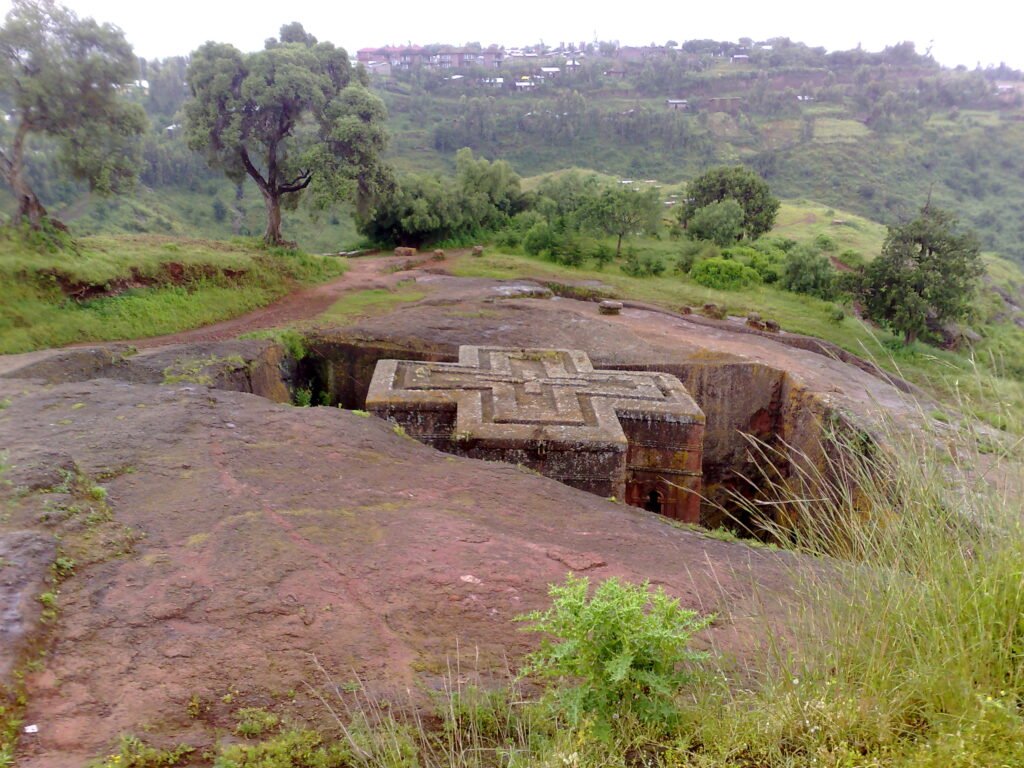
Ethiopia is a landlocked country in the Horn of Africa and the only African nation, along with Liberia, that was never formally colonized by a European power during the nineteenth-century Scramble for Africa. Its rugged highlands are home to Lalibela, a complex of eleven medieval churches carved directly out of solid rock, whose cross-shaped Church of Saint George is one of the most recognizable religious monuments on the continent.
Where Is Ethiopia Located?
Ethiopia sits in the Horn of Africa, bordered by Eritrea to the north, Djibouti and Somalia to the east, Kenya to the south, and South Sudan and Sudan to the west. It has been landlocked since Eritrea’s independence in 1993 severed its access to the Red Sea, and it now relies heavily on the port of Djibouti for maritime trade.
Geography of Ethiopia
Much of Ethiopia sits on a high plateau split by the Great Rift Valley, giving the country dramatic variation in elevation, from the Simien Mountains in the north, among the highest ranges in Africa, to the Danakil Depression in the northeast, one of the hottest and lowest-lying places on Earth. Lake Tana, in the northern highlands, is the source of the Blue Nile, which flows into Sudan to join the White Nile.
A Brief History of Ethiopia
Ethiopia’s recorded history stretches back to the ancient Kingdom of Aksum, which adopted Christianity in the fourth century CE, making Ethiopia one of the oldest Christian nations in the world. In the twelfth and thirteenth centuries, King Lalibela commissioned eleven churches carved downward out of solid volcanic rock in the town that now bears his name, intended as a “New Jerusalem” for Ethiopian Christians unable to travel to the Holy Land. Italy briefly occupied Ethiopia from 1936 to 1941, but aside from that occupation, Ethiopia maintained its independence throughout the colonial era, a distinction that gives it particular symbolic significance across Africa and the African diaspora.
Government and Economy
Ethiopia is a federal parliamentary republic organized into ethnically based regional states. According to the World Bank, Ethiopia has pursued reforms aimed at shifting toward a more competitive, private sector-led economy that creates jobs at scale, part of a broader country partnership strategy the World Bank has developed with the government. Agriculture, particularly coffee, of which Ethiopia is considered an original home, remains a central pillar of the economy alongside a growing manufacturing sector.
Culture and People
With a population exceeding 120 million, Ethiopia is Africa’s second-most populous country. It is home to more than eighty ethnic groups and languages, with Amharic, Oromo, and Tigrinya among the most widely spoken. Ethiopia also uses its own calendar, running roughly seven to eight years behind the Gregorian calendar, and its own script, Ge’ez, used to write several of the country’s languages, including in the liturgy of the Ethiopian Orthodox Tewahedo Church.
What Is Ethiopia Known For?
Ethiopia is known for Lalibela’s rock-hewn churches, recognized by UNESCO as a World Heritage Site, and above all for Bete Giyorgis, the Church of Saint George, carved in the unmistakable shape of a Greek cross and sunk more than ten meters into the rock below ground level. Ethiopia is also widely known as the likely birthplace of coffee and as the site of the discovery of “Lucy,” a roughly 3.2-million-year-old Australopithecus afarensis fossil that remains central to the study of human origins.
Why Ethiopia Matters
As the only African country to have avoided sustained European colonization, and as one of the world’s oldest continuously Christian nations, Ethiopia holds a distinctive place in African and religious history, one made physically visible in the churches of Lalibela, carved from rock nearly a millennium ago and still active places of worship today.
Key Takeaways
- Ethiopia is landlocked in the Horn of Africa and was never formally colonized, aside from a brief Italian occupation from 1936 to 1941.
- Lalibela’s eleven rock-hewn churches, carved in the twelfth and thirteenth centuries, are a UNESCO World Heritage Site.
- Bete Giyorgis, the Church of Saint George, carved in the shape of a Greek cross, is Ethiopia’s most iconic landmark.
- Ethiopia is Africa’s second-most populous country, with more than eighty ethnic groups.
- Ethiopia uses its own calendar and the Ge’ez script, and is widely regarded as coffee’s place of origin.
Sources
- UNESCO World Heritage Centre, Rock-Hewn Churches, Lalibela
- World Bank, Ethiopia Overview
- Encyclopaedia Britannica, Ethiopia
Key facts
- Lalibela's eleven rock-hewn churches, carved 12th-13th century, are a UNESCO World Heritage Site1
- Only African country never formally colonized, aside from Italian occupation 1936-19413
- Africa's second-most populous country, over 120 million people3
- Uses its own calendar and the Ge'ez script3
- Widely regarded as the place of origin of coffee3
Quick checkWhat is Bete Giyorgis?Show answer
The Church of Saint George at Lalibela, carved in the shape of a Greek cross directly out of solid rock in the 12th-13th century.
Sources
- UNESCO World Heritage Centre. Rock-Hewn Churches, Lalibela. 1978 (accessed 2026-09-23)
- World Bank. Ethiopia Overview. Undated (accessed 2026-09-23)
- Encyclopaedia Britannica. Ethiopia. Undated (accessed 2026-09-23)
Editorially reviewed by Specialty Digest Editorial TeamLast reviewed September 23, 2026Researched and drafted with AI assistanceReport an issue