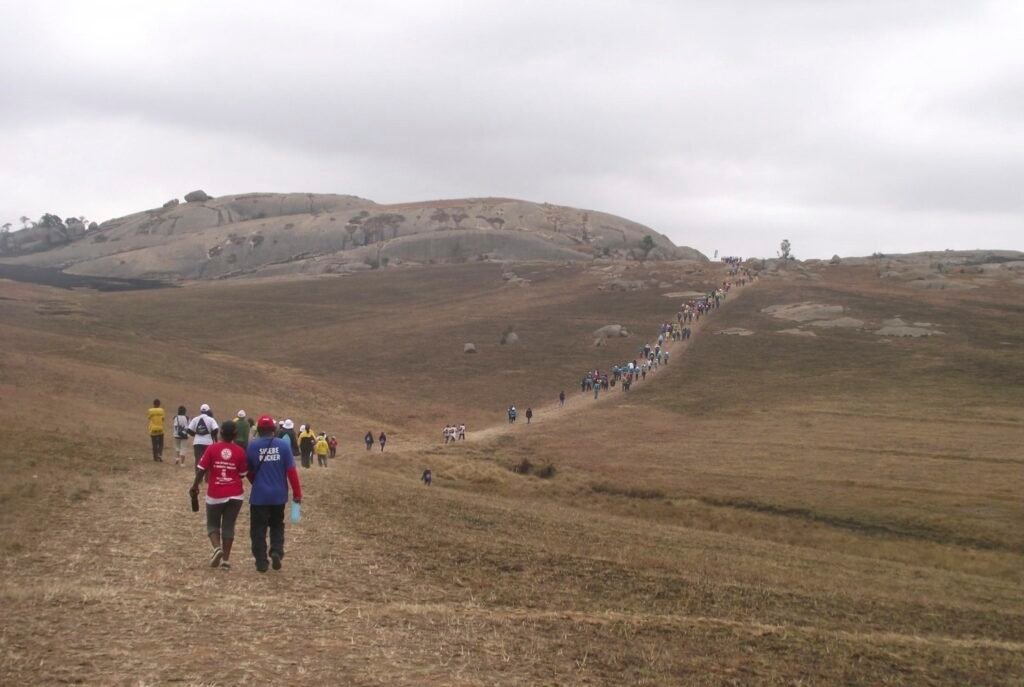
Eswatini is a small, landlocked kingdom in Southern Africa and one of the last remaining absolute monarchies in the world. Renamed from Swaziland to Eswatini by royal decree in 2018, it remains one of the least internationally visited African countries, despite natural landmarks such as Sibebe Rock, one of the largest exposed granite domes on Earth.
Where Is Eswatini Located?
Eswatini is entirely landlocked, bordered by South Africa to the north, west, and south, and by Mozambique to the east. Its small size, roughly comparable to New Jersey, places it among the smallest countries on the African mainland.
Geography of Eswatini
The country descends in a series of terraces from the high veld in the west, along the border with South Africa’s Mpumalanga province, through the middle veld to the low veld and the Lubombo plateau near Mozambique in the east. Just outside the capital, Mbabane, Sibebe Rock rises as a single granite dome often described as the second-largest exposed monolith in the world after Australia’s Uluru, and it is a defining feature of the landscape around the capital.
A Brief History of Eswatini
The Swazi kingdom traces its origins to the eighteenth century under King Ngwane III, consolidating as a distinct nation in the nineteenth century amid pressure from Zulu and Boer expansion. Britain administered the territory as a protectorate from 1903 until independence in 1968, after which Swaziland retained its monarchy rather than adopting a Westminster-style parliamentary system. In 2018, on the fiftieth anniversary of independence, the reigning monarch renamed the country Eswatini, meaning “land of the Swazi,” to distinguish it from Switzerland and to use its Indigenous name.
Government and Economy
Eswatini is one of the world’s few remaining absolute monarchies, in which the king holds significant executive authority alongside a parliament with limited independent power. Its economy is closely tied to South Africa through the Southern African Customs Union and the Common Monetary Area, with its currency, the lilangeni, pegged one-to-one to the South African rand. Agriculture, particularly sugarcane, along with textile manufacturing and remittances from citizens working in South Africa, form major pillars of the economy.
Culture and People
SiSwati and English are the official languages, and Eswatini maintains some of the most visible traditional royal ceremonies in Southern Africa, including the annual Umhlanga, or Reed Dance, in which thousands of unmarried women present reeds to the queen mother, and the Incwala, a sacred kingship ceremony held each summer. These events remain central to national identity and draw both domestic and international attention.
What Is Eswatini Known For?
Eswatini is known for being one of the world’s last absolute monarchies and for its Reed Dance and Incwala ceremonies. Sibebe Rock, the massive granite dome outside Mbabane, is the country’s most distinctive natural landmark, popular for hiking and offering panoramic views over the surrounding valleys.
Why Eswatini Matters
As one of the few countries anywhere still governed as an absolute monarchy, Eswatini offers a rare living example of a governance model that has largely disappeared elsewhere, while its geography, dominated by features like Sibebe Rock, reflects the transition zone between South Africa’s interior plateau and the lower-lying plains toward the Indian Ocean.
Key Takeaways
- Eswatini, formerly Swaziland, is a landlocked kingdom bordered entirely by South Africa and Mozambique.
- It renamed itself from Swaziland to Eswatini in 2018.
- Sibebe Rock, near Mbabane, is often cited as the world’s second-largest exposed granite monolith.
- Eswatini is one of the world’s last absolute monarchies.
- Its currency, the lilangeni, is pegged to the South African rand through the Common Monetary Area.
Sources
Key facts
Quick checkWhat is Sibebe Rock?Show answer
A massive granite dome near Mbabane, often cited as the world's second-largest exposed monolith after Uluru.
Sources
- World Bank. Eswatini Overview. Undated (accessed 2026-09-23)
- Encyclopaedia Britannica. Eswatini. Undated (accessed 2026-09-23)
Editorially reviewed by Specialty Digest Editorial TeamLast reviewed September 23, 2026Researched and drafted with AI assistanceReport an issue