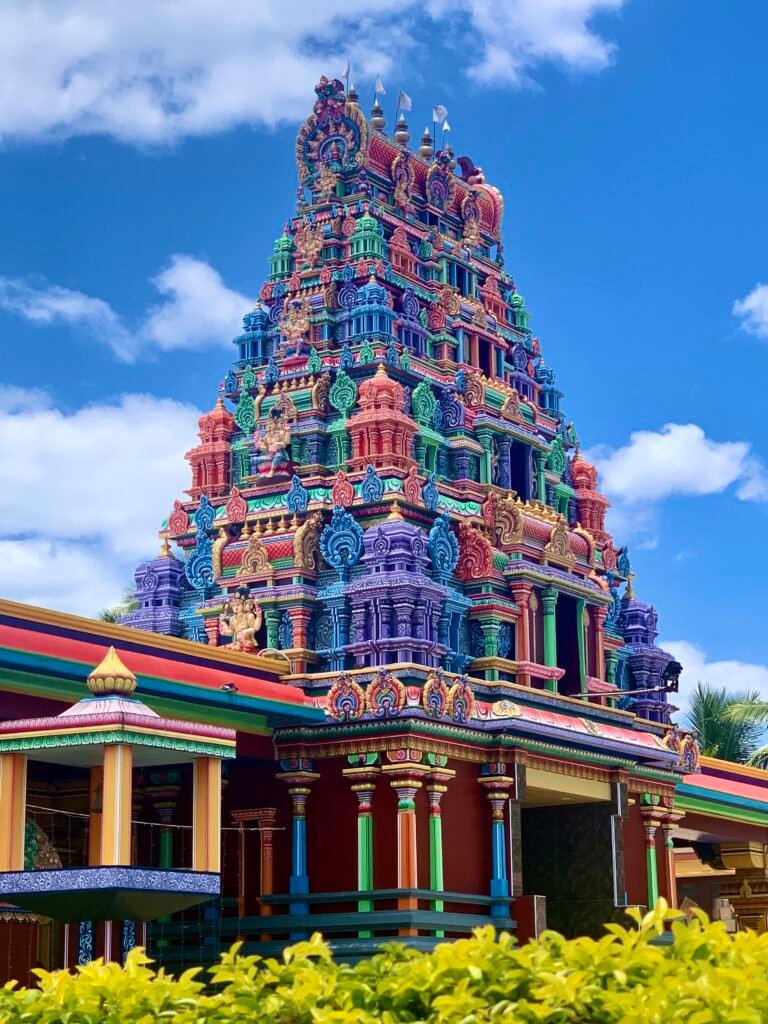
Fiji is a South Pacific archipelago of more than 300 islands, roughly a third of them inhabited, built on a cultural mix of Indigenous Melanesian and Polynesian heritage and a large population descended from Indian indentured laborers brought by British colonizers in the late nineteenth century. That mix is on vivid display in Nadi, where the Sri Siva Subramaniya Temple, the largest Hindu temple in the Southern Hemisphere, stands as one of the country’s most photographed landmarks.
Where Is Fiji Located?
Fiji sits in the South Pacific Ocean, roughly two-thirds of the way from Hawaii to New Zealand, at the crossroads of Melanesia, Polynesia, and Micronesia. Its two largest islands, Viti Levu and Vanua Levu, account for the great majority of its land area and population, with the capital, Suva, located on Viti Levu.
Geography of Fiji
Most of Fiji’s islands are volcanic in origin, with rugged interior mountains, tropical rainforest, and fringing coral reefs, while some of the smaller outer islands are low-lying coral atolls. The islands lie within the Pacific cyclone belt and experience a tropical maritime climate with a distinct wet season.
A Brief History of Fiji
Fiji was settled by Melanesian and later Polynesian voyagers roughly 3,500 years ago, developing complex chiefly societies before European contact in the seventeenth and eighteenth centuries. Britain annexed Fiji as a crown colony in 1874, and in the decades that followed brought tens of thousands of indentured laborers from India to work sugar plantations, a policy that permanently reshaped the country’s demographics. Fiji gained independence from Britain in 1970 and has since experienced several periods of political instability, including multiple military coups, before returning to elected parliamentary government.
Government and Economy
Fiji is a parliamentary republic. Its economy relies heavily on tourism, which draws visitors from Australia, New Zealand, and beyond to its beaches and reefs, along with sugar production and, increasingly, other agricultural exports. As a Pacific Island economy, Fiji works closely with regional and international development partners, including the World Bank’s Pacific Islands program, on issues ranging from climate resilience to infrastructure.
Culture and People
Fiji’s population is composed mainly of Indigenous iTaukei Fijians, who form the majority, and Indo-Fijians, descendants of Indian indentured laborers, who remain a substantial minority. English, Fijian, and Fiji Hindi are all widely spoken, and the country’s religious landscape reflects this dual heritage, combining Christianity, predominant among iTaukei Fijians, with Hinduism and Islam, both practiced widely within the Indo-Fijian community.
What Is Fiji Known For?
Fiji is known internationally for its beaches, coral reefs, and resort tourism, and for rugby, a sport in which the national team has achieved significant international success relative to the country’s small population. Within Fiji, the Sri Siva Subramaniya Temple in Nadi, built in a South Indian Dravidian architectural style and completed in the 1990s, is the country’s most visited religious landmark and the largest Hindu temple in the Southern Hemisphere.
Why Fiji Matters
Fiji’s population, blending Indigenous Pacific and South Asian heritage within a small island nation, makes it a distinctive case among Pacific states, while its geographic position and vulnerability to cyclones and rising sea levels have made it an active voice in international climate diplomacy on behalf of small island developing states.
Key Takeaways
- Fiji is an archipelago of more than 300 South Pacific islands, with Viti Levu and Vanua Levu as its two largest.
- Britain colonized Fiji in 1874 and brought Indian indentured laborers who founded today’s substantial Indo-Fijian community.
- Fiji gained independence in 1970 after nearly a century of British rule.
- The Sri Siva Subramaniya Temple in Nadi is the largest Hindu temple in the Southern Hemisphere.
- Tourism and sugar are central pillars of Fiji’s economy.
Sources
Key facts
- Archipelago of more than 300 islands; Viti Levu and Vanua Levu are the two largest1
- British colony from 1874; independence in 19701
- Indo-Fijians descend from Indian indentured laborers brought to work sugar plantations1
- Sri Siva Subramaniya Temple, Nadi, is the largest Hindu temple in the Southern Hemisphere1
- Economy centers on tourism and sugar2
Quick checkWhat is the Sri Siva Subramaniya Temple?Show answer
A Dravidian-style Hindu temple in Nadi, Fiji, the largest Hindu temple in the Southern Hemisphere, reflecting Fiji's Indo-Fijian community.
Sources
- Encyclopaedia Britannica. Fiji. Undated (accessed 2026-09-23)
- World Bank. Pacific Islands Overview. Undated (accessed 2026-09-23)
Editorially reviewed by Specialty Digest Editorial TeamLast reviewed September 23, 2026Researched and drafted with AI assistanceReport an issue