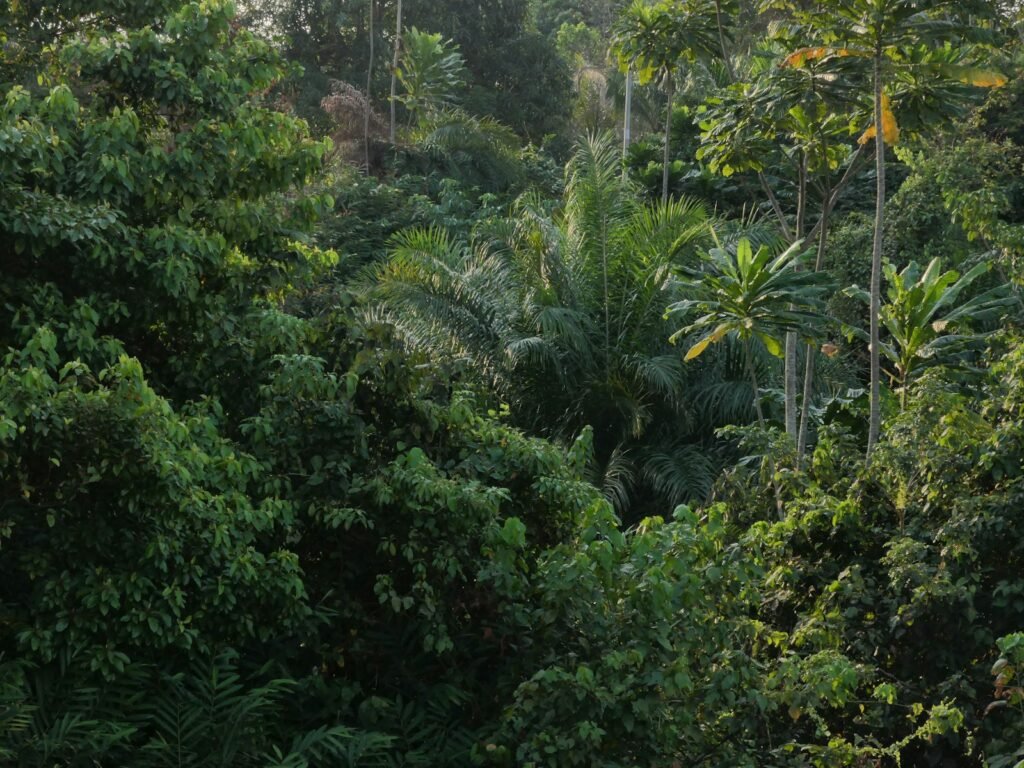
Gabon is a rainforest-covered nation on Central Africa’s Atlantic coast, straddling the equator between Cameroon, Equatorial Guinea, and the Republic of the Congo. Sparsely populated relative to its land area, it is known internationally for its dense biodiversity, its oil-dependent economy, and a 2023 military coup that ended 56 years of rule by the Bongo family.
Where Is Gabon Located?
Gabon sits in West Central Africa on the Gulf of Guinea, bordered by Equatorial Guinea and Cameroon to the north and the Republic of the Congo to the east and south, with the Atlantic Ocean forming its entire western coastline. The equator runs through the country, and the capital, Libreville, lies on the coast near the Komo River estuary.
Geography of Gabon
Covering roughly 267,667 square kilometers (103,347 square miles), Gabon is one of the most densely forested countries in the world, drained chiefly by the Ogooue River. In the country’s north, Ivindo National Park protects nearly 300,000 hectares of rainforest crossed by blackwater rivers, rapids, and waterfalls, including Kongou Falls. UNESCO inscribed the park as a World Heritage Site in 2021, citing its ecological processes and its habitat for forest elephants, western lowland gorillas, chimpanzees, mandrills, and more than 500 species of butterfly.
A Brief History of Gabon
Independence and the Bongo Era
Gabon gained independence from France in 1960 under President Leon M’ba, whose attempt to establish single-party rule triggered a 1964 military rebellion that French troops put down, restoring him to power. After M’ba died in 1967, Vice President Albert-Bernard Bongo, later known as Omar Bongo, became president. He formalized one-party rule under the Gabonese Democratic Party in 1968 and governed for more than four decades, winning repeated elections in 1973, 1979, 1986, 1993, 1998, and 2005 after a 2003 constitutional change eliminated presidential term limits. Oil revenue financed his rule even as, according to Encyclopaedia Britannica, a small elite comprising roughly 2 percent of the population came to control some 80 percent of personal income. Omar Bongo died on June 8, 2009.
The 2023 Transition
His son, Ali Bongo, won the presidency in August 2009 with about 40 percent of the vote amid fraud allegations, and was reelected in 2016 with a disputed 50.66 percent. After suffering a stroke in 2018, he was declared the winner of the August 26, 2023 election with roughly 64 percent of the vote when results were announced four days later. Military officers seized power within hours, dissolving state institutions and canceling the results. A new constitution was approved by referendum in November 2024, and General Brice Oligui Nguema, who led the coup, was elected president in April 2025.
Government and Economy
Gabon is a unitary multiparty republic with a president as head of state and a prime minister as head of government. Its economy remains heavily dependent on oil, though aging oilfields have reduced output even as public investment in infrastructure has supported growth, estimated at 2.5 percent in 2025 with inflation of 1.6 percent. The World Bank describes Gabon as facing persistent fiscal and debt pressures despite its resource wealth. Timber and manganese are also significant exports, and the government has pursued international carbon markets tied to its forest, which the World Bank notes functions as a net absorber of carbon dioxide.
Culture and People
More than 40 ethnic groups live in Gabon. The Fang make up over a quarter of the population north of the Ogooue River, while the Sira, including the Punu, and the Nzebi are the largest groups to the south. French is the official language, alongside Bantu languages including Fang. Christianity, predominantly Roman Catholic, is the majority religion, with Islam and traditional beliefs also practiced.
What Is Gabon Known For?
Gabon is known above all for its rainforest, which covers most of the country and shelters some of Central Africa’s most significant wildlife populations, including forest elephants, western lowland gorillas, chimpanzees, and mandrills. Its network of national parks, anchored by sites such as Ivindo National Park and its Kongou Falls, has made the country a reference point for rainforest conservation in the Congo Basin.
Why Gabon Matters
As one of the most heavily forested countries on Earth and, per the World Bank, a net absorber rather than emitter of carbon dioxide, Gabon carries outsized weight in global conversations about climate and biodiversity. Its 2023 political transition, ending more than five decades of rule by a single family, also makes it a closely watched case for democratic change in Central Africa.
Key Takeaways
- Gabon borders Equatorial Guinea, Cameroon, and the Republic of the Congo, with the equator running through its territory.
- Ivindo National Park, home to Kongou Falls, became a UNESCO World Heritage Site in 2021.
- The Bongo family ruled Gabon from 1967 until a military coup in August 2023.
- General Brice Oligui Nguema was elected president in April 2025 under a new constitution.
- Gabon’s rainforest functions as a net absorber of carbon dioxide, according to the World Bank.
Sources
- World Bank, Gabon Overview
- Encyclopaedia Britannica, Gabon
- UNESCO World Heritage Centre, Ivindo National Park
Key facts
- Ivindo National Park, home to Kongou Falls, was inscribed as a UNESCO World Heritage Site in 20213
- A military coup in August 2023 ended 56 years of Bongo family rule2
- General Brice Oligui Nguema was elected president in April 2025 under a new constitution1
- More than 40 ethnic groups live in Gabon, with the Fang the largest single group2
- Gabon's forests function as a net absorber of carbon dioxide, according to the World Bank1
Quick checkWhat ended the Bongo family's 56 years of rule in Gabon?Show answer
A military coup in August 2023, staged after Ali Bongo was declared the winner of a disputed election.
Sources
- World Bank. Gabon Overview. Undated (accessed 2026-09-23)
- Encyclopaedia Britannica. Gabon. Undated (accessed 2026-09-23)
- UNESCO World Heritage Centre. Ivindo National Park. Undated (accessed 2026-09-23)
Editorially reviewed by Specialty Digest Editorial TeamLast reviewed September 23, 2026Researched and drafted with AI assistanceReport an issue