The Gambia is Africa’s smallest mainland country, a narrow strip of West African territory that follows the Gambia River inland from the Atlantic Ocean and is almost entirely surrounded by Senegal. Its role in the Atlantic slave trade, preserved today at Kunta Kinteh Island, gave it lasting international visibility, and it has operated as a multiparty republic since a 2016 election ended 22 years of authoritarian rule.
Where Is The Gambia Located?
The Gambia occupies a thin corridor of land in West Africa, hugging both banks of the Gambia River as it runs inland from the Atlantic coast. Senegal borders it on the north, east, and south; only its short Atlantic coastline is not bordered by Senegalese territory. The capital, Banjul, sits where the river meets the ocean.
Geography of The Gambia
Covering roughly 10,700 square kilometers (4,127 square miles), the Gambia is the smallest country on the African mainland and among the continent’s most densely populated, with an estimated density of about 176 people per square kilometer and more than half its roughly 2.5 million residents living in urban areas, according to the World Bank. The Gambia River dominates the country’s geography and economy, supporting agriculture, fishing, and the mangrove forests that line much of its length.
A Brief History of The Gambia
Trading Post to Colony
Portuguese traders established a presence on what is now Kunta Kinteh Island around 1456, and the site later passed through Dutch, Courlander, and British control as a fortified trading post on the Gambia River. UNESCO inscribed Kunta Kinteh Island and six related sites as a World Heritage property in 2003, describing it as recording both the beginning and the eventual suppression of the Atlantic slave trade: Fort Bullen and the Six-Gun Battery, built between 1816 and 1826, were constructed specifically to intercept slave ships after Britain outlawed the trade. Britain later administered the Gambia as a colony and protectorate before granting independence within the Commonwealth in 1965; the country became a republic in 1970, with Dawda Kairaba Jawara, prime minister since 1962, as its first president.
Coup, Autocracy, and Democratic Transition
Jawara was overthrown in a 1994 military coup that brought Yahya Jammeh to power. Jammeh ruled for 22 years before losing the December 2016 election to Adama Barrow, a result he initially disputed before ultimately stepping down. Barrow was reelected in 2021 and has pursued institutional reforms, including a Truth, Reconciliation, and Reparations Commission examining abuses under Jammeh, though efforts to pass a new constitution have repeatedly stalled; the next presidential election is scheduled for December 2026.
Government and Economy
The Gambia is a multiparty republic with a single legislative chamber and a directly elected president. Its economy grew an estimated 5.9 percent in 2025, driven by agriculture, construction, and tourism, while inflation eased to 7.9 percent and extreme poverty fell to an estimated 20.3 percent, according to the World Bank. Groundnuts (peanuts) and rice are leading agricultural products, tourism is a major source of foreign exchange, and the country’s debt remains at high risk of distress despite a narrowing fiscal deficit.
Culture and People
The Gambia’s population includes the Malinke, who make up roughly two-fifths of the population, the Fulani at about one-fifth, the Wolof at roughly one-eighth, and several smaller groups. English is the official language, a legacy of British rule, alongside widely spoken Mandinka, Wolof, and Fula. Islam is the predominant religion, practiced by the large majority of Gambians, with a Christian minority.
What Is The Gambia Known For?
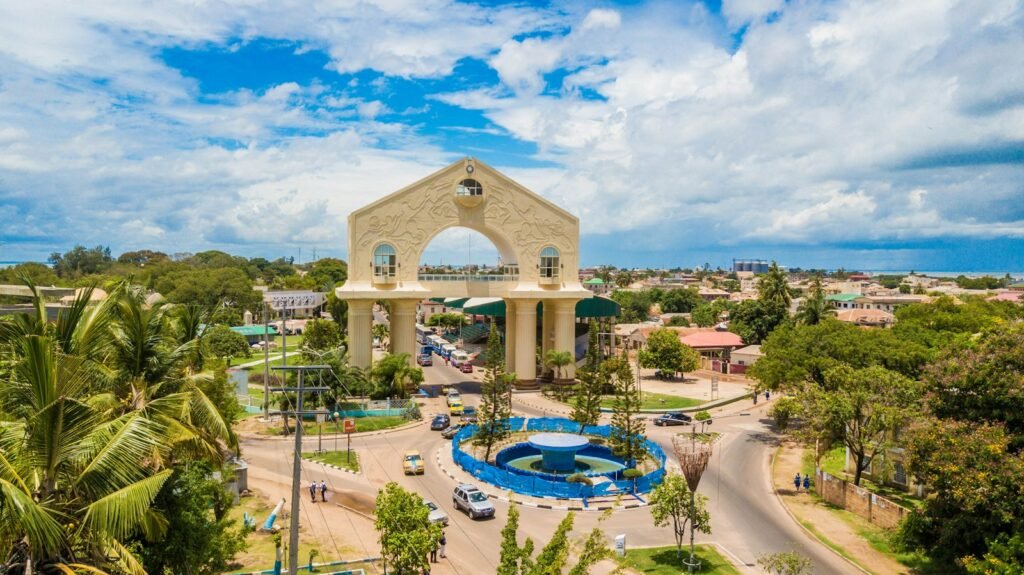
The Gambia is best known internationally for Kunta Kinteh Island and its related sites, a UNESCO World Heritage property that documents nearly five centuries of European trading posts and the Atlantic slave trade on the Gambia River. The island’s name recalls Kunta Kinte, the enslaved ancestor at the center of Alex Haley’s 1976 novel Roots, and the site now draws diaspora visitors to an annual International Roots Homecoming Festival, established in 1996. In Banjul itself, Arch 22, a monumental gateway built in 1996 at the city’s main entrance, has become the country’s most recognized modern landmark.
Why The Gambia Matters
Beyond its small size, the Gambia matters as one of the clearest physical records of the Atlantic slave trade’s arc, from its fifteenth-century origins to its nineteenth-century suppression, preserved along a single river. Its 2016 transition from 22 years of authoritarian rule to competitive multiparty politics has also made it a reference point for democratic change in West Africa, even as constitutional reform remains unfinished.
Key Takeaways
- The Gambia is Africa’s smallest mainland country, surrounded almost entirely by Senegal.
- Kunta Kinteh Island and its related sites became a UNESCO World Heritage property in 2003 for their role in the Atlantic slave trade.
- The Gambia gained independence from Britain in 1965 and became a republic in 1970.
- Yahya Jammeh ruled for 22 years after a 1994 coup before losing power to Adama Barrow in 2016.
- President Adama Barrow was reelected in 2021; the next presidential election is scheduled for December 2026.
Sources
- World Bank, The Gambia Overview
- Encyclopaedia Britannica, The Gambia
- UNESCO World Heritage Centre, Kunta Kinteh Island and Related Sites
Key facts
- The Gambia is Africa's smallest mainland country, covering roughly 10,700 square kilometers1
- Kunta Kinteh Island and its related sites became a UNESCO World Heritage property in 2003 for their role in the Atlantic slave trade3
- The Gambia gained independence from Britain in 1965 and became a republic in 19702
- Yahya Jammeh ruled for 22 years after a 1994 coup before losing power to Adama Barrow in 20161
- President Adama Barrow was reelected in 2021; the next presidential election is scheduled for December 20261
Quick checkWhy was Kunta Kinteh Island inscribed as a UNESCO World Heritage Site?Show answer
Because it documents nearly five centuries of the Atlantic slave trade, from its fifteenth-century origins to its nineteenth-century suppression.
Sources
- World Bank. The Gambia Overview. Undated (accessed 2026-09-23)
- Encyclopaedia Britannica. The Gambia. Undated (accessed 2026-09-23)
- UNESCO World Heritage Centre. Kunta Kinteh Island and Related Sites. Undated (accessed 2026-09-23)
Editorially reviewed by Specialty Digest Editorial TeamLast reviewed September 23, 2026Researched and drafted with AI assistanceReport an issue