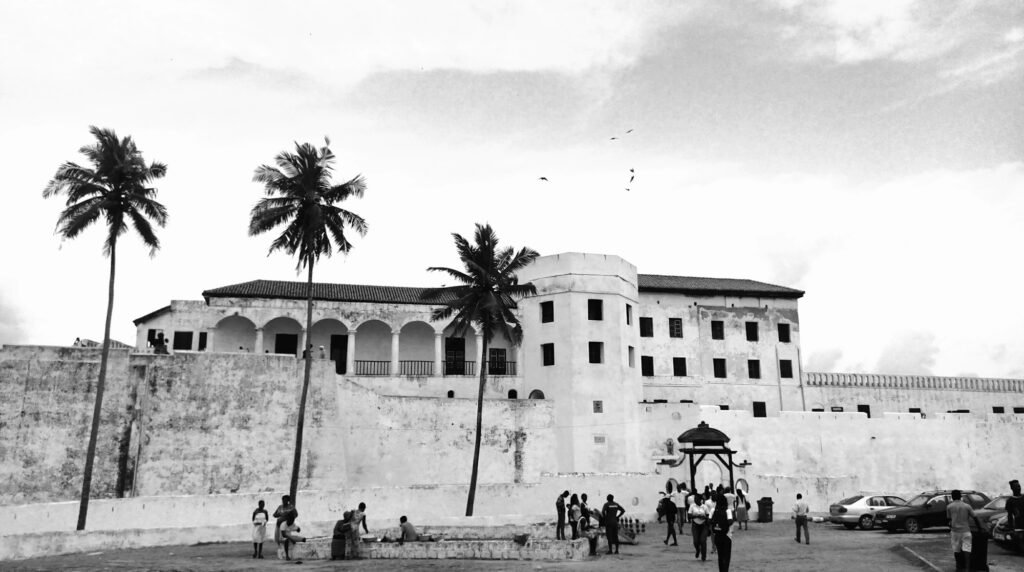
Ghana is a West African country on the Gulf of Guinea, bordered by Cote d’Ivoire, Burkina Faso, and Togo. Formerly the British colony of the Gold Coast, it became independent in 1957, the first country in sub-Saharan Africa to break from European colonial rule, and its capital, Accra, sits on the Atlantic coast.1
Geography
Ghana covers about 238,533 square kilometers, roughly the size of the United Kingdom, and is bordered by Burkina Faso to the north, Togo to the east, and Cote d’Ivoire to the west, with a coastline of roughly 550 kilometers on the Gulf of Guinea to the south.2 The south is heavily forested, transitioning to open savanna grassland across the north, and the Akwapim-Togo Ranges run along the country’s eastern edge.3 The country’s defining physical feature is Lake Volta, created behind the Akosombo Dam on the Volta River; measured by surface area, it is the largest reservoir made by human construction anywhere in the world.3
Brief History
Long before European contact, the Akan-speaking Asante (Ashanti) built one of West Africa’s most powerful states. Osei Tutu founded the Asante Empire around 1701, with its capital at Kumasi, and the empire grew to dominate much of what is now southern Ghana. The Asante took part in the regional slave trade during the 18th century and later resisted British expansion militarily before the empire was finally absorbed into the British Gold Coast colony around 1900 and 1901.4 Along the coast, a separate history unfolded starting in 1482, when Portuguese traders built the first in a chain of fortified trading posts that Portugal, the Netherlands, Denmark, Sweden, Germany, and Britain would construct or occupy over the following three centuries. Initially built for the gold trade, these forts and castles became central hubs of the transatlantic slave trade, and UNESCO has inscribed them collectively as a World Heritage Site documenting that history.5
Britain formally established the Gold Coast as a colony in the late 19th century. Kwame Nkrumah led the colony to independence on March 6, 1957, renaming the new state Ghana after the medieval West African empire, and became its first prime minister and later president. Nkrumah saw Ghana’s independence as, in his words, a spearhead for the liberation of the rest of the African continent, and he pursued pan-African unity alongside domestic development projects. His government was overthrown in a February 1966 military coup while he was traveling abroad.1 Political instability followed for more than two decades. Flight Lieutenant Jerry Rawlings first seized power in a 1979 coup, restored civilian rule after 112 days, then took power again in a December 1981 coup, this time governing for more than a decade under a Provisional National Defense Council. After initial populist policies faltered, Rawlings shifted toward market-oriented economic reform in 1983. In 1992, Ghana adopted a new constitution establishing the Fourth Republic, and Rawlings won the country’s first multiparty presidential election that year, then was reelected in 1996 before stepping down after the 2000 election.6
Government and Economy
Ghana is a multiparty republic operating under the 1992 constitution. The president, who serves as both head of state and head of government, and a vice president are elected together by universal adult suffrage for four-year terms, with a two-term limit, and the country has a unicameral Parliament whose members are also directly elected to four-year terms. Ghana is divided into 16 administrative regions, each subdivided into districts with elected assemblies.7
Ghana reached middle-income status in 2011, but more than a fifth of its population still lives in poverty, with rates exceeding 50 percent in the northern regions. The economy relies heavily on gold, cocoa, and, since the 2010s, offshore oil production, including a newer field known as Pecan. Growth rebounded to an estimated 5.8 percent in 2024 and about 6 percent in 2025 after an acute economic crisis in 2022 that pushed public debt to roughly 92 percent of GDP; the recovery has come through debt restructuring and an International Monetary Fund program, alongside falling inflation and a stronger currency.8
Culture and People
Ghana’s population was estimated at roughly 34 million people. English is the official language, a legacy of British colonial rule, while Akan, Mossi (in the Mole-Dagbani-speaking north), Ewe, and Ga-Adangme are among the country’s major indigenous ethnic and linguistic groups. Christianity is the largest religion, followed by Islam and traditional African beliefs.2 Among Ghana’s most distinctive cultural exports is kente, a strip-woven cloth historically associated with Asante and Ewe weavers, in which patterns are typically named for the people, events, or natural features they represent. According to the Metropolitan Museum of Art, Kwame Nkrumah’s embrace of kente as a national symbol helped turn it into something recognized well beyond Ghana, describing it as having become “almost the uniform of pan-Africanism.”9
What Ghana Is Known For
Ghana is known internationally as a pioneer of African independence, the first sub-Saharan nation to shed colonial rule, and as a comparatively stable multiparty democracy in a region that has seen repeated military takeovers in recent years, including in neighboring Burkina Faso. Along its coast, the UNESCO-listed forts and castles, among them Cape Coast Castle, Elmina Castle, and Christiansborg Castle, stand as one of the world’s most significant physical records of the transatlantic slave trade, drawing scholars and members of the African diaspora seeking to trace that history; similar fortified trading posts mark other stretches of the West African coast, including in neighboring Benin.5 Ghana is also closely associated with kente cloth and with gold and cocoa production, both central to its economy and its historical identity as a former “Gold Coast.”
Why Ghana Matters
Ghana’s 1957 independence was a watershed moment in African decolonization, inspiring liberation movements across the continent and establishing Kwame Nkrumah as a leading voice for pan-Africanism.1 Since adopting its current constitution in 1992, Ghana has sustained continuous multiparty government, a record that stands out against a wave of coups elsewhere in West Africa, including in neighboring Burkina Faso, in recent years. As a significant global source of gold and cocoa, Ghana’s economy is closely tied to international commodity markets, and its coastal forts and castles remain one of the world’s foremost sites for confronting the history and legacy of the transatlantic slave trade.
Key Takeaways
- Ghana became independent from Britain on March 6, 1957, the first sub-Saharan African country to do so, under founding leader Kwame Nkrumah.1
- The Asante Empire, founded around 1701 by Osei Tutu and centered on Kumasi, dominated much of the region before its absorption into the British Gold Coast colony around 1900.4
- Ghana’s coastal forts and castles, built between 1482 and the 18th century, are inscribed as a UNESCO World Heritage Site documenting the Atlantic gold and slave trades.5
- Jerry Rawlings, who first seized power in 1979 and again in 1981, presided over the 1992 transition to the Fourth Republic and was elected president twice under the new constitution.6
- Lake Volta, formed by the Akosombo Dam, is by surface area the largest human-made reservoir in the world.3
- Ghana’s economy centers on gold, cocoa, and offshore oil, and reached middle-income status in 2011, though poverty remains widespread, especially in the north.8
- Kente cloth, associated with Asante and Ewe weaving traditions, became an internationally recognized symbol of pan-Africanism under Nkrumah.9
Sources
- Encyclopaedia Britannica | “Ghana – Independence” | Undated | https://www.britannica.com/place/Ghana/Independence | Accessed September 23, 2026
- Encyclopaedia Britannica | “Ghana summary” | Undated | https://www.britannica.com/summary/Ghana | Accessed September 23, 2026
- Encyclopaedia Britannica | “Ghana – The land” | Undated | https://www.britannica.com/place/Ghana/The-land | Accessed September 23, 2026
- Encyclopaedia Britannica | “Asante empire” | Undated | https://www.britannica.com/place/Asante-empire | Accessed September 23, 2026
- UNESCO World Heritage Centre | “Forts and Castles, Volta, Greater Accra, Central and Western Regions” | Undated | https://whc.unesco.org/en/list/34/ | Accessed September 23, 2026
- Encyclopaedia Britannica | “Jerry J. Rawlings” | Undated | https://www.britannica.com/biography/Jerry-J-Rawlings | Accessed September 23, 2026
- Encyclopaedia Britannica | “Ghana – Government and society” | Undated | https://www.britannica.com/place/Ghana/Government-and-society | Accessed September 23, 2026
- World Bank | “Ghana Overview” | 2025 | https://www.worldbank.org/en/country/ghana/overview | Accessed September 23, 2026
- The Metropolitan Museum of Art | “Man’s Kente (Prestige Cloth), Asante-Akan Peoples” | Undated | https://www.metmuseum.org/art/collection/search/85576 | Accessed September 23, 2026
Key facts
- First sub-Saharan African country to gain independence from colonial rule, on March 6, 19571
- The Asante Empire, founded around 1701, dominated the region before British colonization around 19004
- Lake Volta, formed by the Akosombo Dam, is the largest reservoir by surface area in the world3
- Ghana's coastal forts and castles, built 1482-1786, are a UNESCO World Heritage Site tied to the transatlantic slave trade5
- Ghana adopted its Fourth Republic constitution in 1992, ending over a decade of military rule under Jerry Rawlings6
Quick checkWhy was Ghana's 1957 independence historically significant?Show answer
Ghana was the first country in sub-Saharan Africa to gain independence from colonial rule, and it inspired liberation movements across the continent under founding leader Kwame Nkrumah.
Sources
- Encyclopaedia Britannica. Ghana - Independence. Undated (accessed 2026-09-23)
- Encyclopaedia Britannica. Ghana summary. Undated (accessed 2026-09-23)
- Encyclopaedia Britannica. Ghana - The land. Undated (accessed 2026-09-23)
- Encyclopaedia Britannica. Asante empire. Undated (accessed 2026-09-23)
- UNESCO World Heritage Centre. Forts and Castles, Volta, Greater Accra, Central and Western Regions. Undated (accessed 2026-09-23)
- Encyclopaedia Britannica. Jerry J. Rawlings. Undated (accessed 2026-09-23)
- Encyclopaedia Britannica. Ghana - Government and society. Undated (accessed 2026-09-23)
- World Bank. Ghana Overview. 2025 (accessed 2026-09-23)
- The Metropolitan Museum of Art. Man's Kente (Prestige Cloth), Asante-Akan Peoples. Undated (accessed 2026-09-23)
Editorially reviewed by Specialty Digest Editorial TeamLast reviewed September 23, 2026Researched and drafted with AI assistanceReport an issue