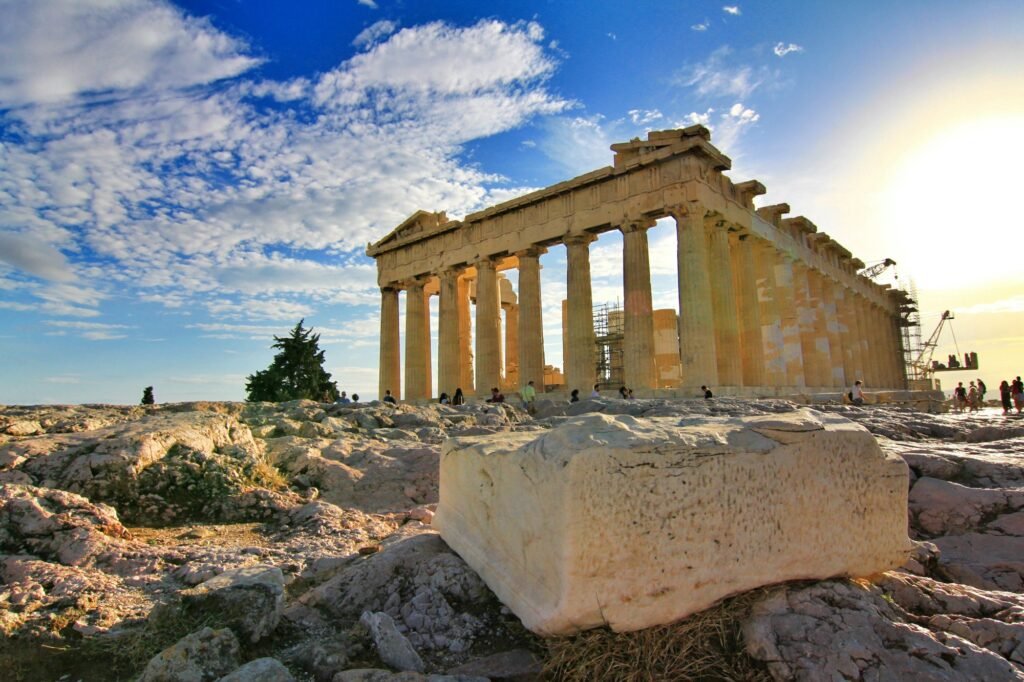
Greece is the southernmost country of the Balkan Peninsula in southeastern Europe, a nation whose Classical Athenian civilization laid foundations for Western philosophy, democracy, and science that are still felt worldwide. Its capital, Athens, is home to the Acropolis and the Parthenon, the temple that remains the single most recognizable symbol of ancient Greek achievement.1
Geography
Greece sits at the junction of Europe, Asia, and Africa, bordered by Albania, North Macedonia, and Bulgaria to the north and Turkey to the northeast, with the Ionian Sea to the west and the Aegean Sea to the east.1 The mainland is dominated by the Pindos mountain range running down its center, and roughly one-fifth of the country’s total area consists of islands, including Crete and Rhodes, scattered across the Aegean and Ionian Seas.1 Mount Olympus, on the border of Thessaly and Macedonia in the northeast, rises to 2,917 meters and is Greece’s highest peak; in Greek mythology it was regarded as the home of Zeus and the other Olympian gods.2
Brief History
Classical Athens reached its political and cultural height in the fifth century BC. Around 508 to 507 BC, the statesman Cleisthenes introduced a series of reforms, including reorganizing citizens into new tribal units cutting across old aristocratic loyalties, that are widely credited as the foundation of Athenian democracy.3 On the Acropolis, the hill overlooking the city, the Parthenon was built between 447 and 432 BC under the statesman Pericles, followed by the Propylaia gateway, the Temple of Athena Nike, and the Erechtheion; UNESCO recognizes the complex as a universal symbol of Classical civilization and of the birth of democracy and philosophy, and inscribed it as a World Heritage Site in 1987.4
Greek civilization gave way over subsequent centuries to Macedonian, then Roman, then Byzantine rule, before the Ottoman Empire absorbed Greek lands. Greece remained under nearly four centuries of Ottoman rule before Greek rebels launched a war of independence in March 1821. The conflict, which drew international support, including from Britain, France, and Russia, and volunteers such as the poet Lord Byron, culminated in the 1827 Battle of Navarino and led to the establishment of an independent Greek kingdom recognized by 1832.5
Government and Economy
Modern Greece is a parliamentary republic in which the prime minister holds most executive power. It has been a member state of what is now the European Union since January 1, 1981, and adopted the euro on January 1, 2001, ahead of the currency’s physical launch across the eurozone the following year.67 Greece’s economy was at the center of the euro area’s sovereign debt crisis, requiring three successive international rescue programs between 2010 and 2018 worth a combined 288.7 billion euros, funded jointly by eurozone governments, the International Monetary Fund, and, in the final program, the European Stability Mechanism. Greece exited its last program in August 2018, after which unemployment fell from a peak of 27.5 percent to 19.5 percent and the country regained access to international bond markets.8 Tourism and shipping remain central to the modern Greek economy alongside agriculture.
Culture and People
Greece’s population was estimated at roughly 10.4 million people, and Greek, one of the oldest continuously recorded languages in the world, is the official language.6 The great majority of Greeks belong to the Church of Greece, an autocephalous Eastern Orthodox body headed by the Archbishop of Athens, while smaller Muslim, Catholic, Protestant, and Jewish communities exist, concentrated in specific regions such as western Thrace.9 Ancient Greek philosophy, drama, and political thought, from Socrates and Plato to Aristotle and Sophocles, continue to underpin much of Western intellectual and artistic tradition, and Greece’s Byzantine and Ottoman-era history has left an equally deep mark on its religious architecture, cuisine, and music.
What Greece Is Known For
Greece is known above all as the birthplace of Western democracy and philosophy, and the Acropolis and Parthenon in Athens remain its defining visual symbols, drawing scholars and visitors to the same hill where Pericles oversaw their construction nearly 2,500 years ago.4 Greece is also inseparable from the Olympic Games: the ancient Games began at Olympia in 776 BC as part of a religious festival honoring Zeus and continued for more than a thousand years before ending under Roman rule around 393 AD.10 Athens hosted the first modern Olympic Games in 1896, reviving the ancient tradition with roughly 280 athletes from 12 countries and introducing the marathon race, won that year by the Greek runner Spyridon Louis.11 The country’s thousands of islands, from Crete to the smaller Aegean and Ionian groups, and its Byzantine and Orthodox Christian heritage, shared culturally with island nations such as Cyprus, round out its global identity.
Why Greece Matters
Greece’s foundational role in Western philosophy, democracy, and the arts gives it an outsized cultural weight relative to its size, and the Acropolis stands as one of the most universally recognized monuments on Earth.4 As a European Union and eurozone member bordering Albania and Bulgaria, Greece also sits at a strategic crossing point between Europe, the Balkans, and the eastern Mediterranean, and its 2010s debt crisis became a defining test of the eurozone’s ability to manage a member state’s near-default, with consequences for European economic policy that are still studied today.8
Key Takeaways
- Greece is the southernmost Balkan country, bordered by Albania, North Macedonia, Bulgaria, and Turkey, with roughly a fifth of its territory made up of islands.1
- Cleisthenes’s reforms of 508-507 BC are widely credited as the foundation of Athenian democracy.3
- The Parthenon was built on the Acropolis between 447 and 432 BC under Pericles; UNESCO inscribed the Acropolis as a World Heritage Site in 1987.4
- Greece won independence from nearly four centuries of Ottoman rule after a war fought between 1821 and 1832.5
- Greece joined the European Union in 1981 and adopted the euro in 2001, then underwent three international bailout programs totaling 288.7 billion euros between 2010 and 2018.8
- The ancient Olympic Games began at Olympia in 776 BC, and Athens hosted the first modern Olympics in 1896.10
- Mount Olympus, at 2,917 meters, is Greece’s highest peak and the mythological home of the Greek gods.2
Sources
- Encyclopaedia Britannica | “Greece” | Undated | https://www.britannica.com/place/Greece | Accessed September 23, 2026
- Encyclopaedia Britannica | “Mount Olympus” | Undated | https://www.britannica.com/place/Mount-Olympus-mountain-Greece | Accessed September 23, 2026
- Encyclopaedia Britannica | “Cleisthenes of Athens” | Undated | https://www.britannica.com/biography/Cleisthenes-of-Athens | Accessed September 23, 2026
- UNESCO World Heritage Centre | “Acropolis, Athens” | Undated | https://whc.unesco.org/en/list/404/ | Accessed September 23, 2026
- Encyclopaedia Britannica | “War of Greek Independence” | Undated | https://www.britannica.com/event/War-of-Greek-Independence | Accessed September 23, 2026
- European Union | “Greece” | Undated | https://european-union.europa.eu/principles-countries-history/eu-countries/greece_en | Accessed September 23, 2026
- European Commission | “Greece and the euro” | Undated | https://economy-finance.ec.europa.eu/euro/eu-countries-and-euro/greece-and-euro_en | Accessed September 23, 2026
- European Stability Mechanism | “Greece” | Undated | https://www.esm.europa.eu/assistance/greece | Accessed September 23, 2026
- Encyclopaedia Britannica | “Greece – Religion” | Undated | https://www.britannica.com/place/Greece/Religion | Accessed September 23, 2026
- Encyclopaedia Britannica | “Ancient Olympic Games” | Undated | https://www.britannica.com/sports/ancient-Olympic-Games | Accessed September 23, 2026
- Encyclopaedia Britannica | “Athens 1896 Olympic Games” | Undated | https://www.britannica.com/event/Athens-1896-Olympic-Games | Accessed September 23, 2026
Key facts
- Cleisthenes's reforms of 508-507 BC are widely credited as the foundation of Athenian democracy3
- The Parthenon was built on the Acropolis between 447 and 432 BC; UNESCO inscribed the site in 19874
- Greece won independence from nearly four centuries of Ottoman rule after an 1821-1832 war5
- Greece joined the EU in 1981 and adopted the euro in 2001, then underwent three bailout programs totaling 288.7 billion euros between 2010 and 20188
- The ancient Olympic Games began at Olympia in 776 BC; Athens hosted the first modern Olympics in 18961011
Quick checkWhat is credited as the foundation of Athenian democracy?Show answer
The reforms introduced by the statesman Cleisthenes around 508-507 BC, which reorganized Athenian citizens into new tribal units, are widely credited as the foundation of Athenian democracy.
Sources
- Encyclopaedia Britannica. Greece. Undated (accessed 2026-09-23)
- Encyclopaedia Britannica. Mount Olympus. Undated (accessed 2026-09-23)
- Encyclopaedia Britannica. Cleisthenes of Athens. Undated (accessed 2026-09-23)
- UNESCO World Heritage Centre. Acropolis, Athens. Undated (accessed 2026-09-23)
- Encyclopaedia Britannica. War of Greek Independence. Undated (accessed 2026-09-23)
- European Union. Greece. Undated (accessed 2026-09-23)
- European Commission. Greece and the euro. Undated (accessed 2026-09-23)
- European Stability Mechanism. Greece. Undated (accessed 2026-09-23)
- Encyclopaedia Britannica. Greece - Religion. Undated (accessed 2026-09-23)
- Encyclopaedia Britannica. Ancient Olympic Games. Undated (accessed 2026-09-23)
- Encyclopaedia Britannica. Athens 1896 Olympic Games. Undated (accessed 2026-09-23)
Editorially reviewed by Specialty Digest Editorial TeamLast reviewed September 23, 2026Researched and drafted with AI assistanceReport an issue