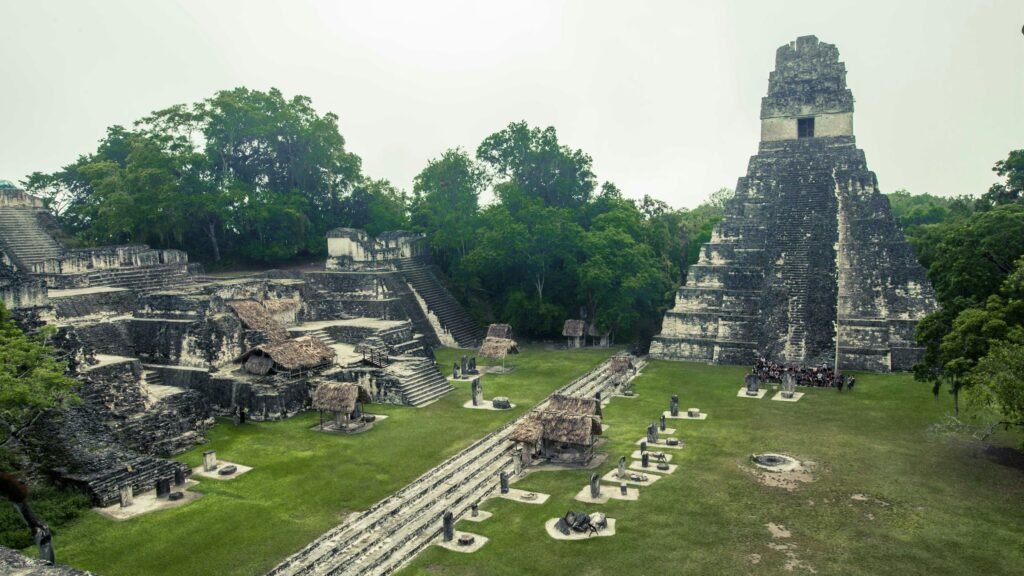
Guatemala is the most populous country in Central America and home to more Indigenous Maya people than any other nation in the region. Its ancient city of Tikal, whose stepped stone pyramids rise above the rainforest canopy of the Peten lowlands, is one of the most recognized archaeological sites in the Western Hemisphere and the anchor of a Maya civilization that shaped the region for well over a thousand years before Spanish colonization.
Where Is Guatemala Located?
Guatemala sits at the northern end of Central America, bordered by Mexico to the north and west, Belize to the northeast, and Honduras and El Salvador to the southeast. It has coastlines on both the Pacific Ocean to the southwest and a short stretch of the Caribbean Sea in the northeast. Its capital and largest city is Guatemala City. Central America is made up of seven countries, including Guatemala, Belize, El Salvador, and Costa Rica, and Guatemala is the largest of them by population.
Geography of Guatemala
Guatemala’s terrain is dominated by volcanic highlands running through the center and south of the country, home to numerous active and dormant volcanoes. Its highest point, Tajumulco Volcano, rises to 4,220 meters (13,845 feet), making it the highest peak in all of Central America. North of the highlands, the country flattens into the Peten, a vast lowland region of tropical rainforest that once supported the dense urban centers of Classic Maya civilization and today still shelters Tikal within a national park.
A Brief History of Guatemala
The Maya Civilization and Tikal
Tikal was one of the major population and ceremonial centers of the Maya civilization, occupied from roughly the sixth century BC to the tenth century AD. Its Great Plaza, temple pyramids, palaces, and ball courts, along with carved stone monuments recording dynastic history, made it one of the most powerful Maya cities of its era. UNESCO inscribed Tikal National Park as a World Heritage Site in 1979, recognizing it for both its cultural significance and the surrounding tropical forest ecosystem.
Spanish Conquest and Colonial Antigua
Spanish forces conquered the highland Maya kingdoms in the early sixteenth century, and in 1524 established the colonial capital of Santiago de Guatemala, which moved to its third and final site, the city now known as Antigua Guatemala, in 1543. For roughly 230 years, Antigua served as the political, religious, and educational capital of the Captaincy General of Guatemala, a Spanish colonial jurisdiction covering much of Central America, before the Santa Marta earthquakes largely destroyed it in 1773. UNESCO listed Antigua Guatemala as a World Heritage Site in 1979 for its preserved Renaissance-style street grid and its Baroque colonial architecture, built to withstand the region’s frequent earthquakes.
Independence and the Twentieth-Century Civil War
Guatemala gained independence from Spain in 1821. The twentieth century brought decades of political instability that culminated in a civil war lasting from 1960 to 1996, one of the longest and deadliest internal conflicts in the Western Hemisphere. According to the United Nations-backed Commission for Historical Clarification, the conflict killed more than 200,000 people, and the army was found responsible for the vast majority of human rights violations, with Indigenous Maya communities suffering the heaviest losses. In 2013, former head of state Efrain Rios Montt was convicted of genocide and crimes against humanity over the killing of at least 1,771 members of the Maya Ixil people during his rule, though the conviction was later overturned on procedural grounds. The war formally ended with the Agreement on a Firm and Lasting Peace, signed on December 29, 1996, after three years of United Nations-moderated negotiations between the government and the Guatemalan National Revolutionary Unity (URNG) rebel coalition.
Government and Economy
Guatemala is the largest economy in Central America. Growth has averaged an estimated 3.6 percent annually over the two decades to 2024 and accelerated to about 4.3 percent in 2025, according to the World Bank, though poverty remains widespread: as of 2023, an estimated 47.3 percent of Guatemalans lived on less than $8.30 a day (in 2021 purchasing-power terms). Chronic child malnutrition is also a persistent problem, affecting an estimated 46 percent of children under five as of 2024. The economy rests substantially on agriculture, including coffee, sugar, and bananas, alongside a large informal labor sector and significant remittance income from Guatemalans working abroad.
Culture and People
Guatemala’s population is estimated at roughly 18.7 million as of 2025, the largest in Central America. Spanish is the official language, but the country’s interior highlands remain a center of living Maya culture, with a number of Mayan languages still spoken alongside Spanish, particularly around the western highland city of Quetzaltenango. Guatemalan human rights advocate Rigoberta Menchu, who campaigned for Indigenous rights and reconciliation after the civil war, was awarded the Nobel Peace Prize in 1992, one of the country’s most internationally recognized honors.
What Is Guatemala Known For, and Why It Matters
Guatemala is best known internationally for its Maya heritage: the ruins of Tikal, the colonial streets of Antigua Guatemala, and living highland Maya communities together make it one of the most historically layered countries in the Americas. It is also a major coffee producer and, as the region’s largest economy and most populous nation, plays an outsized role in Central America’s politics, trade, and migration patterns, including strong economic and remittance ties to the United States. Its neighbors, Belize and El Salvador, along with other Central American nations such as Costa Rica, share both this geography and much of this colonial and Indigenous history, but Guatemala’s scale and the depth of its Maya archaeological record set it apart in the region.
Key facts
- Population: approximately 18.7 million (2025), the most populous country in Central America.2
- Tikal, inscribed as a UNESCO World Heritage Site in 1979, was a major Maya center occupied from roughly the sixth century BC to the tenth century AD.7
- Independence from Spain: 1821.3
- Guatemala's 36-year civil war (1960-1996) killed more than 200,000 people, most of them Indigenous Maya, according to the UN-backed Commission for Historical Clarification.6
- Tajumulco Volcano, at 4,220 meters, is the highest point in Central America.5
Quick checkWhat ended Guatemala's 36-year civil war?Show answer
The Agreement on a Firm and Lasting Peace, signed on December 29, 1996, between the Guatemalan government and the URNG guerrilla coalition, reached after three years of UN-moderated negotiations.
Sources
- World Bank. Guatemala Overview. Undated (accessed 2026-09-23)
- World Bank. World Bank Open Data: Guatemala. 2025 (accessed 2026-09-23)
- Encyclopaedia Britannica. Guatemala. Undated (accessed 2026-09-23)
- Encyclopaedia Britannica. Guatemala - Moving Toward Peace. Undated (accessed 2026-09-23)
- Encyclopaedia Britannica. Tajumulco Volcano. Undated (accessed 2026-09-23)
- United Nations. UN and Guatemala Peace Process. Undated (accessed 2026-09-23)
- UNESCO World Heritage Centre. Tikal National Park. 1979 (accessed 2026-09-23)
- UNESCO World Heritage Centre. Antigua Guatemala. 1979 (accessed 2026-09-23)
Editorially reviewed by Specialty Digest Editorial TeamLast reviewed September 23, 2026Researched and drafted with AI assistanceReport an issue