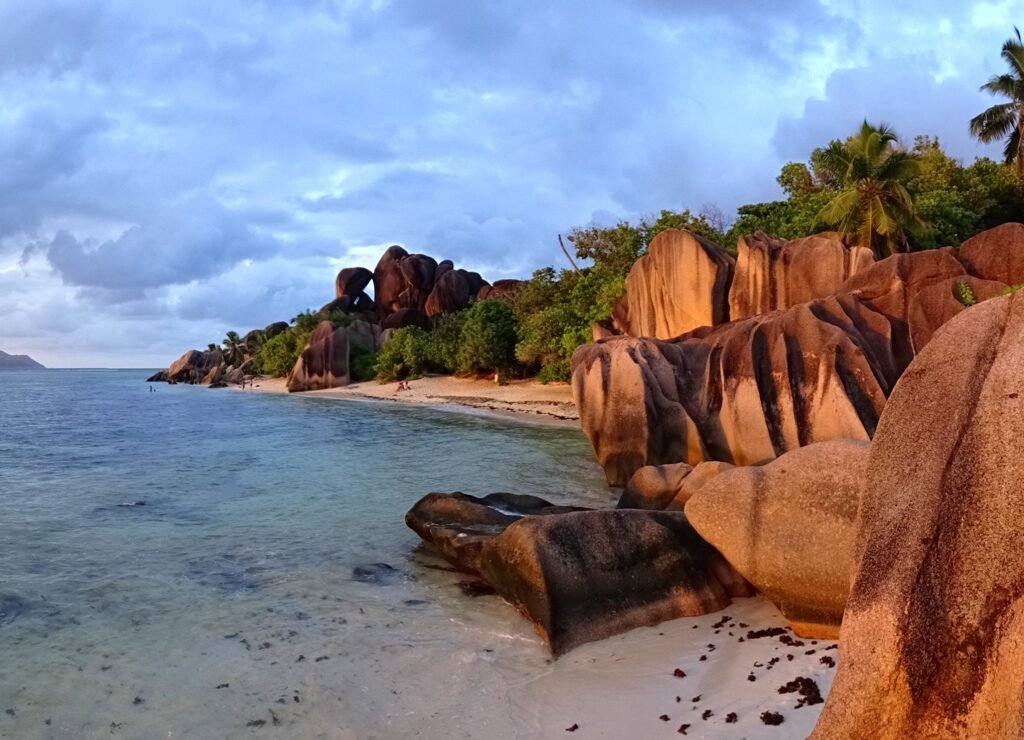
Seychelles is an archipelago of 115 islands in the Indian Ocean, northeast of Madagascar, known for granite-boulder beaches found nowhere else on Earth and for having one of the highest standards of living in Africa.
Where Is Seychelles Located?
Seychelles lies in the western Indian Ocean, roughly 1,000 miles off the coast of East Africa and northeast of Madagascar. According to the World Bank, the country has a total population of about 122,730 people, with three-quarters living on Mahe, the main island, which is also home to the capital, Victoria.[1]
Geography and Landscape
The islands fall into two distinct groups: granite islands, including Mahe, Praslin, and La Digue, which are the eroded remnants of an ancient continental fragment and feature some of the oldest exposed granite rock on the planet, and low-lying coral islands and atolls scattered further from the center of the group. The granite islands’ beaches are famous for enormous, smoothly weathered boulders, nowhere more so than at Anse Source d’Argent on La Digue, widely considered one of the most photographed beaches in the world.
A Brief History
Seychelles was uninhabited until French settlers arrived in the mid-eighteenth century, bringing enslaved laborers to work early plantations. Britain took control during the Napoleonic Wars and administered the islands until Seychelles became independent in 1976. A one-party socialist government took power shortly after independence and held it until a new constitution introduced multiparty elections in 1993.[1]
Government and Economy Today
Seychelles is a presidential republic. It held general elections in September 2025 covering both the presidency and the National Assembly, in which opposition leader Patrick Herminie of United Seychelles defeated incumbent President Wavel Ramkalawan, with United Seychelles also winning a majority of seats in the Assembly.[1] The economy is heavily dependent on tourism and fisheries, and the World Bank notes that Seychelles has the highest per-capita income of any country in Sub-Saharan Africa, though climate change poses long-term risks to its low-lying coral islands and coastal tourism infrastructure.[1]
Culture and People
Seychellois Creole, French, and English are all official languages, and most of the population descends from a mix of French, African, Indian, and Chinese settlers brought together over more than two centuries. Music and dance forms such as moutya, with roots in the islands’ plantation past, remain part of cultural life alongside a strong Roman Catholic influence inherited from French and British colonial rule.
What Is Seychelles Known For?
Seychelles is best known internationally for its beaches, and above all for Anse Source d’Argent on La Digue, where pink-granite boulders frame shallow turquoise water in a scene that has become one of the most recognizable images in global tourism. The islands are also known for rare endemic species, including the giant Aldabra tortoise and the coco de mer, a palm that produces the largest seed of any plant on Earth.
Why Seychelles Matters
As one of the smallest and wealthiest countries in Africa by income per person, Seychelles is frequently cited in debates over small-island vulnerability to climate change, since rising seas threaten both its low-lying islands and the tourism industry its economy depends on. Its granite islands are also geologically unusual, preserving some of the oldest rock exposed anywhere in the ocean.
Key Takeaways
- Seychelles is a 115-island archipelago in the Indian Ocean, northeast of Madagascar, with most people living on Mahe.
- Anse Source d’Argent on La Digue, framed by giant granite boulders, is one of the world’s most photographed beaches.
- Independent from Britain since 1976, Seychelles moved from one-party rule to multiparty democracy in 1993.
- Patrick Herminie was elected president in September 2025, defeating incumbent Wavel Ramkalawan.
- The economy depends heavily on tourism and fisheries, and Seychelles has the highest per-capita income in Sub-Saharan Africa.
Sources
Key facts
Quick checkWhat is the single most photographed beach landmark in Seychelles?Show answer
Anse Source d'Argent on La Digue, known for its giant pink-granite boulders.
Sources
- World Bank. Seychelles Overview. Undated, continuously updated (accessed 2026-10-04)
Editorially reviewed by Specialty Digest Editorial TeamLast reviewed October 4, 2026Researched and drafted with AI assistanceReport an issue