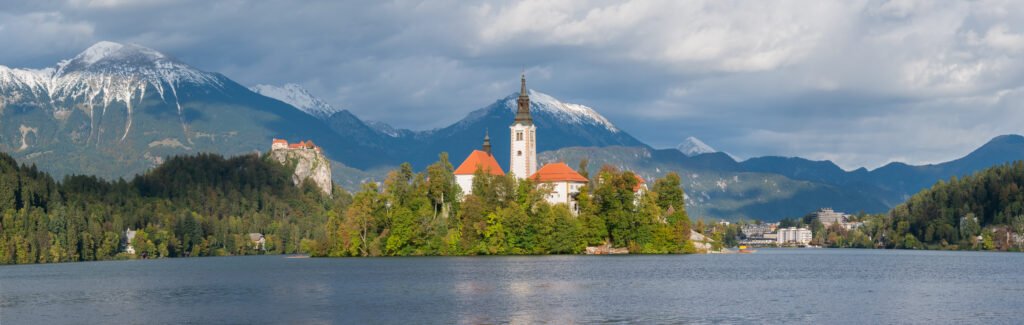
Slovenia is a small, mountainous country in Central Europe where the Alps meet the Adriatic, best known for Lake Bled, where a tiny church-topped island sits in turquoise water beneath a hilltop castle.
Where Is Slovenia Located?
Slovenia sits in Central Europe, bordered by Austria to the north, Hungary to the northeast, Croatia to the south and east, and Italy to the west, with a short coastline on the Adriatic Sea. According to the Slovenian Statistical Office, the country’s population was 2,136,385.[1] The capital, Ljubljana, lies roughly in the center of the country.
Geography and Landscape
The Julian Alps dominate the northwest, holding Slovenia’s highest peak, Triglav, which also appears on the national flag, while the landscape transitions through rolling wine country and karst limestone plateaus, including the Skocjan and Postojna cave systems, before reaching a brief stretch of Adriatic coast near Trieste. In the northwest, Lake Bled sits in a glacial valley beneath the Julian Alps, its small island crowned by a seventeenth-century church and the medieval Bled Castle perched on a cliff above the water.
A Brief History
The area that is now Slovenia was part of the Austro-Hungarian Empire until the end of the First World War, after which it became part of the Kingdom of Serbs, Croats and Slovenes and later the Socialist Federal Republic of Yugoslavia. Slovenia declared independence from Yugoslavia in June 1991, and after a brief ten-day war with Yugoslav federal forces, became fully independent with comparatively little of the violence that affected other parts of the former Yugoslavia later in the decade. It joined the European Union and NATO in 2004 and adopted the euro in 2007.
Government and Economy Today
Slovenia is a parliamentary republic and a member of the European Union and the eurozone. It is among the more prosperous of the states that emerged from Yugoslavia, with an economy built on manufacturing, including automotive parts and pharmaceuticals, as well as tourism centered on its Alpine and coastal scenery. Its national statistical office reported a population of 2,136,385 as part of its continuously updated population figures.[1]
Culture and People
Slovene, a South Slavic language, is the official language, and Slovenia has one of the highest rates of literacy and library use per capita in Europe, reflecting a strong tradition of public education dating back to the nineteenth-century national revival movement. Alpine skiing, mountaineering, and beekeeping all hold an outsized place in Slovenian cultural life relative to the country’s small population, and Ljubljana has developed a reputation as one of the greenest and most walkable small capitals in Europe.
What Is Slovenia Known For?
Slovenia is best known internationally for Lake Bled, whose postcard view of Bled Island’s church and the hilltop castle above the lake is the single image most associated with the country. Slovenia is also known for the Postojna and Skocjan cave systems, the Julian Alps and Mount Triglav, and for producing an unusually large number of world-class skiers and mountaineers for its small population.
Why Slovenia Matters
Slovenia’s rapid, comparatively peaceful exit from Yugoslavia and its subsequent integration into the European Union and eurozone have made it a frequently cited example of a small post-communist state’s successful transition to a market economy. Its position straddling the Alps, the Adriatic, and the Pannonian basin also gives it an unusually dense concentration of distinct landscapes for its size.
Key Takeaways
- Slovenia lies in Central Europe between Austria, Hungary, Croatia, and Italy, with a short Adriatic coastline.
- It declared independence from Yugoslavia in 1991 after a brief, largely nonviolent ten-day war.
- Lake Bled, with its island church and hilltop castle, is the country’s most iconic image.
- Slovenia joined the EU and NATO in 2004 and adopted the euro in 2007.
- The national statistical office recorded a population of 2,136,385.
Sources
Key facts
- Population recorded as 2,136,385 by the national statistical office (SURS)1
- Declared independence from Yugoslavia in June 1991 after a brief ten-day war
- Joined the European Union and NATO in 2004
- Adopted the euro as its currency in 2007
Quick checkWhat lake, with an island church and hilltop castle, is Slovenia's most iconic image?Show answer
Lake Bled, in the Julian Alps in the northwest of the country.
Sources
- Statistical Office of the Republic of Slovenia (SURS). Population of Slovenia. Continuously updated (accessed 2026-10-04)
Editorially reviewed by Specialty Digest Editorial TeamLast reviewed October 4, 2026Researched and drafted with AI assistanceReport an issue