Sri Lanka is an island nation in South Asia, situated in the Indian Ocean southeast of India and sharing maritime borders with India and the Maldives. Its capital and largest city is Colombo. Known for its tea exports, Buddhist heritage, and dramatic ancient monuments, Sri Lanka has also weathered a long civil conflict and a severe recent economic crisis on its way to becoming one of South Asia’s most historically rich destinations.
Where Is Sri Lanka Located?
Sri Lanka lies in the Indian Ocean off the southeastern tip of the Indian subcontinent, separated from India by the Gulf of Mannar and the Palk Strait. The island’s interior rises into a mountainous central highlands region, ringed by coastal lowlands and beaches, and its position along major Indian Ocean shipping lanes has shaped its history as a trading hub for more than two thousand years.
A Brief History of Sri Lanka
Ancient Kingdoms and Buddhist Heritage
Sri Lanka’s recorded civilization dates back over two thousand years, with early kingdoms centered on cities such as Anuradhapura and Polonnaruwa. Buddhism, introduced to the island in the third century BCE, became central to Sinhalese culture and remains the majority religion today, alongside Hindu, Muslim, and Christian communities shaped by later waves of trade and migration.
Colonial Rule and Independence
Sri Lanka, then known as Ceylon, passed through Portuguese, Dutch, and British colonial control between the sixteenth and twentieth centuries before gaining independence from Britain in 1948. It adopted its current name in 1972, when it became a republic.
Civil War and Recovery
Between 1983 and 2009, Sri Lanka was engulfed in a civil war between the government and Tamil separatist forces seeking an independent state in the north and east. Since the war’s end, the country has focused on reconstruction, though it was later hit by a severe economic crisis beginning in 2022, marked by fuel and food shortages, high inflation, and a sovereign debt default, which triggered political upheaval and ongoing International Monetary Fund-supported reforms.
Government and Economy
The World Bank classifies Sri Lanka as an upper-middle-income country, with a population of approximately 21.9 million as of 2024 and a gross national income per capita of about $3,870 that same year.[2] The economy has long depended on agricultural exports such as tea, rubber, coconut, and spices, alongside a growing services sector built around tourism, transport, and financial services, and the World Bank notes that Sri Lanka has also been a long-standing regional leader in health and education outcomes relative to its income level.[1]
Culture and People
Sinhala and Tamil are the country’s official languages, reflecting its two largest ethnic communities, with English widely used in business and government. Buddhist temples, Hindu kovils, mosques, and churches stand alongside one another across the island, and the cuisine, built around rice, curry, and coconut, draws on centuries of trade contact with South India, the Arab world, and Europe.
What Is Sri Lanka Known For?
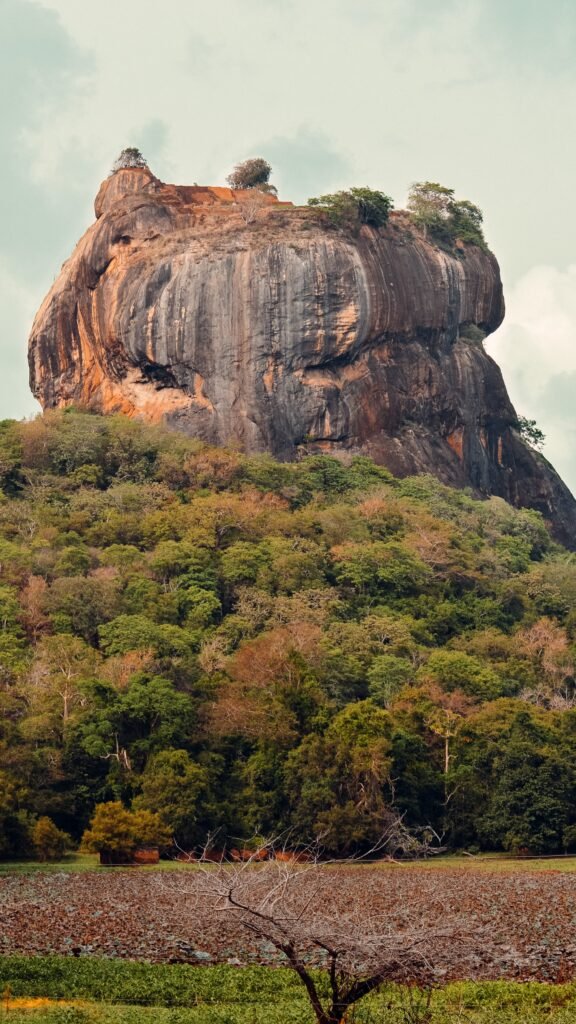
The Ancient City of Sigiriya, a fifth-century rock fortress rising nearly 200 meters above the surrounding plain, is Sri Lanka’s single most recognizable landmark and a UNESCO World Heritage Site.[3] Built, according to traditional accounts, under King Kashyapa I in the late fifth century, the site is known for its surviving frescoes, mirror wall, and the giant lion’s-paw staircase entrance that gives the rock its popular name, Lion Rock. Beyond Sigiriya, Sri Lanka is known globally for Ceylon tea, its wildlife parks and leopard and elephant populations, its ancient Buddhist stupas, and its beaches along the southern and western coasts.
Why Sri Lanka Matters
Sri Lanka’s position astride some of the busiest shipping routes in the Indian Ocean has made it strategically significant for centuries, and that significance persists today as regional and global powers compete for port access and influence in South Asia. The country’s recovery from both civil war and a severe economic crisis also makes it a closely watched case study in post-conflict reconstruction and debt restructuring, while its deep layering of Buddhist, Hindu, colonial, and trading history gives it a cultural density few islands of its size can match.
Key Takeaways
- Sri Lanka is an island nation in the Indian Ocean, located southeast of India and sharing maritime borders with India and the Maldives.
- Its capital is Colombo, and its population was approximately 21.9 million as of 2024.[2]
- Gross national income per capita was about $3,870 in 2024, and the World Bank classifies the country as upper-middle income.[2]
- Sri Lanka gained independence from Britain in 1948 and became a republic under its current name in 1972.
- A civil war between 1983 and 2009 and a severe economic crisis beginning in 2022 are both central to the country’s recent history.
- The Ancient City of Sigiriya, a fifth-century rock fortress, is Sri Lanka’s most iconic landmark and a UNESCO World Heritage Site.[3]
Sources
- World Bank, “Sri Lanka Overview,” worldbank.org/en/country/srilanka/overview, accessed October 4, 2026
- World Bank Open Data (World Development Indicators), population, GNI per capita, and income classification for Sri Lanka, data.worldbank.org/country/sri-lanka, 2024 data, accessed October 4, 2026
- UNESCO World Heritage Centre, “Ancient City of Sigiriya,” whc.unesco.org/en/list/202, accessed October 4, 2026
Key facts
- Population: approximately 21.9 million as of 2024.2
- Gross national income per capita: approximately $3,870 in 2024; classified upper-middle income by the World Bank.2
- Capital: Colombo.2
- Gained independence from Britain in 1948; became a republic under the name Sri Lanka in 1972.
- Ancient City of Sigiriya is a UNESCO World Heritage Site.3
Quick checkWhat is Sri Lanka's most famous ancient landmark?Show answer
Sigiriya, a fifth-century rock fortress and UNESCO World Heritage Site, also known as Lion Rock.
Sources
- World Bank. Sri Lanka Overview. 2026 (accessed 2026-10-04)
- World Bank Open Data. Population, total, GNI per capita, and income classification, Sri Lanka. 2024 data (accessed 2026-10-04)
- UNESCO World Heritage Centre. Ancient City of Sigiriya. Undated (accessed 2026-10-04)
Editorially reviewed by Specialty Digest Editorial TeamLast reviewed October 4, 2026Researched and drafted with AI assistanceReport an issue