India is a country in South Asia, the seventh-largest in the world by land area and, since 2023, the most populous, with a population estimated at more than 1.4 billion people. It occupies most of the Indian subcontinent, stretching from the high peaks of the Himalayas in the north to the Indian Ocean in the south, and its capital is New Delhi.
Where Is India Located?
India sits in South Asia, bordered by Pakistan to the west, China, Nepal, and Bhutan along its northern frontier, and Bangladesh and Myanmar to the east. To the south, its coastline runs along the Arabian Sea and the Bay of Bengal, both arms of the Indian Ocean, and the island nations of Sri Lanka and the Maldives lie offshore. Covering roughly 3.287 million square kilometers, India is large enough to contain enormous internal variety: snow-bound mountain valleys in Kashmir and Ladakh, tropical rainforest in the northeast and the Western Ghats, and arid desert in Rajasthan, all within one country.
Mountains, Plains, and Plateau
The Himalayas form a natural wall along India’s northern border, containing some of the highest mountains on Earth and feeding the rivers that sustain hundreds of millions of people downstream. South of the mountains lies the Indo-Gangetic Plain, a vast, fertile lowland built up by the Indus, Ganges, and Brahmaputra river systems and their tributaries. It has been the demographic and agricultural core of the subcontinent for millennia. Further south, the land rises onto the Deccan Plateau, flanked by the Western and Eastern Ghats, two mountain ranges that shape the monsoon rains reaching the interior. India’s climate is dominated by the seasonal monsoon: a southwest monsoon from roughly June to September brings the bulk of the country’s annual rainfall and remains central to its agricultural output.
The Kashmir Dispute
Part of India’s northern border, in the Kashmir region, has been contested since the 1947 partition of British India. India administers the Kashmir Valley and Jammu as part of the union territory of Jammu and Kashmir and maintains that the entire former princely state belongs to India. Pakistan controls a portion in the west, which it administers as Azad Kashmir and Gilgit-Baltistan, while China administers Aksai Chin in the east. India and Pakistan have fought several wars over the territory, and India and China also dispute sections of their shared Himalayan border further east. The dispute remains unresolved and is a recurring source of regional tension. Each government’s territorial claims are described here as claims, not as settled fact.
A Brief History of India
Ancient and Classical Periods
India is home to one of the world’s oldest urban civilizations. The Indus Valley Civilization, centered on cities such as Harappa and Mohenjo-daro, flourished from roughly 2500 BCE with sophisticated urban planning and drainage systems. It was followed by the Vedic period, during which the foundational texts of Hinduism took shape, and, in the third century BCE, by the Maurya Empire under Emperor Ashoka, who unified much of the subcontinent and promoted Buddhism after his conversion. The Gupta Empire, from roughly the fourth to sixth centuries CE, is often called a classical age of Indian civilization, marked by advances in mathematics, including the concept of zero, astronomy, and Sanskrit literature.
Medieval and Mughal India
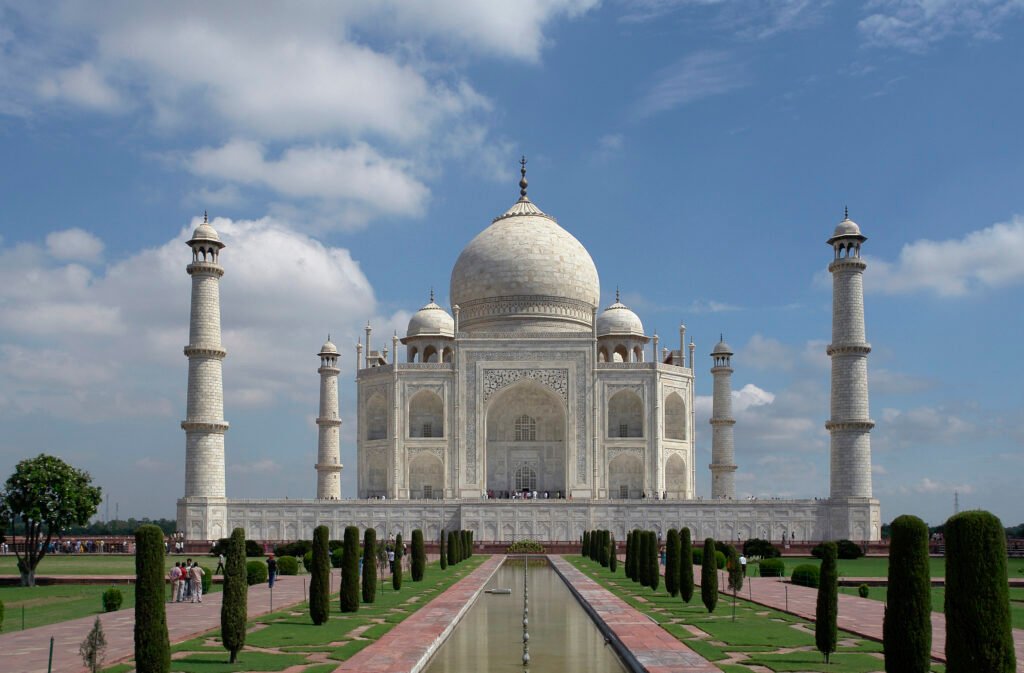
From the 13th century, the Delhi Sultanate brought sustained Islamic political rule to northern India, and in 1526 the Mughal Empire began a period of centralized rule that lasted more than three centuries. Mughal emperors such as Akbar and Shah Jahan presided over a synthesis of Persian, Central Asian, and Indian artistic traditions. Shah Jahan commissioned the Taj Mahal in Agra in memory of his wife, Mumtaz Mahal, with construction of the mausoleum running from 1632 to 1648.
Colonial Rule and Independence
European trading companies, especially the British East India Company, established a growing commercial and military presence from the early 1600s and gradually took direct control of large parts of the subcontinent. Following a major rebellion in 1857, the British Crown assumed direct rule, a period known as the British Raj, which lasted until 1947. A sustained independence movement, associated above all with Mohandas Gandhi’s philosophy of nonviolent resistance, grew through the early 20th century. India became independent on August 15, 1947, an event accompanied by the partition of British India into India and Pakistan and by mass displacement and violence along religious lines.
Government and Economy
India is a federal parliamentary republic made up of 28 states and several union territories. A president serves as head of state in a largely ceremonial capacity, while executive power rests with a prime minister and council of ministers accountable to a bicameral Parliament, consisting of the Lok Sabha (House of the People) and the Rajya Sabha (Council of States). India holds the largest elections in the world by number of eligible voters.
According to the World Bank, India’s economy has grown substantially since 2000, nearly quadrupling in real terms and roughly tripling per capita income. Its share of the global economy doubled from about 1.6 percent in 2000 to 3.4 percent in 2023, making it the world’s fifth-largest economy. Growth has been driven in part by a large services sector, including software and business-process exports, alongside agriculture and a growing manufacturing base. The World Bank also reports that extreme poverty fell sharply, from 16.2 percent of the population in fiscal year 2011-12 to 2.3 percent in fiscal year 2022-23, though it notes continuing development challenges, including informal labor markets, low female labor force participation, and regional disparities in development outcomes.
People and Culture
Languages
India’s linguistic diversity is exceptional. The Constitution lists 22 scheduled languages, and hundreds more are spoken across the country. Hindi and English are the two languages used for official union government business, while individual states designate their own official languages, among them Bengali, Tamil, Telugu, Marathi, Gujarati, Punjabi, and many others.
Religion
India is the birthplace of four major world religions: Hinduism, Buddhism, Jainism, and Sikhism. Hinduism is practiced by roughly four-fifths of the population, and India also has one of the largest Muslim populations of any country in the world, alongside significant communities of Christians, Sikhs, Buddhists, Jains, and smaller religious groups such as Zoroastrian Parsis. This religious and cultural diversity is expressed across regional cuisines, classical and folk performing arts such as Bharatanatyam and Kathak dance, a large and internationally recognized film industry centered in Mumbai, and a calendar rich with festivals, including Diwali, Holi, and Eid.
What Is India Best Known For?
Internationally, India is most closely associated with the Taj Mahal, the white marble mausoleum in Agra that stands as one of the most recognized buildings on Earth and a UNESCO World Heritage Site. Beyond that single monument, India is known for its ancient and continuous civilizational history, its role as the birthplace of major world religions and of yoga, its diverse and spice-rich regional cuisines, and a film industry, popularly called Bollywood, that produces more feature films annually than any other country. It is also increasingly known as a global hub for information technology and software services and for an expanding space program, run by the Indian Space Research Organisation.
Why India Matters Globally
India’s scale alone gives it outsized global significance. It is home to roughly one in six people on Earth, and its economic growth trajectory, as tracked by institutions such as the World Bank, is reshaping global trade, labor markets, and technology supply chains. As a nuclear-armed state and a member of groupings such as the G20, which it hosted in 2023, India plays an increasingly central role in international diplomacy and security. Its large and continuing diaspora, its democratic scale, and its historical role as a meeting point of religious and cultural traditions all mean that developments inside India, from economic policy to elections, tend to have consequences well beyond its borders.
Key Takeaways
- India is the world’s most populous country, with more than 1.4 billion people, and the seventh-largest by land area.
- It is a federal parliamentary republic composed of 28 states and several union territories.
- India’s history stretches from the Indus Valley Civilization, one of the world’s earliest urban cultures, through the Mauryan, Gupta, and Mughal empires to British colonial rule and independence in 1947.
- The Taj Mahal, in Agra, is India’s most recognized landmark and a UNESCO World Heritage Site.
- India is the birthplace of Hinduism, Buddhism, Jainism, and Sikhism, and is home to one of the world’s largest Muslim populations.
- According to the World Bank, India’s economy grew to become the world’s fifth-largest by 2023, though significant development challenges remain.
- Part of India’s northern border, in the Kashmir region, remains the subject of an unresolved territorial dispute involving Pakistan and, in part, China.
Sources
- World Bank, “India Overview”: worldbank.org/en/country/india/overview
- UNESCO World Heritage Centre, “Taj Mahal”: whc.unesco.org/en/list/252
Key facts
- Capital: New Delhi
- Population: More than 1.4 billion, the world's most populous country (UN estimate)
- Area: Approximately 3.287 million square kilometers, the seventh-largest country by land area
- Government: Federal parliamentary republic
- Official languages: Hindi and English at the union level; 22 languages listed in the Constitution
- Currency: Indian rupee (INR)
- Independence: August 15, 1947, from the United Kingdom
- Major religions: Hinduism, Islam, Christianity, Sikhism, Buddhism, Jainism
Quick checkWhat is India's most globally recognized landmark, and where is it located?Show answer
The Taj Mahal, a white marble mausoleum built by Mughal Emperor Shah Jahan in memory of his wife Mumtaz Mahal, located in Agra, in the state of Uttar Pradesh.
Sources
- World Bank, India Overview, worldbank.org/en/country/india/overview
- UNESCO World Heritage Centre, Taj Mahal, whc.unesco.org/en/list/252
Editorially reviewed by Specialty Digest Editorial TeamLast reviewed September 27, 2026Researched and drafted with AI assistanceReport an issue