Turkey is a transcontinental country that stretches across the southeastern edge of Europe and the western edge of Asia, with the Bosporus and Dardanelles straits marking the boundary between the two continents. Bordered by the Black Sea to the north, the Aegean and Mediterranean Seas to the west and south, and eight countries across Europe, the Caucasus, and the Middle East, Turkey occupies one of the most strategically significant positions on Earth.
Where Is Turkey Located?
Turkey sits at the meeting point of Europe and Asia. Its small European portion, Eastern Thrace, lies west of the Bosporus and is separated from the much larger Asian portion, Anatolia, by the Bosporus Strait, the Sea of Marmara, and the Dardanelles Strait. This waterway system, known collectively as the Turkish Straits, connects the Black Sea to the Mediterranean and has made the region a crossroads of trade and conquest for thousands of years. Turkey shares land borders with Greece, Bulgaria, Georgia, Armenia, Azerbaijan, Iran, Iraq, and Syria.
Geography of Turkey
Most of Turkey’s territory lies on the Anatolian Plateau, a high interior flanked by mountain ranges: the Pontic Mountains along the Black Sea coast and the Taurus Mountains along the Mediterranean coast. The country’s highest point, Mount Ararat, near the border with Armenia, rises to 5,137 meters. Turkey is also one of the most seismically active countries in the world, sitting astride the North Anatolian and East Anatolian fault lines. A pair of major earthquakes in February 2023 caused more than 50,000 deaths and widespread destruction across the country’s southeast, with recovery and reconstruction needs estimated at roughly $81.5 billion.[1]
A Brief History of Turkey
Anatolia has been continuously inhabited for thousands of years and has been home to civilizations including the Hittites, the Greeks, and the Romans. From the fourth century CE it formed the heartland of the Byzantine Empire, with Constantinople, now Istanbul, as its capital. In 1453, Ottoman forces under Sultan Mehmed II captured Constantinople, ending the Byzantine Empire and establishing the city as the seat of the Ottoman Empire, which at its height controlled territory across southeastern Europe, the Middle East, and North Africa.
From Empire to Republic
The Ottoman Empire’s defeat in the First World War led to its dissolution and the occupation of parts of Anatolia by foreign powers. Mustafa Kemal, later given the surname Ataturk, meaning Father of the Turks, led a national resistance movement that secured Turkish independence. The Republic of Turkey was proclaimed on October 29, 1923, with Ankara as its capital, and Ataturk introduced sweeping secularizing and modernizing reforms, including a new Latin based alphabet, that continue to shape the country’s institutions today.
Government and Economy
Turkey is a presidential republic and a founding member of the United Nations, as well as a member of NATO, the OECD, and the G20. As of 2024, it had the 17th largest economy in the world, with a gross domestic product of approximately $1.32 trillion and a GDP per capita of roughly $15,461. Real GDP growth averaged 5.4 percent a year between 2002 and 2022, roughly doubling income per capita in real terms and cutting the poverty rate from above 20 percent in 2007 to 7.6 percent in 2021, though inflation and slowing productivity growth have presented challenges in more recent years.[1]
Culture and People
Turkey’s population, estimated at 85.5 million in 2024, is predominantly Turkish, with a significant Kurdish minority concentrated in the southeast and smaller communities including Arabs and Circassians.[1] The country is overwhelmingly Muslim by tradition, though the republic is constitutionally secular. Turkish cuisine, music, and hospitality traditions draw on a blend of Central Asian, Middle Eastern, Balkan, and Mediterranean influences, reflecting the country’s long history as a meeting point of peoples and trade routes.
What Is Turkey Known For?
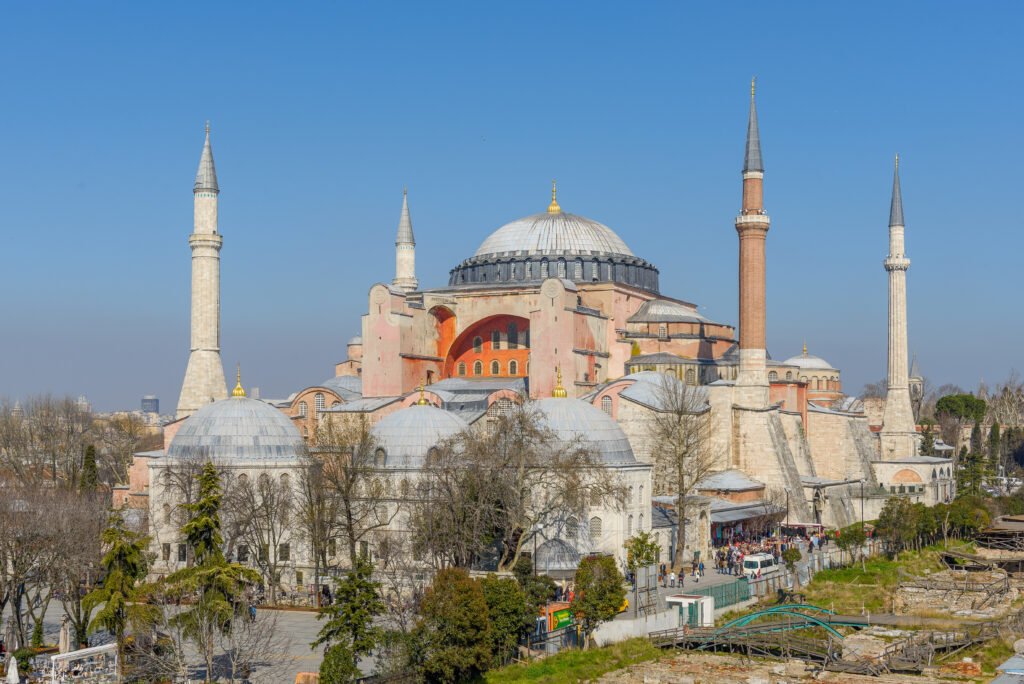
Turkey is best known internationally for Istanbul, the only major city in the world to straddle two continents, and for the monuments that trace its layered religious and imperial history. Chief among these is the Hagia Sophia, built as a Christian cathedral under the Byzantine Emperor Justinian I in 537 CE, converted into a mosque after the Ottoman conquest of 1453, used as a museum for much of the twentieth century, and reconverted into a working mosque in 2020. Its vast dome and interior mosaics make it one of the most recognizable buildings on Earth, and it forms part of the Historic Areas of Istanbul, a UNESCO World Heritage Site.[2] Turkey is also known for the fairy chimney landscape of Cappadocia, the classical ruins of Ephesus, and its position as a bridge between European and Middle Eastern cultures.
Why Turkey Matters
Turkey’s location gives it outsized geopolitical weight: it controls the only sea passage between the Black Sea and the Mediterranean, borders both the European Union and several of the Middle East’s most volatile states, and has historically served as a bridge between NATO and its neighbors to the east. Its economy, among the world’s twenty largest, makes it an important trading partner and a significant player in regional energy and transit infrastructure.
Key Takeaways
- Turkey is a transcontinental country, with a small European portion and a much larger Asian portion, Anatolia, divided by the Bosporus and Dardanelles straits.
- Istanbul, built on the site of the former Byzantine and Ottoman capital of Constantinople, is the only major city in the world situated on two continents.
- The Hagia Sophia, part of the UNESCO listed Historic Areas of Istanbul, has served in turn as a cathedral, a mosque, a museum, and today a mosque again.
- The Republic of Turkey was founded in 1923 by Mustafa Kemal Ataturk after the collapse of the Ottoman Empire.
- Turkey had the world’s 17th largest economy in 2024, with a GDP of approximately $1.32 trillion.
Sources
- World Bank, “Turkiye Overview” (last updated April 24, 2025, accessed October 5, 2026)
- UNESCO World Heritage Centre, “Historic Areas of Istanbul” (accessed October 5, 2026)
- Encyclopaedia Britannica, “Turkey” (accessed October 5, 2026, used as a tertiary reference for uncontroversial chronology)
Key facts
- Population: approximately 85.5 million (2024)1
- GDP: approximately $1.32 trillion, the world's 17th largest economy (2024)1
- Capital: Ankara; largest city: Istanbul
- Founding member of the United Nations; member of NATO, the OECD, and the G201
- The Hagia Sophia and the Historic Areas of Istanbul are a UNESCO World Heritage Site2
Quick checkWhat is Turkey's capital, and what is its largest city?Show answer
Ankara is the capital of Turkey, while Istanbul, the historic former capital of the Byzantine and Ottoman Empires, is its largest city and economic center.
Sources
- World Bank. Turkiye Overview. Last updated April 24, 2025 (accessed Accessed October 5, 2026)
- UNESCO World Heritage Centre. Historic Areas of Istanbul. Undated (accessed Accessed October 5, 2026)
- Encyclopaedia Britannica. Turkey. Undated (accessed Accessed October 5, 2026)
Editorially reviewed by Specialty Digest Editorial TeamLast reviewed October 5, 2026Researched and drafted with AI assistanceReport an issue