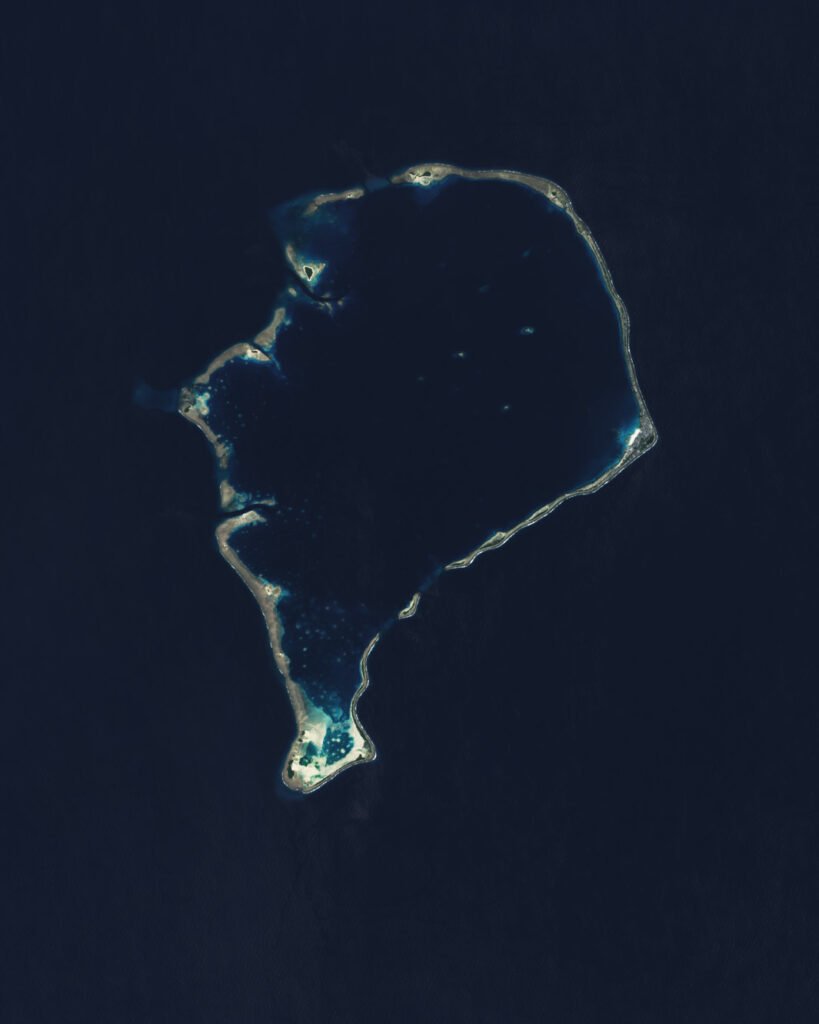
Tuvalu is a Polynesian island nation in the central Pacific Ocean, made up of nine coral atolls and islands with a combined land area of roughly 26 square kilometers, about 3 percent of the land area of New York City.[1] With a mean elevation of only about 2 meters above sea level, it is one of the lowest lying and most climate vulnerable countries on Earth.[1]
Where Is Tuvalu Located?
Tuvalu sits in the central Pacific Ocean, roughly halfway between Hawaii and Australia, north of Fiji and south of Kiribati. Its nine islands and atolls are scattered across a wide expanse of ocean, with a total land area smaller than most cities despite the large stretch of sea the country claims as its exclusive economic zone.
Geography of Tuvalu
Tuvalu’s largest atoll, Funafuti, encloses a central lagoon reached through seven main ocean passages, with the Funafuti Conservation Area protecting reefs and islets along its western side.[1] Funafuti’s largest islet is home to more than half of Tuvalu’s population of roughly 12,000 people.[1] The islands have no rivers and little elevation, so residents depend heavily on rainwater catchment and imported goods. Average sea levels around Tuvalu have risen about 15 centimeters over the past 30 years, a rate about 1.5 times the global average, and a 2023 NASA assessment projected that much of the country’s land and infrastructure will sit below the average high tide line by 2050.[1]
A Brief History of Tuvalu
The islands were originally settled by Polynesian voyagers. They became a British protectorate in the late nineteenth century and were administered together with the Gilbert Islands, now Kiribati, as the Gilbert and Ellice Islands colony, with Tuvalu then known as the Ellice Islands. Following a 1974 referendum, the Ellice Islands separated from the Gilbert Islands, and Tuvalu became fully independent on October 1, 1978. It joined the United Nations in 2000.
Funafuti and the Science of Atolls
Funafuti has long attracted scientific attention as a natural laboratory for understanding how coral atolls form. Drawing on observations from the 1831 to 1836 voyage of HMS Beagle, Charles Darwin proposed that atolls evolved from coral reefs that grew upward around sinking volcanic islands. Between 1896 and 1898, the Royal Society sponsored expeditions to Funafuti that drilled more than 300 meters into the atoll’s carbonate rock without striking volcanic material, a result broadly consistent with Darwin’s theory, and a commemorative plaque still marks the drill site today.[1]
Government and Economy
Tuvalu is a parliamentary democracy and a constitutional monarchy within the Commonwealth, with its own parliament and prime minister handling day to day governance. It has one of the smallest economies and populations of any sovereign state. A notable source of government revenue is the licensing of its internet country code, .tv, to media and streaming platforms worldwide, alongside fishing license fees and international development assistance. The low lying country has become a leading voice in international climate diplomacy, and it participates in the Rising Nations Initiative, launched with the United Nations Global Centre for Climate Mobility, and the Tuvalu Coastal Adaptation Project to fortify its coastline against rising seas.[1]
Culture and People
Tuvaluans are Polynesian, and most of the population lives on Funafuti. Tuvaluan and English are the official languages, and community life is centered on the maneapa, a large open sided meeting house found on each island that serves as a venue for ceremonies, councils, and gatherings. Fishing, subsistence agriculture on coral soil, and strong extended family and communal obligations remain central to daily life.
What Is Tuvalu Known For?
Tuvalu is best known today as a frontline case in global discussions of sea level rise and climate change, given its combination of extremely low elevation, small land area, and total dependence on the surrounding ocean. Funafuti atoll itself, visible from above as a narrow ring of land enclosing a turquoise lagoon, has become a widely used visual symbol of that vulnerability, and remains historically significant as one of the sites where Darwin’s theory of atoll formation was first tested in the field.[1]
Why Tuvalu Matters
Despite its small size, Tuvalu has an outsized voice in international climate negotiations, where it has pushed for stronger global commitments on emissions and adaptation funding on the grounds that its very existence as a habitable country is at stake. Its situation is frequently cited in scientific and policy discussions as an early indicator of the risks that low lying island and coastal communities worldwide are likely to face as sea levels continue to rise.
Key Takeaways
- Tuvalu is a nine island Polynesian nation in the central Pacific with a total land area of about 26 square kilometers.
- Its mean elevation of roughly 2 meters makes it one of the countries most exposed to sea level rise.
- Tuvalu became independent from Britain on October 1, 1978, after separating from the Gilbert Islands, now Kiribati.
- Funafuti, its largest atoll, was a key site in testing Charles Darwin’s theory of how coral atolls form.
- Tuvalu licenses its .tv internet domain internationally as a significant source of government revenue.
Sources
- NASA Earth Observatory, “Funafuti Atoll, Tuvalu” (published 2024, accessed October 5, 2026)
- Encyclopaedia Britannica, “Tuvalu” (accessed October 5, 2026, used as a tertiary reference for uncontroversial chronology)
Key facts
- Population: approximately 12,000 (2023 estimate)1
- Land area: approximately 26 square kilometers across nine atolls and islands
- Capital: Funafuti
- Independent from the United Kingdom since October 1, 1978
- Sea level around Tuvalu has risen about 15 centimeters over the past 30 years, 1.5 times the global average1
Quick checkWhy is Tuvalu considered especially vulnerable to climate change?Show answer
Its nine islands have a mean elevation of only about 2 meters above sea level, so even modest sea level rise threatens much of its habitable land and infrastructure.
Sources
- NASA Earth Observatory. Funafuti Atoll, Tuvalu. 2024 (accessed Accessed October 5, 2026)
- Encyclopaedia Britannica. Tuvalu. Undated (accessed Accessed October 5, 2026)
Editorially reviewed by Specialty Digest Editorial TeamLast reviewed October 5, 2026Researched and drafted with AI assistanceReport an issue