Mumbai, formerly known as Bombay, is the largest city in India and the country’s financial capital, built on a cluster of islands off the west coast that were joined into a single peninsula over several centuries.
Where Is Mumbai Located?
Mumbai sits on the Arabian Sea coast of the Indian state of Maharashtra, on what was originally a group of seven islands. Land reclamation projects carried out mainly under Portuguese and later British control gradually fused these islands into a single landmass over the 18th and 19th centuries, creating the narrow peninsula on which the city’s commercial core, South Mumbai, now stands.
A Brief History of Mumbai
The islands passed to Portugal in the 16th century and were given to England’s King Charles II in 1661 as part of a royal marriage dowry, after which the English Crown leased them to the East India Company in 1668. The Company developed Bombay into a major trading port, and by the 19th century, under direct British Crown rule following 1858, it had become India’s leading cotton-trading and financial center, a position reflected in landmark construction such as the Victoria Terminus railway station, completed in 1888. India gained independence in 1947, and the city, renamed Mumbai in 1995 after the Marathi goddess Mumbadevi, has remained the country’s principal commercial hub and the capital of Maharashtra state.
Culture, Economy and Daily Life in Mumbai
Mumbai is India’s financial capital, home to the Bombay Stock Exchange and the National Stock Exchange, the Reserve Bank of India’s main offices, and the headquarters of most major Indian corporations and banks. It is also the center of the Hindi-language film industry known as Bollywood, one of the largest film industries in the world by output. According to the World Bank, India’s economy has nearly quadrupled in real terms since 2000, becoming the world’s fifth-largest economy, growth in which Mumbai’s financial and media sectors have played an outsized role relative to the city’s share of the national population.
Mumbai’s Most Famous Landmarks
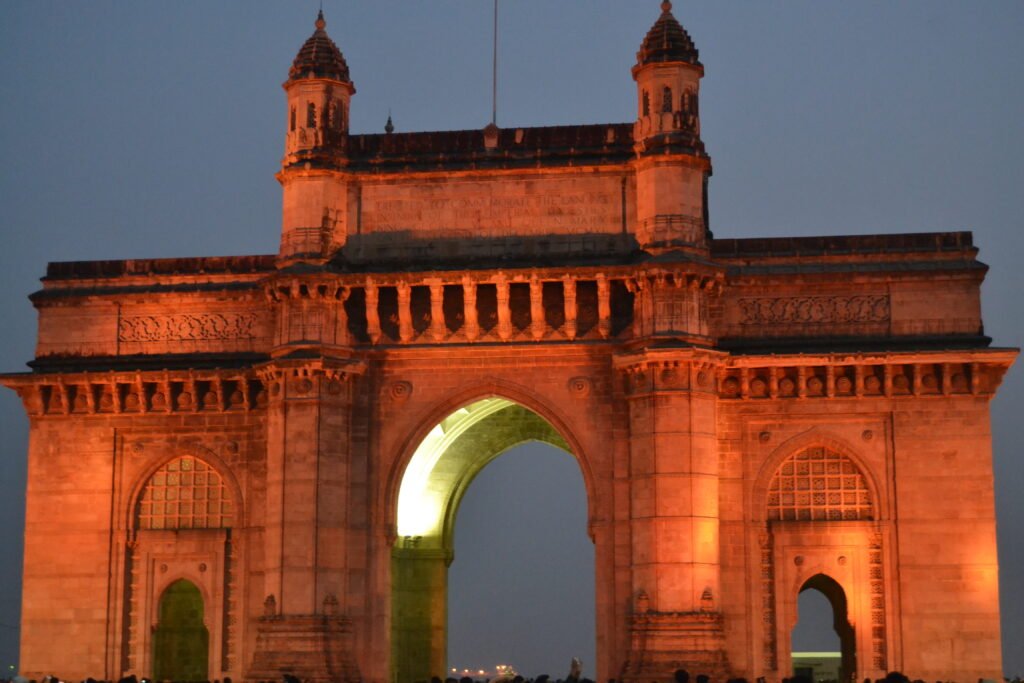
The Gateway of India, a monumental arch built on the Mumbai waterfront and completed in 1924 to commemorate a 1911 royal visit by King George V and Queen Mary, is the city’s single most recognized landmark and the point from which the last British troops departed India in 1948. Mumbai’s Victorian Gothic and Art Deco buildings, including the Chhatrapati Shivaji Terminus (formerly Victoria Terminus) railway station, are recognized together by UNESCO as World Heritage Sites, reflecting the city’s distinctive architectural layering.
What Is Mumbai Known For?
Mumbai is known internationally for the Gateway of India, for Bollywood, for its Victorian Gothic and Art Deco architecture, and for its role as India’s financial capital and one of the most densely populated large cities in the world.
Why Mumbai Matters
Mumbai matters as the financial and media capital of India, a country that has become the world’s fifth-largest economy, and as a city whose colonial-era architecture has been formally recognized by UNESCO as being of outstanding universal value. Its transformation from a cluster of islands leased to a trading company into one of the world’s great financial centers illustrates the long arc of South Asian urban and economic history.
Key Takeaways
- The islands that became Mumbai passed to England’s Crown in 1661 and were leased to the East India Company in 1668.
- Mumbai became India’s leading cotton-trading and financial center under British Crown rule after 1858.
- The city was renamed Mumbai in 1995, having previously been known as Bombay.
- The Gateway of India, completed in 1924, is the city’s most recognized landmark.
- Mumbai’s Victorian Gothic and Art Deco ensembles are UNESCO World Heritage Sites.
Sources
- UNESCO World Heritage Centre, “Victorian Gothic and Art Deco Ensembles of Mumbai”, undated, https://whc.unesco.org/en/list/1480
- UNESCO World Heritage Centre, “Chhatrapati Shivaji Terminus (formerly Victoria Terminus)”, undated, https://whc.unesco.org/en/list/945
- World Bank Group, “India Overview”, 2026, https://www.worldbank.org/en/country/india/overview
- Encyclopaedia Britannica, “Mumbai”, undated, https://www.britannica.com/place/Mumbai
Key facts
Quick checkIn what year was Mumbai's Gateway of India completed?Show answer
1924.
Sources
- UNESCO World Heritage Centre. Victorian Gothic and Art Deco Ensembles of Mumbai. Undated (accessed 2026-10-06)
- UNESCO World Heritage Centre. Chhatrapati Shivaji Terminus (formerly Victoria Terminus). Undated (accessed 2026-10-06)
- World Bank Group. India Overview. 2026 (accessed 2026-10-06)
- Encyclopaedia Britannica. Mumbai. Undated (accessed 2026-10-06)
Editorially reviewed by Specialty Digest Editorial TeamLast reviewed October 6, 2026Researched and drafted with AI assistanceReport an issue