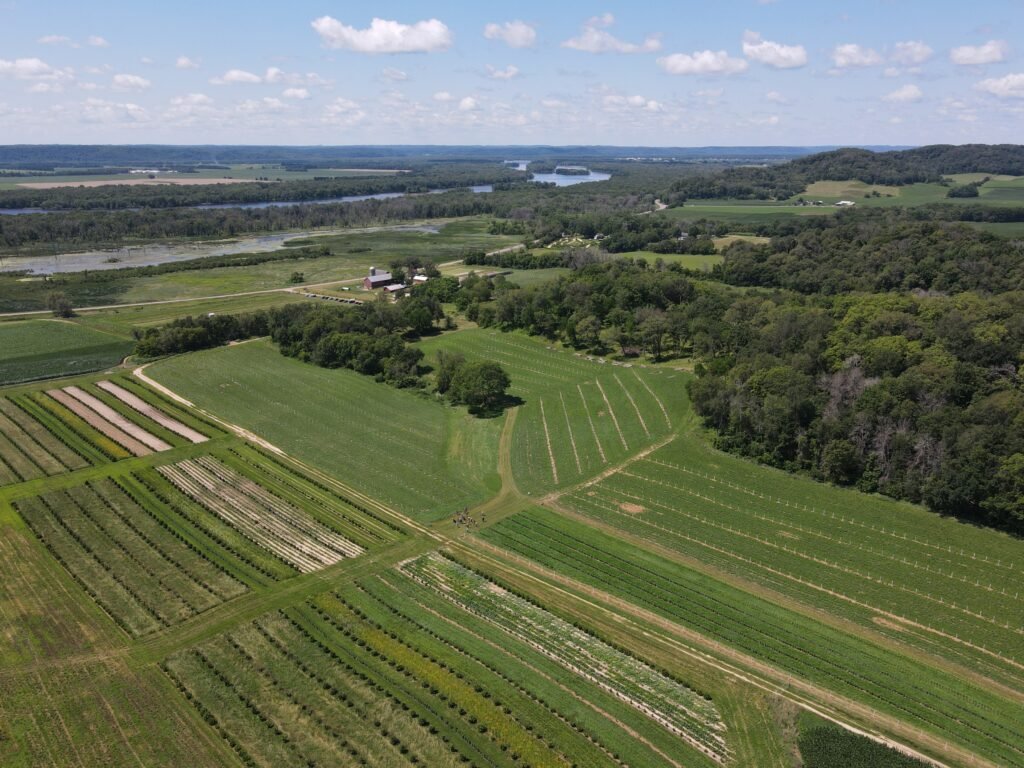
Agroforestry is a land management approach that deliberately combines woody perennial plants, such as trees, shrubs, palms, or bamboo, with crops, livestock, or both on the same piece of land, so that the different components interact with and benefit one another ecologically and economically rather than being grown in complete isolation. According to the United Nations Food and Agriculture Organization, this deliberate integration distinguishes agroforestry from simply having scattered trees on a farm; the trees and the agricultural components are intentionally combined and managed together as a single system.
The three main agroforestry systems
The FAO groups agroforestry into three broad categories based on which components are combined. Agrisilvicultural systems combine trees with crops, including practices such as alley cropping, where crops are grown in the open strips between rows of trees, and homegardens, which mix fruit trees, vegetables, and other useful plants in a dense, multi-layered planting around a dwelling. Silvopastoral systems combine trees with grazing livestock, allowing animals to graze beneath or around trees that can provide shade, fodder, or windbreaks while the land continues to produce timber or other tree products. Agrosilvopastoral systems combine all three elements together, trees, crops, and livestock, as in certain homegarden arrangements that also keep small livestock alongside the planted trees and vegetables.
Why farmers adopt agroforestry
Agroforestry diversifies what a farm produces and, by extension, what income a farmer can earn, since a single plot can yield grain or vegetables in the short term alongside fruit, nuts, timber, or fodder from trees over the medium and long term, spreading risk across multiple products rather than depending entirely on one crop’s success in a given season. This diversification particularly benefits smallholder farmers in lower-income regions, where a poor harvest of the main annual crop can be partly offset by income or food from the tree component of the same land, supporting food security in a way a single-crop field cannot. Trees integrated into a farming system can also provide nitrogen fixation when leguminous species are used, directly enriching the soil the neighboring crops grow in, along with shade that can reduce heat stress on both crops and livestock and windbreaks that protect against soil erosion.
Climate resilience and carbon storage
The FAO highlights agroforestry’s role in increasing farm resilience to climate change, since the tree component typically has deeper root systems than annual crops, helping the system access water during dry spells and hold soil in place during heavy rainfall, reducing the erosion risk a bare or shallow-rooted annual cropland faces under extreme weather. Trees growing within an agroforestry system also store carbon in their trunks, branches, and roots over their lifetime, giving agroforestry a climate mitigation benefit alongside its resilience benefits, one reason agroforestry features prominently in many national and international strategies for making agricultural land use more sustainable without taking land out of production entirely.
A long-standing practice with a newer name
Although the term agroforestry only came into common scientific and policy use in the 1970s, farmers in many parts of the world have combined trees with crops and livestock for centuries without using that label. Traditional homegardens across South and Southeast Asia, shaded coffee and cacao cultivation under a canopy of taller trees in parts of Latin America and Africa, and the use of nitrogen-fixing Faidherbia albida trees scattered through cropland across the Sahel region of Africa, where the species conveniently sheds its leaves during the cropping season rather than during the dry season, are all long-established traditional practices that modern agroforestry research has studied, formalized, and in some cases sought to scale up or adapt to new regions.
Agroforestry and desertification resistance
Agroforestry has become a central tool in efforts to combat land degradation in dry and semi-dry regions, since trees scattered or deliberately rowed through cropland help bind loose topsoil, moderate wind speed at ground level, and maintain some vegetation cover even during the driest stretches of the year, all of which help slow the kind of degradation that can push marginal farmland toward desertification. The Great Green Wall initiative across Africa’s Sahel region, which aims to restore a band of degraded land stretching across the continent, relies heavily on agroforestry techniques, including planting Faidherbia albida and other locally adapted trees among crops and pasture, rather than on tree planting alone in isolated forest blocks, reflecting a broader recognition that integrating trees directly into working farmland can be more durable and more immediately beneficial to local farmers than reforestation efforts that exclude agricultural use entirely.
Limitations and tradeoffs
Agroforestry is not without tradeoffs. Trees can compete with neighboring crops for light, water, and soil nutrients if species and spacing are not chosen carefully, potentially reducing the yield of the primary crop compared with growing it alone in a simple monoculture, and the benefits of tree products such as timber or fruit may take years to materialize, requiring farmers to wait for payoffs that a single annual crop would deliver immediately. Successfully designing an agroforestry system also typically requires more specialized agronomic knowledge than conventional monoculture farming, since matching the right tree species, spacing, and management to a specific crop, climate, and soil type is considerably more complex than planting a single familiar crop across a uniform field.
FAQs
Is agroforestry the same as simply planting trees on farmland? Not quite. Agroforestry specifically means deliberately integrating and managing trees together with crops or livestock as a combined system, rather than simply having trees present somewhere on a farm without any intentional interaction between them and the farmed components.
Does agroforestry reduce crop yields compared with monoculture? It depends on the system and species chosen; trees can compete with crops for light and nutrients if poorly matched, but well-designed agroforestry systems are often intended to produce more total value per unit of land across all their combined outputs, even if the yield of any single crop component is somewhat lower than in a dedicated monoculture.
Key facts
- Three FAO system types: agrisilvicultural, silvopastoral, agrosilvopastoral
- Term came into common use in the 1970s, though the practice is centuries old
- Traditional examples: South/Southeast Asian homegardens, Sahelian Faidherbia albida intercropping
- Diversifies income and increases climate resilience via deeper tree root systems
Related concepts
Quick checkIs agroforestry the same as simply planting trees on farmland?Show answer
No, it specifically means deliberately integrating and managing trees together with crops or livestock as one combined system.
Sources
- FAO. Agroforestry overview. https://www.fao.org/agroforestry/about-agroforestry/overview/en
Editorially reviewed by Specialty Digest Editorial TeamLast reviewed November 1, 2026Researched and drafted with AI assistanceReport an issue